


With a deep understanding of your business alongside clear and honest communication, we help clients face challenges fearlessly.
Learn more about our services and how we help clients.


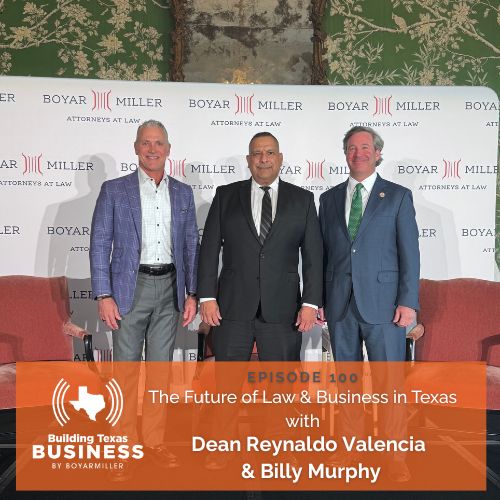
In this special live 100th episode of Building Texas Business, Chris Hanslik talks with Dean Reynaldo Valencia, President and Dean of South Texas College of Law Houston, and William Murphy, CEO of University Lands, about the intersection of law, leadership, and innovation in shaping Texas’ future.
From higher education to resource management, both guests share how Texas institutions are adapting to a rapidly changing world while balancing tradition and transformation. Dean Valencia discusses the law school’s century-long commitment to access and opportunity, its pioneering online programs, and how artificial intelligence is reshaping legal education. Murphy offers a look inside University Lands, where a small team manages 2.1 million acres and billions in annual revenue to fund public universities, while navigating emerging challenges such as renewable energy, AI, and sustainability.
Together, they explore how legal training builds critical thinking and leadership skills that extend far beyond the courtroom, and why innovation, ethics, and stewardship remain central to Texas’ continued growth.
If you’re interested in leadership, education, and the forces shaping the future of business in Texas, this milestone episode offers a thoughtful, forward-looking conversation about progress built on purpose.
Transcripts are generated by machine learning, so typos may be present.
Chris Hanslik: [00:00:00]
Welcome, everybody. I think I know everyone in the room. My name’s Chris Hanslik, and I’m the chairman of BoyarMiller. I just want to welcome you to what we call BTV Live — a live recording of our podcast, Building Texas Business.
Tonight’s a special night because not only do we have special guests, but we’re also celebrating the hundredth episode of our podcast. Never thought we’d make it here, but we did — thanks to our great listeners, our incredible guests, and all the supporters who promote us on social media.
I really want to thank both of you for being here tonight, not just for the recording, but for doing it live in front of an audience. Let’s start by having each of our guests introduce themselves. Dean Valencia, you want to start?
Dean Reynaldo Valencia:
Sure. My name is Ray Valencia, and I’m the incoming president and dean of South Texas College of Law.
William Murphy:
Thanks for having us, Chris. I’m Billy Murphy. I’m a graduate of South Texas College of Law, and I also went to Texas Tech University. I grew up in Houston and now work for University Lands, which is part of the UT System. I manage a great team of roughly 80 people, and we’re in the resource space — primarily oil and gas.
Chris Hanslik: [00:01:00]
Go a little deeper on University Lands so the audience can get an idea of what that organization does.
William Murphy:
Sure. Most people haven’t heard of University Lands — it’s not exactly a household name. It’s a company within the University of Texas System that manages what’s called the Permanent University Fund Lands.
The Permanent University Fund was established in the late 1870s by the Texas Constitution to serve as a funding mechanism for public higher education in the state. It consists of 2.1 million acres in West Texas — both surface and minerals — which is rare because most minerals in Texas have been separated from the land.
We steward these lands like a business within higher education, generating revenue that funds 27 public institutions in the UT and Texas A&M systems — universities, hospitals, and other public-serving institutions. It’s truly one of a kind. There’s nothing quite like it anywhere else, and it’s very Texan — higher education built on West Texas land.
Chris Hanslik:
It really is very Texan — and also, I’d say, one of the state’s best-kept secrets. Dean, on that note, tell us a little more about South Texas College of Law. I know it’s the oldest law school in Houston. What else can you share?
Dean Reynaldo Valencia: [00:03:00]
Just to build on what Billy said, I actually grew up in Lubbock, so I know West Texas well. After law school, I worked at Jones Day, then transitioned to teaching full time at St. Mary’s, where I spent 21 years. We always viewed South Texas as a comparable and competitive school, so I knew a lot about it before coming here.
After two decades at St. Mary’s, I helped start the law school at UNT Dallas, then later served as dean at Capital Law School in Ohio for five years. When the South Texas opportunity came up, it was the perfect time for me and my son to come home to Texas.
What really impressed me when I learned more about the school is its mission of access and opportunity. Back at the turn of the century, many law schools started out of YMCAs, providing working professionals with a chance to study law. South Texas, founded in 1923, shares that legacy — and we recently celebrated our centennial.
That commitment to access is built into our DNA. Today, we have nearly 18,000 alumni — about 8,000 here in Houston — and roughly 1,100 students, which is quite large for a law school. The programs here, especially our advocacy and clinical programs, are incredibly strong and nationally respected.
Chris Hanslik: [00:05:00]
That’s impressive. Another fun fact I love about South Texas — the first class in 1923 had 36 or 37 students, and five of them were women.
Dean Reynaldo Valencia:
That’s right.
Chris Hanslik:
In 1923! Most people wouldn’t guess that. It really shows that inclusivity and opportunity have been part of the school’s identity since day one.
William Murphy:
Absolutely. That authenticity runs deep. South Texas has been walking the walk from the very beginning.
Chris Hanslik:
And you might be wondering, why are we talking about law school and anniversaries tonight? Well, South Texas just celebrated its 100th, and we’re celebrating our 100th podcast episode. It felt like a perfect connection.
Plus, many people don’t realize that a law degree isn’t just for becoming a lawyer. It’s incredible training for business leadership, too. Dean, from your experience, how does a legal education translate into business leadership?
Dean Reynaldo Valencia: [00:06:00]
I still teach — corporations is one of my courses. My background is in corporate restructuring and bankruptcy, but when I started teaching at St. Mary’s, I took on business associations as well.
Many students come in wanting to litigate, but I tell them — even if you never become a corporate lawyer, understanding how businesses are structured is essential. It helps you understand how to resolve disputes and where the real decision-making power lies.
I often say: take ten lawyers and ask if they’re doing what they thought they’d do — eight will say no. Then ask if they enjoy what they do — eight will say yes. So, keep your mind open. You never know where your law degree will take you.
For me, I never had the fire to be in a courtroom. I’ve always preferred the transactional side of law — helping businesses build, grow, and solve problems creatively.
Chris Hanslik:
That makes sense.
Dean Reynaldo Valencia: [00:08:00]
The last time I went to court was for my housekeeper in Dallas. Her husband had been diagnosed with cancer, and I helped them prepare a will. Sadly, he didn’t survive surgery, and I had to probate the will. That was my last courtroom experience — and I decided if I never went inside a courtroom again, I’d be perfectly happy.
That experience reaffirmed that I’m wired for the transactional world.
Chris Hanslik:
Billy, you started your career in private practice, then transitioned into business leadership. How did your legal education shape that path?
William Murphy: [00:09:00]
I get that question a lot, especially from students who think switching from law to business is a big leap. For me, it wasn’t — it was always the plan.
Growing up in Houston in the 1980s, the lawyers were the ones who seemed to have stability while oil and real estate were crashing. So as a teenager, I decided law school was the path. I didn’t have any lawyers in my family, but I saw it as a way to open doors.
I loved my time at South Texas. It’s an incredible advocacy school — it pushes you to present, to be critiqued, and to get comfortable being uncomfortable. That builds confidence. I also held leadership roles, like on the law review, which helped me develop as a leader.
But I always wanted to end up in business. The opportunity that changed everything came five or six years after law school, when I joined King Ranch — one of the most historic companies in Texas.
William Murphy: [00:10:00]
At King Ranch, the first thing they told me was, “We want you in a business role.” But what surprised me was how much my law degree opened doors. It gave me instant credibility and allowed me to navigate different parts of the company — from operations to governance to contracts.
Even though I wasn’t practicing as a lawyer, that training gave me an analytical edge and a confidence that translated well into leadership. At one point, I was the only person in the company with a law degree. That perspective helped me see problems differently and contribute at a higher level, even outside the legal department.
Chris Hanslik:
Two of the things you both mentioned really stand out — critical thinking and advocacy. I’ve always believed a law degree sharpens your ability to think critically and quickly.
Whether you’re in business or any other field, you have to think on your feet. Advocacy work trains you to process information, form a position, and communicate clearly — and that skill translates into every part of life.
Even parenting, right? Your kids throw you a curveball, and you have to think on your feet.
William Murphy:
That’s usually around 12:05 when they come in late — that’s when those cross-examination skills come in handy.
Chris Hanslik:
Exactly! Dean, your title is both President and Dean, which means you’re running a business as much as an academic institution. How has your legal background shaped your leadership style?
Dean Reynaldo Valencia: [00:13:00]
When I left my previous institution in Ohio, the team hosted a farewell event and described one of my strengths as “cutting to the chase.” I hadn’t thought of that as a skill, but it made sense — that’s what legal training does.
In administration, there’s always noise — competing priorities, personality dynamics, and logistical hurdles. Law school taught me to separate the noise from the real issue.
South Texas is unique because we’re one of only about 15 standalone law schools in the country — not part of a larger university system. That means we don’t have a financial safety net. Our board and I are fully responsible for everything — from budget to personnel to accreditation.
We have an annual operating budget of about $50 million, 1,100 students, 51 faculty members, around 135 full-time staff, and 75 adjunct professors. Plus, nearly 18,000 alumni. That’s a lot of responsibility, but my background prepared me for it.
Before becoming a dean, I spent 12 years in administrative roles handling budgets, accreditation, HR, and operations. That experience sharpened my ability to lead with both structure and empathy.
Chris Hanslik: [00:15:00]
I always tell people — leadership is about building a team around you. You can’t do it alone.
Billy, your organization has a lot of history and tradition. How do you honor that legacy while also pushing innovation forward?
William Murphy:
That’s a great question. It’s a constant balance between respecting the past and preparing for the future.
At University Lands, I talk a lot about creativity and curiosity — they’re essential to innovation. Our work is rooted in land management and natural resources, but we can’t rely solely on what’s worked before.
For example, 25 years ago, the UT System thought oil and gas were in decline. They focused on managing the money already generated, assuming the land’s value had peaked. But then horizontal drilling and technological innovation completely changed the game.
That revitalization brought enormous opportunity — not just for us, but for Texas as a whole. It’s a powerful reminder that innovation often starts with asking new questions about old assets.
Chris Hanslik: [00:17:00]
That’s fascinating.
William Murphy:
Exactly. The land itself hasn’t changed, but how we use and manage it constantly evolves. Today, we’re dealing with inbounds every day — people calling about AI data centers, renewable energy projects, and emerging technologies.
Our challenge is to stay ahead of that knowledge curve. We have to understand these industries as well as the people coming to us with proposals. Every decision we make can have a 10-, 20-, or even 50-year impact.
That’s where a law degree really helps — being able to analyze complexity, weigh risks, and think long-term.
Chris Hanslik:
Dean, innovation’s also a huge theme in education right now. How is South Texas College of Law staying ahead of those changes, especially with technology?
Dean Reynaldo Valencia: [00:19:00]
That’s one of my favorite topics. I think our challenge — and opportunity — is to honor tradition while embracing the future.
For example, during my investiture ceremony, the school traditionally uses a bagpiper for the procession. I wanted to honor that, but also reflect my heritage. So, after the bagpiper led the way, a Mariachi band followed. It was a beautiful blend of history and progress — and a reminder that innovation doesn’t mean erasing tradition.
In terms of academics, the biggest transformation is AI. We need to integrate it responsibly into our curriculum — teaching students not only how to use it, but how to use it ethically.
Dean Reynaldo Valencia: [00:20:00]
We’re looking at ways to bring AI into legal education thoughtfully. I believe one of the most important positions we’ll create soon is an AI director — someone who can help integrate AI into our curriculum, our faculty research, and even our classroom teaching.
We need to train our students to use AI effectively and ethically — to harness its power without falling into the mistakes we’ve already seen lawyers make. There have been cases of attorneys being sanctioned for submitting filings that included AI-generated, fictitious case citations. Our goal is to make sure our students understand the tool, not fear it.
For context, most law schools when you attended probably had large law libraries. Now, much of that material is online. Many students don’t even buy physical books — they use digital copies. On top of that, the bar exam itself is changing. It’s shifting from broad memorization to deeper, practical problem-solving — more like real legal work.
Chris Hanslik:
That’s a huge shift.
Dean Reynaldo Valencia:
It really is. And then, there’s technology in actual practice. Our Dean of Clinical Education recently told me that most family court hearings in Harris County are now held on Zoom. That changes everything — from courtroom presence to preparation to advocacy.
We have to train students to handle that. So, whether it’s AI or online proceedings, we’re rethinking how to prepare students for a legal world that looks very different from what many of us knew.
Chris Hanslik: [00:22:00]
That’s such an important point. If students are paying for this education, they deserve to be prepared for the real world.
Dean Reynaldo Valencia:
Exactly. I take that responsibility seriously. Law school is a significant investment, especially for students taking on loans. If we’re not doing everything we can to equip them with real-world skills and modern tools, then we’re failing them.
Our board is very aligned on this. They’ve asked us to develop a new strategic plan — a five-year roadmap that includes integrating technology, improving student support, and expanding opportunities.
William Murphy:
If I can add to that — Chris, you and I were talking about AI before the show. I really think this moment in time is similar to when the calculator or the internet first entered the classroom. It’s transformative.
We see it in our business already. AI is starting to influence how companies analyze data, make investment decisions, and optimize resources. And that’s just scratching the surface.
If you’re leading an organization right now and not thinking about AI, you’re behind. It’s that simple.
Chris Hanslik: [00:23:00]
That’s exactly right.
William Murphy:
Right now, most people use AI for simple tasks — writing an email or doing quick research. But we’re on the edge of something much bigger. The students Dean’s training today will be entering a world where AI will fundamentally change how every industry operates.
That’s why I actually think the educators who are saying “no AI in my classroom” are missing the point. You can’t ban the future. You have to teach responsible use — how to get the most out of it, how to question it, how to fact-check it.
If you teach people to fear technology, they’ll fall behind.
Chris Hanslik:
Well said.
William Murphy:
At its simplest, AI is a tool that can process and analyze vast amounts of information faster than any human. But you have to ask it the right questions. It’s all about prompts — knowing how to guide the tool to get the right results.
And you also can’t blindly trust it. AI is fast and confident, but not always accurate.
Chris Hanslik:
Exactly. That’s where the human element matters most.
William Murphy: [00:25:00]
Absolutely. Students need to learn that they can’t take what AI says at face value. We’ve already seen high-profile examples of legal filings citing non-existent cases. That’s not the AI’s fault — that’s user error.
It reminds me of when technology first entered law firms. I joined Jones Day’s Dallas office in 1990, and that was the first year associates had desktop computers. Before that, everything went through dictation and word processing centers. That was a massive shift.
AI is the same — only faster and more profound.
In the business world, we’re already seeing similar transitions. Look at OpenAI hiring a hundred investment bankers to automate financial modeling and due diligence. The legal industry is right behind that curve.
Teaching students — and professionals — to use AI wisely will determine who thrives and who gets left behind.
Chris Hanslik: [00:26:00]
That’s such a good point. And for law students especially, this evolution means the “first-year document review” roles might not look the same anymore. But that doesn’t mean opportunities are disappearing — they’re shifting.
William Murphy:
Exactly. Those entry-level tasks might be handled by AI, but there will still be a need for smart, strategic thinkers to interpret results, make decisions, and ensure ethical standards. The key is adaptability.
Dean Reynaldo Valencia:
That’s especially true for our graduates. Many of them go straight into solo or small firm practice. Those environments don’t have the same safety net as large firms. They have to be resourceful and self-sufficient from day one.
So we emphasize mentorship, support, and practice readiness. AI, used correctly, can actually empower solo practitioners — helping them manage research, drafting, and client service more efficiently.
Chris Hanslik:
That’s fascinating.
Dean Reynaldo Valencia: [00:28:00]
I remember when students first started practicing with laptops and cell phones. Suddenly, their law firm was their bedroom — literally. They’d live with their parents after law school, meet clients at coffee shops, and run their practice from a laptop. That’s the modern version of access and opportunity.
AI will be the next evolution of that — lowering barriers, increasing efficiency, and helping students succeed in new ways.
Chris Hanslik:
Speaking of access, South Texas recently launched an online program. That feels like a natural extension of your mission. How has that impacted the school so far?
Dean Reynaldo Valencia: [00:29:00]
It’s been transformative. When I was at my previous school during COVID, we all had to pivot to online teaching. Some of our professors were in their 70s and 80s — it was a challenge, but they adapted.
We learned that online legal education can work if done right. Around the same time, St. Mary’s received approval from the American Bar Association to offer a fully online JD program — the first in the country. That opened the door for others.
We launched our online program a couple of years ago, and the demand has been incredible. It allows students who can’t commute to still pursue their legal education — whether they’re in Houston or across the country.
What’s interesting is that about 75% of our online students actually live within 50 miles of campus. They just can’t make it downtown regularly due to work or family commitments. So this model truly expands access in a modern way.
Dean Reynaldo Valencia: [00:30:00]
Our online program follows best practices that have evolved since the early days of virtual teaching. It’s not just turning on Zoom and lecturing. We combine asynchronous learning — recorded lectures, assignments, and discussions — with synchronous sessions where students and professors meet live.
We also require short residency periods, where students come to Houston for in-person learning. It creates community and gives them that real-world connection to faculty and peers.
Our early data shows strong engagement and academic success. We haven’t had a cohort graduate and sit for the bar yet, but the indicators are very positive. I believe online legal education, done right, opens doors for students who otherwise wouldn’t have the opportunity.
Chris Hanslik:
That’s incredible.
Dean Reynaldo Valencia:
Exactly — it aligns perfectly with our mission of access and opportunity. Law should be for those who want to pursue it, not just those who can rearrange their lives to attend classes in person.
Chris Hanslik: [00:32:00]
Billy, bringing it back to you — when you think about the mission and goals of University Lands, what does success look like from your perspective?
William Murphy:
That’s a great question. Our organization has a very clear mission: generate revenue, protect the land, and do it all in a sustainable and responsible way.
We’re managing a massive asset — 2.1 million acres that support higher education across Texas. Our success isn’t just financial; it’s about making smart, forward-thinking decisions that will stand the test of time.
Sometimes those priorities align perfectly — sustainability, revenue, and stewardship all working together. Other times, they compete. You might have a project that’s highly profitable but environmentally questionable. That’s where we have to balance our values and our vision.
I tell my team that success isn’t just what happens today; it’s what people say about our decisions 50 years from now.
Chris Hanslik: [00:34:00]
That’s a powerful way to look at it.
William Murphy:
I learned that perspective at King Ranch. That’s a family enterprise that’s lasted eight generations. They’ve seen what happens when you neglect the land — and when you take care of it. You have to reinvest in the land if you expect it to keep producing.
We operate the same way. Sometimes that means spending money without an immediate return because it’s the right thing for long-term health — environmentally, financially, and ethically.
At University Lands, we generate nearly $2 billion a year, managed by fewer than a hundred people. That’s an incredible responsibility. We’ll know we’ve succeeded when future generations look back and say, “They made the right calls.”
Chris Hanslik:
Dean, that’s a great segue. As you think about your leadership at South Texas, what does success look like for you personally?
Dean Reynaldo Valencia: [00:35:00]
For me, success is rooted in where I came from. I grew up in a migrant farmworker family. My dad had a third-grade education, my mom went to sixth grade, and I have 87 first cousins. Education completely changed my life, and that’s what drives me — giving others the same chance.
In 1999, I was selected as a White House Fellow — a leadership program that places professionals in government roles to learn and serve. I worked in the West Wing under Maria Echaveste, who was the highest-ranking Latina in the Clinton administration.
That experience was life-changing. Every day I walked into the White House, I reminded myself how rare that opportunity was. I told myself, “This won’t last forever — make it count.”
It deepened my belief that education is transformative. My job now is to pay that forward — to help students who might come from backgrounds like mine reach their full potential.
Dean Reynaldo Valencia: [00:37:00]
At my investiture, I chose the quote, “The moral arc of the universe is long, but it bends toward justice.” Our role as educators is to keep bending that arc — to produce lawyers and leaders who pursue justice in all its forms.
And I mean that broadly — not politically. I want my students to go out into the world as ethical, competent professionals, whether they become prosecutors, defense attorneys, business leaders, or public servants.
If our graduates leave South Texas ready to serve with integrity, then I’ve done my job.
Chris Hanslik:
That’s beautifully said.
Before we wrap up, I have two final questions — both quick ones. You’re both busy people, so let’s start here: What do you each do to rest and recharge?
Dean Reynaldo Valencia: [00:39:00]
Honestly? I unwind by watching TV and following politics — I’m a political junkie. But more meaningfully, I spend time with my sons. I’m a single dad with three boys — 21, 20, and 16 — and being with them keeps me grounded.
I also go to the gym when I can. That’s my space to clear my head.
William Murphy:
For me, it’s family time. I love taking walks with my wife, watching my kids play sports, and having dinner together. That’s how I recharge.
And I’ll admit — I find driving relaxing. I know that sounds strange, but long drives, especially outside the city, are peaceful for me. I listen to audiobooks, podcasts, or just enjoy the quiet.
And I’m an avid quail hunter. Being outdoors, watching the dogs work, seeing the land — that’s my happy place.
Chris Hanslik: [00:40:00]
That sounds amazing. Alright, last question — and it’s an important one: Tex-Mex or barbecue?
William Murphy:
That’s easy — Mexican food, all day long.
Chris Hanslik:
Dean, I’m guessing I know your answer.
Dean Reynaldo Valencia:
You do. Tex-Mex, no contest.
Chris Hanslik:
That’s what I thought. And when you’re back in Houston, where’s your go-to spot?
William Murphy:
Molinas.
Chris Hanslik:
Mine too — or Pico’s for margaritas.
Dean Reynaldo Valencia:
I’ll have to join you both sometime.
Chris Hanslik:
Deal. Thank you both for being here tonight — for your time, your insight, and for sharing your stories. It’s been a fantastic conversation, and a perfect way to celebrate our hundredth episode.
With a deep understanding of your business alongside clear and honest communication, we help clients face challenges fearlessly.
Learn more about our services and how we help clients.