


With a deep understanding of your business alongside clear and honest communication, we help clients face challenges fearlessly.
Learn more about our services and how we help clients.



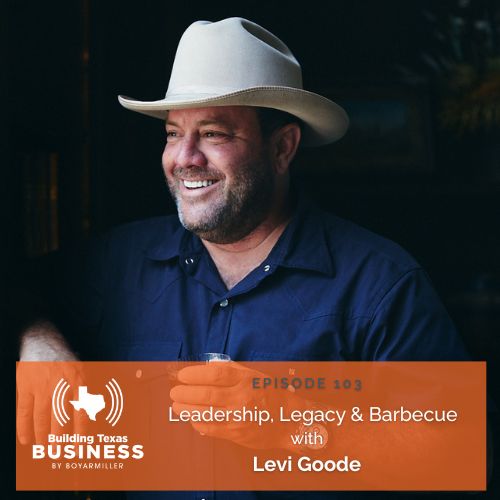
In this episode of Building Texas Business, Chris Hanslik sits down with Levi Goode, president of Goode Company, to talk about leadership, legacy, and building a business rooted in Texas culture.
A fifth-generation Texan and three-time James Beard Award nominee, Levi grew up in the family business founded by his father, Jim Goode. From washing dishes as a kid to leading one of Houston’s most iconic hospitality groups, Levi shares what it means to carry forward a legacy while continuing to evolve.
The conversation explores the realities of running a family business, earning trust as a leader, and preserving culture as a company grows. Levi reflects on the role Texas traditions play in Goode Company’s identity, from backyard barbecue and barbecue cook-offs to Houston Rodeo season, community gatherings, and the cookout culture that brings people together year after year.
Chris and Levi also discuss leadership development, team culture, and the responsibility that comes with stewarding a brand that has been part of Houston’s food scene and rodeo tradition for decades. This episode offers thoughtful insight into entrepreneurship, hospitality, and what it takes to build a business that lasts in Texas.
Transcripts are generated by machine learning, so typos may be present.
Chris Hanslik: Levi, welcome to Building Texas Business. I can’t think of a better guest for a podcast called Building Texas Business than you and what you’re doing with Goode Company and all the concepts you have.
Levi Goode: Thanks for having me, Chris. I know we’ve been trying to get on the schedule for quite a long time. So glad to be here today.
Chris Hanslik: Yeah, I’m glad it worked out. Let’s just start. You always think you’re familiar with what someone does, but it’s better to hear it from them. So just tell us a little bit about what your company does, what you’re known for. I know you’ve been growing and expanding, and just give us a little overview of that.
Levi Goode: Sure. This is our 49th year in business. My mother and father started our Goode Company Barbecue Restaurant back in 1977. So we’ve got a big 50-year milestone coming up on us here. That’ll be exciting to celebrate. Yeah, going into next year. So excited about that. It’s a family business. My father was a commercial graphic designer prior to jumping into the restaurant business, and he was wanting to get out of being in the commercial arts business. He was known as a guy that’d get a job at 5:00 PM, work all night, and turn it around by 9:00 AM the next day. Primarily his customers were ad agencies back in the seventies, and they’d always beat him up on the price after he did the work. So he just got tired of the grind and wanted to pursue something he was passionate about. So he kind of looked towards his hobbies. One was backyard barbecuing, and the other one was bay saltwater fishing. So he was either going to open a bait camp or a barbecue restaurant.
Chris Hanslik: I think he made the right call.
Levi Goode: Yeah, thankfully enough he opened a barbecue spot. Our location there on Kirby was a barbecue restaurant prior to us getting into it, and it was right around the corner from his studio. So, long story short, it was an all-hands-in kind of family affair. I was very young at the time, and I have an older sister that was also along for the ride. It was our afterschool playground, and my parents wore many hats kind of getting that going and off the ground. So I grew up in the business, doing just about everything from top to bottom. I used to wash dishes on the top of a milk crate, because I wasn’t tall enough to reach over the triple sink. I just grew up in it, strongly on the operational side. Then with school, went to Texas A&M and then went to chef school thereafter. I worked in leadership in our business for quite some time and took over about 20 years ago as president. I feel like it’s just such a strong, not only commitment, but an obligation for everybody that has had a hand in the last 49 years. That’s our team members at Goode Company that were here before us and the ones that remain and will be forthcoming as we continue to grow and jump into the next decade. And also the community has been so strong over the years and super supportive. So it’s really good to kind of have a place in the community where people go for different things. They go there just on a weekly basis because it’s comfort food to them, but they also celebrate milestones, whether it’s a mourning loss of a loved one or first love or whatever it may be. We really enjoy that we are a gathering spot and able to be a facilitator of human connection on that front.
Chris Hanslik: I love that. What’s unique in my view is that when you know Goode Company and what your dad started, what you’re carrying on is clearly in the Mount Rushmore of restaurants, like royalty, if you will, in Houston, because you all have been around forever. You’re known for good quality, good meeting space. People have grown up, right? You grew up in it, and you have friends that grew up, and that’s childhood memories, and they carry them on. I don’t know if there’s a better tribute probably to your dad and that legacy. Talk a little bit about that transition of you taking over. I never really met your dad, but I’ve got to believe he was a powerful figure and probably commanded a room. How did you all work and navigate that? Because there are other family businesses and people trying to navigate that. Some do it better than others, and it looks like you all did it pretty well.
Levi Goode: Yeah. Family business is a dynamic thing, right? And it’s one of those things that’s hard to do a master plan for, at least it was for us at the time. Different emerging skill sets, whether it’s through hard knocks education or book education from going to school. But really there’s no substitute for experience. Working with him, he was a larger-than-life figure. I’d like to consider him a legend in the Houston community. He was known as a man that was very generous, had a heavy heart, and also just took care of people, whether it’s people that helped us build this business and work with us, or just helping the community. Even to this day, a week doesn’t go by where somebody doesn’t tell me a story about my dad. Entering the business as a young adult, those were big shoes to fill. Fortunately, I had a chance to work quite a few years with him at the time. He always gravitated to the creative side, and he focused that energy on creating recipes. He was a self-taught chef. So a lot of our recipes in our restaurants were developed by him and still hold true to this day. He taught me the way he did things. He was a non-conformist, which would be probably a good way to define him. He was a free thinker. He liked to blaze his own trail. He had an interesting way of problem solving and really evaluating challenges and issues and leveraging up his creative skillset to be able to create solutions for those challenges, which are inevitable and ongoing.
Chris Hanslik: Come on every day.
Levi Goode: That’s right. I feel fortunate that you get to stand on the shoulders of those before us and really be the steward of the brand and the cultural champion to ensure that our vision is aligned and moving forward in a positive yet enduring direction.
Chris Hanslik: I would bet it was important for you—you talked about doing dishes and those things when you were little—but when you were coming in as a young adult, gone away to college, culinary school, whatever, that everyone saw you willing to roll up your sleeves and do the dirty work, not just come in as the son of the founder and the owner and just step right into acting like the boss, right? And earn that respect. Any stories you can tell about that or experiences that you could share how that really maybe helped you be part of the culture and maybe then become the champion moving forward?
Levi Goode: Sure. My father was not easy on a son from that, from the work ethic standpoint. He was a man who went to the Navy, fought in the Vietnam War. He wanted to make sure that I understood and ran me through the wringer as far as building work ethic and really kind of developing just basic ways to approach dealing with people, running a business. Our most important asset of all, everything by far, is our team, our teams, our people. And if you don’t have the respect of them, it’s hard to be a leader. That’s first and foremost. You have to have that as a prerequisite, and that’s you’ve got to earn their trust. And you’ve got to be able to understand—you want to make sure nobody’s bullshitting you; you’ve got to know how to do it yourself, right? And be able to hold that standard. Fortunately, I was able to get into the business at a young age and evolve that leadership over time.
Chris Hanslik: So you took over, and going off memory, there was a barbecue, there was seafood, taqueria. I guess Armadillo Palace maybe was part of that. But you’ve really expanded since then. As you look to take on new concepts, it’s almost like starting a new business. Let’s talk a little bit, because there are entrepreneurs out there thinking about starting a business. What are some of the things that you do to evaluate the risk versus reward of, “Okay, it’s time for that,” or what are some of the growing pains you’ve seen in starting some of those new concepts and what have you learned from that?
Levi Goode: Yeah. For better or for worse, I like to try to keep a balance of doing the same thing when we look at concepts versus starting with a blank canvas and doing something new. Whether I inherited it or not, I’ve always had a strong sense and desire to be creative and to create new things. I’m just industrious in that way. And probably to the dismay of my teams, like, “Levi, can we just do the same thing a couple times before we go jump off into something new, or even a new category like we did with Credence?” But it’s one of those things that I really enjoy is the journey and really pushing our competency. Let’s see how far we can go. And just enjoy the ride along the way, and we’re going to learn new things about it as well. And some of those learnings can be painful from time to time. But I also think it really allows us to individually and collectively just stretch a little bit, stretch our capabilities, and build confidence and rapport amongst our teams. And at the end of the day, you don’t really know. We do things we like, and we’re looking for good projects that we want to get involved in. And we want to move at the pace of our talent and what we’re feeling like we’re capable of achieving. We definitely have some scale in mind as we go, but only at the speed that we feel like we can do that in the proper way and still preserve our reputation and our brand that’s been built over many decades.
Chris Hanslik: It sounds like part of that culture you’ve built is a culture of maybe taking some risk, being creative, trying new things. Change is good if it’s done right. I think to your point, if you can instill that in your people where you encourage them to take a chance and there’s going to be no retribution, right? We’re going to learn and adapt and adjust along the way. No one’s got a crystal ball. But if you want to grow, then you’ve got to be willing to take some chances.
Levi Goode: A hundred percent. And we’ve got a saying in our brand values that one of the sub-points is “evolve or die.” So we’re fortunate and blessed to be in business as long as we have. We’re in neighborhoods where we’ve seen entire neighborhoods turn over and we’re still there. What’s that current and evolving emerging demand, and how do we cater to that while not losing our soul in the meantime?
Chris Hanslik: When I think about evolve, one of the things that comes to mind is innovation. What are some of the things you think you’ve done within your concepts to implement some innovative things to continue to evolve?
Levi Goode: Yeah, when we first opened, and really in the early years, it was all about the food, which is obviously an important part of the three-legged stool we like to call it. Houston has some of the most discerning consumers out there, and there’s a lot of competition, more so now than I’ve ever seen it. And we’ve been in some interesting environments, in particular in the last five years, during the pandemic. But our evolution, we’re focused on equally on hospitality, food, and just the environments for which we can create, bring people together, and facilitate that human connection. That’s where our focus is, and that’s really what everything’s in support of—those three pillars that we like to wrap around the experience and be relevant and continue to put our best foot forward as a Houston restaurant group.
Chris Hanslik: So you mentioned earlier, and I believe to be true, your biggest asset is your team, your people. So what are some of the things that you do through the vetting interview process, if you will, to try to make sure, because it’s not perfect, that you are making the right decisions about someone that’s going to be joining the team?
Levi Goode: Sure. We get lots of resumes, and particularly as we’ve been on a bit of a growth spurt for ourselves, we’re getting a lot of attention. And we’ve been named “Best Places to Work,” not only at a local level with the Chronicle but also USA Today since 2017. So that’s all helpful with recruitment. But when it comes down to interviewing, we’re looking probably more so at culture than anything. Do they align with our culture, with our brand values? We’ve had people that, their resume jumps off the page, like, “This person’s got all the technical skill sets that you would need to be successful in this particular role.” But they don’t have that cultural piece that aligns, and that ends up being a recipe for disaster in my opinion. When I interview, depending on what role it is, we, “fire slow and fire fast” is our mantra.
Chris Hanslik: It’s a well-known saying, and it is true, especially the back end of that one.
Levi Goode: That’s right. Nothing can erode culture faster if you don’t fire fast on a cultural misfit. Yeah, that’s right. And so that’s what I look for when I’m interviewing. We all have our different roles on our executive team as we go about the interview process. We’re all aligned on really looking for those cultural similarities and whether we think this person would align with what we’ve got going on.
Chris Hanslik: As you grow, one of the challenges that companies face, and leaders, especially our leadership teams, is fostering and nurturing that culture because the smaller you are, the easier it is. The bigger you get, the more challenging it is. Anything that you’re doing within the company and with your leadership team to help foster and nurture the culture all the way down into the organization?
Levi Goode: Yeah, we’ve doubled down on focusing on our culture, especially as we’ve grown. We’ve added a lot more folks to our teams over the last few years. We live and die by culture. We always look for opportunities to keep that on the forefront of everybody’s minds, starting with the hiring and recruitment process for any position in our organization. Just as an example, during the pandemic, during COVID, we went from 10 restaurants down to four, doing takeout only. We were on a hamster wheel leading into that. And then it’s like you could hear the crickets; everything just, the world slowed down and stopped.
Chris Hanslik: A lot of people in your industry didn’t survive that, right?
Levi Goode: Yeah, and the demands changed so much. People had lots of different factors on why they needed this or that. We pivoted on a few different things and created a couple new businesses during COVID to better support the communities. But more importantly, just really had a chance to stop, jump off the merry-go-round a little bit, look at different aspects of our business, different departments, what the value proposition was for those departments prior to COVID. Liking it to being on the Gulf Coast: a hurricane comes through and knocks your house down, and now you’ve got a slab. Would you build it the same way? And the answer for me was no. And I went to work on that and really started looking at some of our cost centers from a back office standpoint and where I might be able to kind of create more value out of those areas. So, for example, we had an HR department that I created a people and culture department that really focused not only just on the transactional aspects of HR, but also focused on being cultural champions, and that’s part of your job. How do we figure out how to instill that and really kind of make that better as we go and more apparent? We started talking about employee life cycle and career pathing people and being able to assess them quickly if they’re looking to move up, maybe where their voids are in that skill set, and how can we help get them where they want to be if they’re qualified in their career. We’re going to try to figure out how we can help them do that.
Chris Hanslik: That’s great. So sounds like a real focus on investment in the team from a training opportunity standpoint.
Levi Goode: Yeah. We didn’t have a training department prior to COVID. I brought on a training director during COVID, and now we have a team of five. I mean, you can train on anything, and it was just in our blind spot. You throw somebody in a restaurant, give them to the manager on duty and let them teach them. Often times it’s a game of telephone, and sometimes the message that was sent was not the message you wanted to send or the way it was received. There was a lot of holes in it. So really to standardize that, we needed it to be more organized in a way that would allow us to scale in the right way and protect our brand as we go.
Chris Hanslik: One of the things you’re definitely known for is preserving Texas history, Texas heritage in all your concepts, which I found really cool. Taking that to another level, what are some of the advantages you find of being a Texas-based, primarily Houston-based, business as far as, whether that’s just general hospitable environment to government, et cetera. Anything that you’ve found to really play to your advantage?
Levi Goode: Sure. I can’t say enough great things about Houston. The community in Houston is a community that is open for people that want to work hard and are authentic about what they do and have some humility and compassion. Opportunity is endless in Houston, in my opinion. Overall, Texas is a pro-business state, which makes it an easier environment. There’s enough headwinds in just operating a business anywhere, right? With compliance and all sorts of things to keep up with. I like that Texas is pro-business, and it’s easier—it’s never easy, but it’s an easier environment. I’ve got friends all over the country that are in the restaurant business that I visit with on a fairly regular basis, and it’s not the same. They’ve got a whole set of challenges that we’re not faced with here in Texas. And then we’re in an environment that we’re getting a lot of out-of-state traffic moving here, primarily from the West Coast and from the Northeast.
Chris Hanslik: And we see a lot of it. I had a call yesterday, and companies are moving out of that state on the far West Coast. We’ve done a ton of conversions, and those kind of any and all industries—companies moving out of California, coming to Texas.
Levi Goode: I mean, I can’t even imagine operating in California, from what I understand and read. With that in mind, and just knowing all the influx of people we have coming in, I wanted to create a new brand, which is called Levi Goode Brand Holdings. That’s where Credence lives. And then I’ve got an ice house in the Pearl District in San Antonio called Otto’s Ice House. And then it’s also a Texas lifestyle company. I just launched a shop online a couple weeks ago. It allows me to tell my story of Texas, and hopefully it lands well with people, both lifelong Texans and the ones that just got here as quick as they could.
Chris Hanslik: Yeah. So that, I’m going to follow up on that branch out to the Levi Goode Brands. Because there’s got to be some challenges. So you have a brick-and-mortar, your bread and butter, brick-and-mortar restaurants. But through Goode Company, you’re well known for online as well, and the famous pecan pie in the wooden box that we’re all lucky enough to get around the holiday time around here. Talk a little bit about the challenges of managing that online retail side versus the customer-facing brick-and-mortar business, because those have to be very different in how you go about managing those.
Levi Goode: No, absolutely. Two different worlds. Our pecan pie business really started out the back of our Kirby barbecue location. After one of the oil busts in the early eighties, people got displaced and moved elsewhere to find opportunities and would write my dad letters, “Hey, can you send me one of those pies?” And so that’s really kind of how that business was born. Out of the back of our barbecue place on Kirby—I guess we’re in our fifth location now—we do everything. We bake all our pies, package them up, ship them. We have a fulfillment center, and it’s all under one roof. And we do that out of Houston. And that business, I would say the biggest challenge, is so damn seasonal. We do about 85% of our business in 45 days, really between Halloween and Christmas.
Chris Hanslik: Must be a lot of ovens.
Levi Goode: Lots of ovens. It’s a big, it’s pushing a golf ball through a garden hose. That seasonality has its own unique challenges.
Chris Hanslik: From staffing to supply and the whole—
Levi Goode: The whole, yeah, all the above. We’re not mad at it, but it’s definitely something that is a challenge.
Chris Hanslik: When it’s coming, you can plan.
Levi Goode: No, we can plan on it. We’ve got a few months every year to think through that. As far as restaurants are concerned, it’s a personal thing. We’re in an environment that has a lot of, people don’t want to spend their money in the wrong way. They don’t want to be disappointed. Expectations are high. We want to be in a position and a place that we’re able to deliver at least on expectations with the aspiration to exceed expectations on every interaction we have. That’s easier said than done.
Chris Hanslik: Sure. I’ll tell you, man, as a self-prescribed foodie, you’ve got to have good food. But if you don’t have good service, they’re not going to come back. Those two better be very strong if you’re going to be a restaurant and survive, at least in Houston. You’re right, Houstonians have a lot of options for barbecue and everything you’re doing. You’ve got a lot of competitors, right? That’s right. And it’s big enough here, I think, and diverse enough that you can all be successful.
Levi Goode: I agree. Houston’s a dining-out town, which we love. And another thing is we were in business long before the internet came out, but everybody’s got one of these, right? These iPhones, and everybody is a critic, so you better be on your game. You’re always on stage.
Chris Hanslik: Let’s talk about leadership. How would you describe your leadership style?
Levi Goode: Yeah, I lead by example. I lead with an open mind. I like to hear what other people think. I like to develop leaders. It was a tougher transition for me because in our business you wear many hats, and you grow up knowing a little bit about everything. And you’re good enough at it. But I think the real catalyst for me as a leader was getting the right people in the right seats and bringing in the subject matter experts where we needed it, allowing our business to get a little bit more vertical in just our organizational chart and putting people in charge of specific areas that they can own rather than me running around where everybody feels like they’ve got to come to me for decisions and answers. Which is, it’s a bittersweet thing, because we all read the books and know that’s the right thing to do. But it can be difficult, especially as a younger leader, to let somebody else grab the steering wheel and drive. I would say really going from being a hands-on in-the-business doer to being a more architect of vision and clarity and strategy of where we’re heading next is where I really enjoy being. But yeah, it’s not easy to make that transition. Let somebody else drive.
Chris Hanslik: Yeah. Levi, I think you hit it on the head. You perfectly described the journey that a successful leader has if they really want that company to grow and scale to its fullest potential. The entrepreneur, the founder, or whatever leader that is wearing all the hats, if they can’t let go of that, they’re going to be the biggest impediment to the full potential of the organization. It’s easier said than done, and it takes a little bit of humility to let others run with it. But I think clearly you’re figuring it out. For those that are listening, that’s the key to being able to grow and scale and really give that opportunity to the whole organization to thrive.
Levi Goode: Yeah, I think it absolutely attracts better talent because they get a chance to show what they can do. It allows me the space to focus on things that I feel like that I bring unique. What’s my unique value proposition that I can contribute to what we’re doing, and what am I doing right now that somebody else might love doing? Really figuring that out and being able to focus on where I can bring the most value in contribution to our business.
Chris Hanslik: The question I always like to ask people in your position is, as you were evolving as a leader, you mentioned we can read books, and we all have, and there’s great learning in that. We can be part of peer groups and learn, but we also learned by stubbing our toe and making mistakes. When you look back, was there a decision or an encounter or something where it didn’t go like you wanted it to, but you learned from it and it helped reshape your mindset and the lesson you learned from that was invaluable, even though it was maybe a hard one to learn?
Levi Goode: There are plenty of those. There’s plenty of those. I kind of liken it to cooking, right? I learn the most when a recipe doesn’t turn out right that I’m working on. There are so many takeaways from that. And the same goes for making a decision that doesn’t go the way you want it or the outcome and the results aren’t the way you want it. Building the time for reflection on what, why that worked or didn’t, has been important for me. I love giving our leaders enough autonomy where they can also go stub their toe as well, knowing that there’s not one single decision anybody’s going to make that’s going to totally derail us and put us out of business, knock on wood. But give them enough latitude so they can learn as well. I’m a big believer in you’ve just got to make decisions with the best information that you have available at the time. I hope it works out well, but it doesn’t always. What lessons can we learn from that, and how do we move forward?
Chris Hanslik: I think that time for reflection is important because, for a number of reasons, one is, like you said, you can be successful and it may have nothing to do with what you did. There’s this thing called luck. It’s okay to have some luck every now and then, but you don’t want to keep doing something without reflecting to go, “Okay, why? Why did that really go well, and what should change? How can we make it better?” I think because so much goes on during the day, sometimes it’s hard for leaders to find that time for reflection. You have to be intentional about it, or it won’t happen.
Levi Goode: A hundred percent agree on that. There’s plenty to get to, plenty of deadline-oriented things, and that’s with all leaders in our organization, as I’m sure it is across the board. I’ve found that’s really been beneficial to me. You’ve got to stop and gather your senses every now and again, because the world just turns at a fast pace these days. And you don’t want to just float along and shallow. I want to do some deep thinking. I want to take time to really process some things. That’s important for me and my sanity, but also just building that intentionally into my schedule.
Chris Hanslik: Yeah. So I have time to do that. Any advice you’d kind of give to aspiring entrepreneurs or young business leaders as they’re starting their journey that you would pass along?
Levi Goode: Don’t let ambition substitute readiness. I would say be patient with how you choose to grow your business. We’ve had plenty of things that have worked out really well for us on things we do. But I’m also smart enough to know that it’s not because we were that smart that it turned out the way we wanted it to. We just had some luck involved as well, and we were in the right place at the right time on a few things, and we’ve been on the other side of that coin too. I would first start off with being passionate about your product and service, whatever your success matrix might be, whether that’s financial or otherwise. Don’t lead with that. Let that be a byproduct as opposed to the reason why you’re doing something. In our business, if you’re not passionate, you’ll get eaten alive. It’s hard work, as many other businesses are.
Chris Hanslik: You’re right. Passion’s the key. You’ve got to be profitable to stay alive, but let that be the outcome of doing a bunch of other things right and learning to pass that passion on to the people you hire, or find it in them so that they can deliver that service and all the things you need. So let’s talk a little bit about the different concepts, because you mentioned barbecue, how it got started, and it evolved into a restaurant and event center next door. Armadillo Palace.
Levi Goode: Yeah. So we had barbecue, and then during, there was a savings and loan blow up in the early eighties, probably 1980. The property where our Goode Company Taqueria and Goode Company Seafood stayed along West Park just off of Kirby was a foreclosure property that our community bank had taken back over and made my dad a sweetheart deal. And so that allowed for a second and third restaurant to open. Obviously, couldn’t do barbecue right across the street. Came up with those two concepts.
Chris Hanslik: It fits in with the fishing and all that. How did the Railcar come about?
Levi Goode: Oh yeah. My father was from the upper Texas coast. He was the youngest of five kids. His dad was a shift worker at Dow Chemical. Mother would stay at home, and so there was always more month than paycheck. They spent a lot of time on the beach, Surfside, Bryan Beach, and would go fishing, oystering, and get all that Gulf Coastal fresh seafood and cook it up at home and feed all those hungry kids. In Houston at the time, if you were going to have fresh Gulf Coast seafood, you had to go to a white tablecloth restaurant. It used to be Cailloux’s, if you remember that, on Old Spanish Trail, and a few others. But there was no common person’s Gulf Coast seafood place to eat that wasn’t out of the back of a Sysco truck, frozen. So he just thought that was a tragedy and wanted to create a Gulf Coast seafood restaurant that he could share with our kind of burgeoning customer, repeat customers. So that’s what we did with Goode Company Seafood. He wanted to create something in that forties, fifties style and in a diner-esque environment. The train car just happened to be a good fit to fit that aesthetic that he was looking for.
Chris Hanslik: Awesome.
Levi Goode: A good story. He bought it in Massachusetts out of a classified magazine ad from the old Bookstop, which is now Trader Joe’s on West Alabama. He figured out how to navigate that thing all by rail from Massachusetts down just on the other side of Hillstone, or we call it Houston’s, because that’s what it started with. But it was the same rail line where the Ringling Bros. and Barnum & Bailey Circus used to run elephants in the cars down to the Summit back in the day. So he got it right across the street, and then he had a buddy that was in the crane business that set it where it is.
Chris Hanslik: Okay. I love that story. That’s awesome. I appreciate you taking time to come share your story, your family story. Like I said, there’s no question it’s on the Houston restaurant Mount Rushmore with Carrabba’s and Pappas and some of those names, but you all are right there next to them, no doubt. So a couple things before we end on the personal side. This is going to be interesting to ask everybody, and you’re going to be torn, but do you prefer Tex-Mex or barbecue?
Levi Goode: Depends on the day. I had barbecue before I showed up today. Probably Tex-Mex tomorrow. We’ll see.
Chris Hanslik: You get them both right. We didn’t even mention the Cantina.
Levi Goode: Yeah. So Cantina really was a spinoff of Taqueria. With the rise in real estate prices, it was hard to do another Taqueria in the style that we have off of Kirby. So we evolved it to Kitchen Cantina, where we could do more of a full service marg and fajita type of program, add some fun Tex-Mex plates, and build a bar. So far, it’s been well received. We’re on our fourth location now in River Oaks at an Old River Oaks shopping center.
Chris Hanslik: It’s a great location. I like the patio. Thanks. So how about when you get a chance to get away from the business, a little free time, what do you like to do? What helps you recharge?
Levi Goode: It just depends on the season. I like outdoors, period. Whether it’s spring, summer, I like to be on the Texas coast primarily, and that’s really anywhere, but further south the better, and just makes my chances a little better. Catching a stringer of fish. And then in the wintertime and early kind of spring, I like to go to the ranch and drive around, watch some sunsets, maybe sit in a deer blind. I like outdoors. As far as towns around Texas, I like them all for different reasons. I’m heading to Dallas tomorrow. I try to avoid Dallas if I can, but this week I haven’t done that. Looking forward—really, I’m just kidding—but looking forward to spending a couple of days there. It’s been a while since I’ve been to Dallas. Spend a lot of time in San Antonio getting our place going there and enjoy. I really enjoy the magic that San Antonio’s got to offer. And I like them all for all sorts of different—
Chris Hanslik: They each have their own story, right? That’s right. And I can see where your concepts could be successful in any of them. That’s one thing I would think as you’re moving into a city other than Houston. You’re up against incumbents that have the same legacy that you have in Houston to try to break into that. Has that been a challenge in San Antonio, or do you see that in any of your future expansion plans, trying to navigate that challenge?
Levi Goode: Yeah, it’s definitely something we’re talking about. Being outside of Houston definitely poses its own set of unique challenges. There are pros and cons. With our only venture outside of Houston in San Antonio, it’s a fairly unique situation that we’re in with our offerings. Our location is right on the San Antonio River. We’re part of the overall Pearl District, a really neat development. Top-notch, all the way around. We’ve enjoyed it, but we’ve also had a lot of learnings along the way that we’re going to apply if and when we decide to venture outside of the Houston metro area in the future. We’ll be able to have those learnings with us as well.
Chris Hanslik: Great. Levi, thanks again for taking the time. We really appreciate it. Like I said, it’s been great to hear your story and your family’s. And I know your dad’s looking down, proud as hell at you. So congratulations.
Levi Goode: Thanks, Chris. I really enjoyed it.
Chris Hanslik: Yeah. Thank you.
With a deep understanding of your business alongside clear and honest communication, we help clients face challenges fearlessly.
Learn more about our services and how we help clients.