


With a deep understanding of your business alongside clear and honest communication, we help clients face challenges fearlessly.
Learn more about our services and how we help clients.


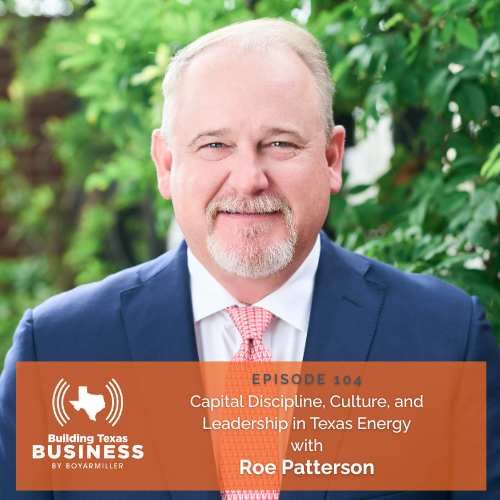
In this episode of Building Texas Business, Chris Hanslik sits down with Roe Patterson, co-founder and Managing Partner of Marauder Capital, for a candid conversation about leadership, resilience, and building energy businesses in one of Texas’ most cyclical industries.
With more than 30 years of experience in the oil and gas sector, Roe has built, scaled, sold, and led companies across the energy spectrum, including serving as CEO of a public oilfield services company and completing more than 130 M&A transactions throughout his career. Today, he invests in and advises energy and industrial services businesses, bringing both operator experience and board-level perspective to the table.
Roe shares what it takes to navigate downturns, manage risk, and know when to walk away, whether from a deal, a strategy, or a hiring decision. He discusses the importance of capital discipline, the industry’s shift toward lower leverage and return of capital, and how technological advancements such as automation and AI continue to reshape energy production without replacing the people who make it work.
The conversation also explores culture, mentorship, and leadership evolution. Roe reflects on lessons learned from early setbacks, the power of listening over talking, and why humility and decisiveness must coexist in strong leadership. From hiring philosophy and team retention to innovation and safety in the field, this episode offers practical insight for business owners navigating growth in dynamic industries.
If you are interested in entrepreneurship, energy, leadership development, and the realities of building businesses in Texas, this episode delivers hard-earned wisdom from someone who has seen the industry from every angle.
Transcripts are generated by machine learning, so typos may be present.
Chris Hanslik: All right, Roe. I want to thank you for taking time to come on
“Building Texas Business.” It’s great to have you here. Glad to be here. Let’s
start by introducing yourself to the listeners. Tell us, what company are you
involved in now? I know you’ve been involved in several. So tell us a little bit
about yourself and the companies you’re affiliated with.
Roe Patterson: I’m affiliated with several at the moment. I built several
businesses after I stepped down as a CEO of a public company in late ’19. I
had to wait out a non-compete in oil field services, and then got back into oil
field services. I started putting together unsponsored businesses with my
capital from friends and family, just in places where I saw dislocation and I
thought there’d be a good opportunity to put some businesses in the way I
wanted to put them in, leaving the public market and going back into the
private sector to pursue opportunities. Then two years ago, my partner and I
decided to form our own private equity fund. We’re doing things in the fund
today, and that’s Marauder Capital. We invest in production services in the
energy business. So, that’s what I do today.
I’ve had a long 30-year career in the oil field and in energy. I grew up in
energy with my family being in the business, so I had a strong pull to come
back after college. I ran several of my own companies, sold them, and then
landed with a public company and worked my way up to CEO of that
company. I’ve done multiple M&A transactions over my career—I think I’m up
to 130 something transactions. Wow. Okay. So a lot of buying and selling
different businesses, a lot of building businesses, building teams. Now I’m at
the point in my career, I guess, where I’m more of a coach, a guy in the press
box. I’m not on the field anymore.
Chris Hanslik: I got you.
Roe Patterson: Which is a good spot to be in. But now I just try to help
different teams. I’m on the board of multiple companies. I’m on a board of
another public company, so I just try to be an industry voice—a guy who’s
faced some of the challenges that they face on a daily basis—and coach them
through all of the good times and the bad times.
Chris Hanslik: You take that experience you’ve learned, seeing it from the
ground up, and you’re using it to help the next generation.
Roe Patterson: Unfortunately, the energy business is one of those businesses
where we see a lot of cyclicality. Knowing how to manage and run your
business in the bad times is just as important, maybe more so, than being
able to run it when things are good.
Chris Hanslik: Oh, for sure. So you mentioned a minute ago you started your
own oil field service company. I think you mentioned you saw some
dislocation in the industry. Are you still affiliated with that company?
Roe Patterson: Yeah, I still have those. I call them a pre-fund or a portfolio,
and I’m still running a couple of those businesses, really more in a board
position, a Chairman role, helping those teams manage those businesses and
helping them with capital allocation and where to go next and what to do next,
where to build, where to grow. Yeah, where to maybe sell and back off. One of
the hard things most business owners have is knowing when to quit, or when
to say, “Hey, this isn’t working. We’ve got to try something different.”
Chris Hanslik: Right. It’s a challenge, right? Because the entrepreneur typically
is so invested that they figure they can make anything work, and sometimes
it’s important to know what to stop doing.
Roe Patterson: Yeah, it’s probably as important, or more, especially when it
comes to things like leverage or debt resources and capital allocation. You’ve
got to know when to say, “Fold ’em,” and walk out. In our business, that’s
probably one of the toughest things to do because by and large, people in the
energy business are entrepreneurial. They’re aggressive, risk-takers. I always
say they’re a bunch of hammers; everything looks like a nail to them, and they
want to keep grinding away.
Sometimes, when you take a step back and you really look at the battlefield
from a different position, saying “that’s enough” or “we’ve got to change this
dramatically and really revolutionize the way we’re thinking about this” is a
hard thing to do. Sure. But you can’t ever get in one of those ruts where you
just keep repeating yourself and beating your head against the wall and never
really seeing a different outcome. At some point, you’ve got to say, “Hey, let’s
re-strategize here.”
Chris Hanslik: Yeah. So let’s just talk about the more recent companies. What
was some of the dislocation? Because in the clients we serve, very similar to
you, entrepreneurial, they’ve been in any kind of industry. Most saw some
gap, some dislocation based on whatever they’d been doing, and decided that
there’s an opportunity here that I’m going to go take advantage of. What was
the dislocation that you saw that you tried to take advantage of with this new
company?
Roe Patterson: They’re different in every single company. We felt like there
was a product or a service offering that was being underserved by the market,
and we knew—based on new technologies or based on the methodology in
drilling for oil and gas—in the Lower 48, obviously, shale production and
horizontal shale production have been the newest advance that we’ve seen in
our sector. [We were] just trying to think two or three jumps ahead of what
everyone is going to need when it comes to products or service offerings or to
enhance efficiency gains.
Obviously, cost is one of the biggest things that our customers and our
companies deal with. So if we can figure out a way to be more automated,
more efficient, and bring some sophistication or technological advance to a
particular segment of the industry, then that’s what we ought to be doing.
Lower lifting costs for the producers so that even with the cyclicality in pricing,
they’re still making a good return on their capital or good margins. So if we can
find ways to do those things and create those efficiency gains, that’s probably
the place we look first.
For instance, we have a midstream water company. One of the things we saw
when we got into that business was that most of those businesses were built
around a hub-and-spoke model where you’d put a saltwater disposal well in a
certain location to gather wastewater, and it was primarily serviced by trucking
fleets. Those are expensive to run. They’re high risk. You’re on the road every
day with the general public. It’s hard to ensure. Insurance costs are very high
in the heavy haul industry.
So we were under the impression that if we could create infrastructure or
pipelines to move that water, we’d be much more efficient. We’d save the
producer dollars, and it would be less risky. So we went about trying to build
out that infrastructure and tie in as much pipe to our saltwater disposal
network as we could. We built redundancy into that so that if one well went
down, other wells could take the water. There’s a lot of automation and
telemetry that goes into that. Essentially, you could cut the water cost for a
producer in half if you could get the water barrels on pipe versus trucking.
That’s just one example of what we were trying to do.
Another business we have, we just tried to bring a lot of sophistication to what
was an older industry, hadn’t really experienced a lot of technological leaps.
So we tried to bring things like a lot of digital data acquisition from the field so
that we could process everything faster, whether it be payroll, payables,
receivables, or time tracking, and then trip times—what were we doing in the
field at the time, and why does it take this rig longer to do it than this rig? And
what are they doing differently? We really dig into the analytics. All of those
things are really taking off within the industry. And AI is going to do nothing but
feed into that because it gives us one more tool to analyze data and to spit
that out of where we see inefficiencies or gaps or something that we can go
make better.
Chris Hanslik: Are you having to build your own AI models so that you can
manage the confidentiality of the information for your clients?
Roe Patterson: At times, in the industry, we call that “tight hole,” where no one
wants anyone to know what they’re doing. If they’re doing it better, they want
to keep it secret to themselves. But a lot of that information is pretty generic,
and we can share it. We can share improvements across the vendor or
customer space, and we can work together even with some of our competitors
to make things a little better in the industry. Obviously, safety is a huge
concern. We always try to keep people in the same condition that they came
to work in; we want to send them home to their families healthy. So if we can
do anything to enhance the safety aspect of what we do every day, that’s
critical.
Chris Hanslik: Makes sense. So you talked a lot about innovation, which is
great. As you’re growing these companies, and I guess moving into that
executive chair position, what role are you playing to try to help the leadership
develop and build a culture in the company? What are some of the things that
you’ve seen in your experience as elements of a culture that leads to the
success that those companies have seen?
Roe Patterson: I think the first thing you want to do when you start interfacing
with a management team—whether it be someone you just acquired, or you
just invested in, or someone you hired off the street to come and run
something for you—is to instill that work ethic. You’re only as good as the
leadership will only be as good as they perform. If they work hard and they’re
dedicated and they show a lot of care for what they do every day, it’ll trickle
down. The first thing we have to do is work ethic.
The second thing is just ethics in the business, period. If it’s not good for all of
the stakeholders involved, don’t do it. The customer has to win. The company
has to win. The vendors have to be taken care of. A lot of people leave
vendors out from time to time—advisors and different people that you interact
with, whether you’re buying products or parts or pieces from them, you’ve got
to take care of them. The employees are at the top of the list. They’re your
best assets.
Chris Hanslik: Right.
Roe Patterson: It doesn’t matter what you do or what business you’re in, your
employees are going to be your best assets. [We focus on] training. We’ve
spent a lot of money trying to train people and make sure we’re sending
people out to do whatever business we’re doing with the most knowledge we
can possibly fill them with so that they can provide as good a service as
possible and that they’re taking care of everybody else at a job site—not only
their own employees but third parties they interact with, too.
I think ethics is probably one of the things we focus most on in a culture: do
the right thing, treat people the way you want to be treated. It sounds cliché,
but it really works in business. A handshake still has to mean something. “Just
do the next right thing” is a big part of what we try to instill from a cultural
standpoint.
Chris Hanslik: And I think one of the things you mentioned earlier, it’s got to
start from the top and go down and be consistent—anything that you do from
a training standpoint, onboarding, and then that consistency throughout to
reinforce those tenets and those core, what I would call core values of integrity
and ethics, work ethic, et cetera.
Roe Patterson: First of all, we take new hire training very seriously. It doesn’t
matter who you worked for, how many years you’ve been in the industry; when
you’re new to us, you need to know the way we do things. What are our
policies and procedures? How are we going to handle each curveball that the
industry is going to throw at us? And how do we react, and when do we go up
the chain of command to ask for permission to modify a procedure or
something like that?
The worst thing you can do is have employees in the field try to do it on the fly
and improvise and make decisions without consulting. We’re a team, so let’s
all work together as a team, put our heads together. It’s always good to stop
the job, slow it down, put our heads together, and make sure we’ve got the
best plan picked for everyone involved.
Chris Hanslik: Yeah.
Roe Patterson: So that’s one of the things we train hard on. And then recurring
training. The cliché is you can never teach an old dog new tricks, and there’s
some truth to that, but…
Chris Hanslik: I bet, especially in the oil field.
Roe Patterson: …but you can remind them of the right way to do things. And it
never hurts people to go back through training. Pilots do it, doctors do it,
lawyers do it, and accountants do it—they go back through training on a
regular basis so that they can provide the best service possible. We should do
that in every industry, in my opinion. So we do a lot of recurring training, and I
think that’s important.
The cultural piece: if you carry yourself and you try to treat customers,
vendors, even competitors, the way you want to be treated, that tends to be
something people pick up on and they notice quickly. We try to always instill
into our employee base, no matter which company we’re talking about, that
doing the right thing—it matters. And it will trickle down; that will affect
everybody. That culture of doing the right thing was something I learned early
on from my father and my uncle who were mentors of mine. They preached
hard to be honest and hardworking, and if they beat you, they wanted to beat
you heads-up, face-to-face, not behind-the-back kind of stuff. That’s the way
we try to run these businesses. It works very well. A bad habit is one of those
things that catches on fast. Good habits do, too. They’re probably harder to
instill, but they’re contagious as well.
Chris Hanslik: Sure. So you talked a lot about once you have a team member
on board and the training and integration, I think that’s great. Let’s talk a little
bit about trying to get the right people on the team and the interview process.
Most owners that I talk to say that’s the hardest piece because everyone
agrees people are your biggest asset, but getting the right person on the
bus—to borrow Jim Collins’ phrase—is a little bit harder to do than it sounds
most times. Through the process of your career, have you come up with some
interview processes or things that you’ve found that have worked, or some
that maybe didn’t work and failed miserably that you could share? I think it’s
so key because every business is unique, and you’ve got to find how you’re
going to go about asking questions that aren’t just the generic ones and
listening to—more importantly—listening to answers to make sure you’re
making a good decision on the hire.
Roe Patterson: I think you have to trust your gut, but sometimes your gut will
lie to you, so you have to be careful. I check references. I do my reference
work. Those references are there for a reason, so you ought to check them
and ask lots of questions. I usually know a lot about a recruit before I have
ever met them face-to-face or even over a Teams call or something. I’ve
known a lot about them beforehand.
I look to see where they’ve worked and how long they worked there. Are they
a chronic job hopper, constantly moving? By the way, that’s a pretty negative
thing.
Chris Hanslik: Huge red flag, right?
Roe Patterson: It’s a red flag. But you can dig into that and ask why.
Sometimes they have good reasons for leaving where they were—maybe their
spouse had to move or something like that. So you just want to ask those
questions. I try to get to know recruits. I try to get to know candidates for
positions and ask a lot about them personally. There are things you can and
can’t ask in an interview process, but you can ask people what they like and
what they don’t like, where they see themselves in five years, et cetera. You
can learn a lot about how an employee is going to carry themselves pretty
quick just by asking a lot of those familiar questions just to get to know them.
I usually finish with, “Why do you want to be here? Tell me what it was that
attracted you about our company, about this business in particular.” You can
learn a lot about somebody that way. I would say, after fielding a lot of those
questions and really doing your homework and research on somebody, then it
comes down to trusting your gut. We always talk about not hiring a problem.
Let’s not hire the next problem; let’s try to avoid it if we can. People will, once
they’re talking about themselves and about their career and about what they
like or dislike about employers and businesses, et cetera, I’ve found that they
usually will spill the beans pretty quick. You pick up fast on whether or not this
is somebody that’s going to fit in here or not.
Chris Hanslik: No, I think you’re right on so many points. But doing that due
diligence upfront, I think, is important. I’ve seen from experience, the more you
can get them talking rather than you talking—so open-ended
questions—they’ll reveal themselves over time.
Roe Patterson: And I try to train the leadership to do that. I try to coach people
up that if you’re doing all the talking, you’re learning nothing. So listening more
than you speak is such a big deal whenever you’re a business leader. I think
as business leaders, there’s a bravado and a pride thing, call it whatever you
want: “I’m in this role, everybody needs to listen to what I have to say.” I have
never found that to be a good practice. I’ve always found that when I shut up, I
learned a lot more, and just asked pointed questions, and asked lots of
questions.
One of the things people forget to ask is, “How are you doing today? How’s
the day going? How’s life?” Because usually, if things aren’t going well, you
find out quick. That may affect their business decisions or their strategy
decisions. If they’re having a tough day, they may be negative about
everything. People are trying to come up with good ideas and be innovative,
and you’ve got one guy or gal in the room that’s saying no to everything. We
need to figure out, maybe they’re just having a bad day. Let’s find out what’s
wrong.
Chris Hanslik: You hit on something. We actually have, in the last couple of
years, really focused a lot of this here at the firm. And that is, okay, we all
know we’re human, but the bigger issue is we all have real stuff going on
outside the office.
Roe Patterson: Absolutely. You only work for eight to ten hours or however
long you work in your shift, and that’s a small part of your world.
Chris Hanslik: Yeah. And you can’t cut that off, right? So I think creating an
environment and a culture where your people feel comfortable talking and
sharing helps you. Because if you’re having a bad day—everyone’s going to
have a bad day—if you have the right people, they’re going to rally around that
person and support them while they’re going through whatever. Because at
some point, it’s going to be you, and you’re going to need and want that same
support.
Roe Patterson: Everybody’s got their time in the hot box. I think that’s one of
the reasons why, after COVID, I was so against this remote office stuff. I try to
encourage people to come into the office more. We do allow some remote
work. You don’t know what’s going on in someone’s life when they’re not in the
office, and you’re not interacting and trying to innovate together and come up
with new ideas and how to make everything at the company better. It’s hard to
have fun at your job when you’re not in that team atmosphere.
Chris Hanslik: Yep.
Roe Patterson: And you don’t know what’s going on in someone’s personal life
when you’re looking at them over a screen. So I like the interaction piece of
coming in and working with your co-workers. It’s super hard to innovate when
everybody’s in a silo or remote, by themselves.
Chris Hanslik: I couldn’t agree more. As humans, we’re meant to be
connected with each other. We talk a lot here about trying to create
community. We’re in this together. If you’ve chosen to be part of this
organization, then you’re part of this team. We have goals and objectives
where I want the organization to be successful, which means every individual
can be successful, and you can’t do that disjointed. We collaborate better.
Roe Patterson: I think that’s old school to a degree, but you have to enjoy your
job. It’s hard to enjoy it when you’re all by yourself and you’re never interacting
with anybody in one of those innovative, brainstorming sessions where people
are throwing out ideas. Not all ideas are good. Some are going to stick to the
wall, and some of them aren’t. But if we don’t know what we’re saying no to,
and we don’t go through that process of kicking the bad ideas to the curb and
grabbing onto the good ideas and running with it, then you lose that spark.
I’m big on trying to get everyone together, have a face-to-face. We try to make
the rounds and see everyone, and we try to coach all of our leadership teams
that that’s what they should be doing, too. Get in front of your folks; make that
face time. One of the things we found in the energy industry, and in a lot of
industries, is there’s been study after study on safety performance: people are
safer when they know that the people they’re working with care about them.
They are inherently safer when they know they’re respected, they’re cared
about, people care how they’re doing, and that they’re happy in their job, et
cetera.
So we try to do a lot of that. That sounds Pollyanna to some, because to some
old-school folks, “Hey, this is your job. You just need to show up and do it.”
Chris Hanslik: “Shut up and get it done.”
Roe Patterson: “Get it done, and shut up and do your work well.” There’s a
place and time for that too, but people have to enjoy where they work. We
have a whole young culture of people who are very connected through digital
means, whether it be social media or other places, and they’re craving some
of that community and interaction.
Chris Hanslik: I think what I’ve found—one of the many reasons it’s
important—is for retention. The more engaged and connected you feel, the
more likely you are to stay. You and I both know that turnover is costly to a
company for so many reasons. So when you create those environments
where they get to know each other, it leads to caring about each other, leads
to being connected to the company, and more likely to be retained. They may
even recruit some of their friends, and you have a pipeline of other good
employees coming in because they know each other. So all of that, to me,
ends up—if you want to look at it in numbers—you’re going to save money. It’s
going to make you more profitable, more efficient, and you’re going to deliver
better product and service to your customer.
Roe Patterson: I think, other than downturns because of commodity prices in
our industry, there’s probably nothing more expensive than turnover. My dad
used to say, “If you’ve got someone who’s doing 60% of the job, don’t quit
looking for their replacement; teach them the other 40%.” I had another
mentor who I worked for who said the same exact thing. I thought, “Wow,
there’s a lot of truth to that.”
Then you get some of these rock stars, these guys that are rainmakers, and
you get a Sally, and she’s just an all-star, and you want four Sallys. You wish
you had five of them. Talk to Sally, because odds are she’s not hanging out
with a bunch of people that don’t approach work like she works, don’t act like
she acts, and don’t have a similar skill set. You want four Sallys? Talk to Sally;
she probably knows another one or two, so it’s a great recruitment tool.
Retention is a big deal. But if you don’t create that place where people are
fighting and wanting to work, you won’t have it. I want to create businesses
that customers are fighting over to be able to do business with us. And I want
to create places where employees are fighting to get their foot in the door, be
part of the team. So if you can work for that and strive for that, you can’t really
mess that up if you’re playing that game and trying to have that be one of your
big goals. But turnover is a killer. And so creating things that not only create
retention but also recruitment is such a big deal.
Chris Hanslik: Yeah. Let’s turn a little bit. 30 years of experience in the oil and
gas industry. What are some of the trends that you’ve observed recently and
where you see things moving in the energy space here in Texas?
Roe Patterson: Obviously, horizontal drilling and the advancements all around
that, and the way we frack wells today through the stage process, have been
a game changer. I can remember times in my career when I thought we found
all the—the rock was too tight in all the other places, and we drilled all of the
Spindletops; they just weren’t…
Chris Hanslik: All the traditional wells.
Roe Patterson: And what I learned from that is never underestimate the power
of science and our engineers to go find and create new ways to do new things
and unlock resources that we thought were never going to be commercially
viable. It happens over and over in our industry. I think in my 30 years, the
quantum leaps in technological gains have been really incredible.
I think I’ve seen different approaches to resourcing capital change over the
years. Our industry had a great affinity for debt just a few years back. You look
at the businesses today that are really performing at a high level; debt is very
low compared to their cash flow. “Low to no leverage” is what we call it.
Chris Hanslik: Okay.
Roe Patterson: And it makes you much more nimble as a business and a
company. The comfort level around debt has changed dramatically. I would
say finally, in the last five years or so, return of capital to investors has been a
huge priority. It probably always should have been, but the public market
usually sets the tone for how businesses are run because shareholders and
analysts and critics that are in the market say, “We want to see growth, and
we want to see your book reserves go up, and we want to see high revenue,”
or “we want to see this or that.” That’s changed a lot in the last five years.
Return of capital has become a huge focus. That’s a good thing for the
industry, by and large, because everybody wins when you’re returning capital.
It should have never probably lost its focus, but at one time, going out and
doing leveraged buyouts and accumulating a very high level of debt compared
to your cash flow was not a sinful thing, and it was embraced at times to be
aggressive. I think in our industry in particular now, return of capital is a high
focus, a big focus. You have technology and improvements in technology, but
the way we handle capital in our industry is probably another big one.
The one thing that hasn’t changed is how important people are. It doesn’t
matter how automated we get, it doesn’t matter how efficient we get, it doesn’t
matter what the technological leaps are—people still matter a lot.
Chris Hanslik: There are still a lot of hands involved in the production of oil
and gas. Technology may help, but you’ve got people out there. You
mentioned a couple of times that safety is a big concern. Most industries and
businesses don’t have to worry about something going wrong and people
dying in your industry.
Roe Patterson: That’s right. And I compare it to AI. There’s a lot of fear factor
out there about AI—it’s going to take away jobs and limit the workforce, et
cetera. I see it the flip side because I’ve seen so many technological jumps
within our industry that actually created new opportunities and new jobs, and
maybe the skill sets changed a little.
Chris Hanslik: Yeah.
Roe Patterson: But it didn’t just do away with the labor force.
Chris Hanslik: Yeah, you bring up a great point. I think oil and gas is a great
example, because the one thing data and research has shown is that through
all the cycles of oil and gas, when we come out of a downturn and it goes
back up, some technology advancement has helped less rigs to produce more
every time. I think oil and gas is a great example to look at—it didn’t eliminate
jobs; it changed the way the job may have been done.
Roe Patterson: It did. And it probably created new jobs, and maybe some of
those jobs that were more upstream in nature before are now more midstream
in nature or more production-oriented in nature. So it just morphs, but I don’t
think it just does away with big, blocky pieces of the workforce, at least it
hasn’t in my career. So I don’t think AI is going to be a lot different than that,
and it could make a lot of people’s job a lot easier, so they can do more with
less, like you say.
Chris Hanslik: Yeah, that’s great. I really appreciate the conversation. I want to
turn a little more to the personal side. So, 30 years in the industry. Maybe just
quickly, how do you think your leadership style evolved over time, and what
were some of the inflection points or learning lessons along the way that
helped you in that leadership journey?
Roe Patterson: Oh gosh, so many. When I started out, I was gung-ho. I
thought I had the Midas touch. There wasn’t anything I couldn’t touch or build
and turn it into the next big business that somebody wanted to buy out. It took
a couple of those to fall flat on their face, and then I fell flat on mine, and
learned that leverage was a real thing first.
Chris Hanslik: Banks really wanted to get repaid.
Roe Patterson: Guarantees are a real thing. Banks do want their money back.
Investors want their money back. So, yeah, I ran into a lot of tough lessons
along the way. I always learn more from the tough times and from things that
go sideways or go wrong than I did when things were going right. My dad
used to say, “A drunk monkey can run this business when oil is a hundred
dollars a barrel and everything’s going perfect. You earn your money when the
stuff hits the fan, and you’ve got to knuckle down and buckle down and try to
figure out how to keep the company alive.”
So I would say for me, I changed a lot from a gung-ho, “we can do anything”
kind of attitude to really analyzing and processing more and doing more
diligence and not trusting my gut right off the bat, doing some homework.
Some people ask me about M&A a lot, and I say, “Some of the best deals that
I ever did were the ones I walked away from.”
Chris Hanslik: Sure. I hear that a lot.
Roe Patterson: I just didn’t feel good about it by the time I did all my
homework. That took me a while in my career to learn to do the homework,
period. But by the time I finished my diligence, I just didn’t have a good feeling
anymore, and it turned out to be for a good reason. Did I miss some deals?
Sure. I missed some that could have been really good, and I got cold feet and
walked. But there was probably a good reason. Maybe we weren’t set up to be
the company that needed to acquire that, or maybe it turned out it wasn’t really
a good time to sell a certain asset or a piece of our business.
I learned that you’re never always right. Don’t think you know it all. I think
when you think you know it all or you’ve got it all figured out, and you’re that
one voice in the room that won’t shut up and listen, you’re probably about to
have your butt handed to you on a silver platter. You’re getting set up for a fall.
So listen. Some of the greenest people you have in your organization can
come up with the best ideas.
Chris Hanslik: Yeah.
Roe Patterson: Because they’re the ones coming in. They’re the outside
looking in. They’re a fresh set of eyes, fresh set of ideas, and…
Chris Hanslik: No restriction or inhibitors, right? They just come in and speak
freely.
Roe Patterson: No filter. They’re not just going to fall in line and say, “That’s
the way we always did it.” One of the worst things you can say in any business
is, “This is the way we’ve always done it.” Why? Why can’t we look at a better
way or a new way? I’ve learned to embrace a lot of change, a lot of ideas,
listen more. I try to ask questions that get conversations going, and then I just
want to sit back and listen and try to process it all. I think that’s how you, as a
leader, can be much more effective: listening than talking.
I try to do that. Sometimes the meeting will shut down, and everyone’s staring
at you going, “What do we do?”
Chris Hanslik: “What do we do now?”
Roe Patterson: And you’ve got to make some decisions. I think being
indecisive is not what I’m talking about. Being indecisive is probably as big of
a risk in any business and from any leadership role as anything else. I’ve had
leaders like that I worked with and around before. We used to say, “You can’t
aim the gun all the time. Eventually, you’ve got to pull the trigger.”
But you run into people that are extraordinarily indecisive, and it’s just their
nature to aim, aim. And that’s risky, too. You’ve got to be decisive—read the
room and know when it’s time to say, “Okay.”
Chris Hanslik: Yeah.
Roe Patterson: Because if you make a mistake, you can always undo it. The
other thing you can do is never do it again. So you make a mistake, you can
say, “Okay, learn from it. That one, I’m not going to do that again. I’m not
going to touch that. It’s really hot.” But if you never make a decision, or you’re
really slow to make decisions, you can bog an organization down. So I try to
be that guy that listens intently, but when it’s time to make a decision, we pull
the trigger. And if we mess up, that’s okay.
Chris Hanslik: You raised a good point. There’s a model out there in decision
making that talks about Align, Act, Adjust. Align is that research, homework,
get the group aligned, but then make the decision, act on it. That doesn’t end.
The next is Adjust. You always learn once you act. They say, “The plan’s just
as good as the game until you get hit in the face.” Something’s going to
change. Something’s going to go unexpected, and you have the ability to
adjust if you’re in that mindset.
Roe Patterson: I think so. And I think good teams will do a lot of post-mortem
work, post-decision work.
Chris Hanslik: Did we…
Roe Patterson: Did we do it right? Did we make the right call? It’s okay.
Humility is a big, important thing in all businesses—to be humble enough to
say, “Man, we screwed that,” or “Gosh, that was a bad call.” That’s okay. Now
what are you going to do? And now how is the team going to pivot?
We always say in our businesses, “Work the problem.” Maybe you created the
problem, maybe you inherited the problem, or maybe it was an act of God that
caused the problem. But how are you going to work the problem? What are
you going to do about it as a team?
Chris Hanslik: I like that.
Roe Patterson: I’ve tried in my career to take those curveballs that you’re
going to get inherently in every business and just work the problem. One of
the most satisfying things in running a business is not the profitability and it’s
not the financial benefit to everyone—at least it’s not for me. It’s seeing teams
rally when there’s a problem and overcome and work their way through it.
Then you look back and do another post-mortem: “We didn’t make the right
call initially, but boy, did the team come together and really handle it.”
Chris Hanslik: Yeah.
Roe Patterson: That’s when you’re most proud of your groups and your teams.
And you’ll be proud of yourself because you listened and you paid attention.
Like I say, sometimes the best ideas are the ones just from out of left
field—somebody who knows the least and has the least amount of experience
or know-how, and they come in with something pretty radical, and you’re like,
“Wow, why did we not think of that?” It’s because you’re in the trench every
day; you can’t see the forest for the trees sometimes.
I think a lot of leaders make that mistake. They don’t do enough meditation:
“Let me take a step back and let me really think about things and let me look
at what we’ve done and where I think we’re going.” Really take a step back
and then ask lots of questions.
I relied heavily on mentors. Everybody should have a mentor. I don’t care how
good you are or how old you are or how much hair you’ve lost in your industry;
you should have a mentor, or people you can rely on and ask questions to and
say, “What do you think about this? Do you think we’re doing the right thing
here?” I still do that today. I still call up old friends and peers and folks and just
say, “I’m dealing with something, and I’m not quite sure exactly what I want to
do. I got this path or this path. And what do you think?”
Chris Hanslik: Yeah.
Roe Patterson: They may not give you the perfect answer, but having
someone else’s take on it when they’re outside looking in is sometimes
invaluable.
Chris Hanslik: And that trusted advisor, that mentor. You’re so right. You never
outgrow the need for one of those.
Roe Patterson: They never do. If you ever quit asking questions, and you ever
quit taking a poll, and you ever quit asking people, “What do you think?”—and
it could be, like I said, the newest guy in the room—you should say, “What do
you think? What are you hearing?” Sometimes you’d be amazed by the
answer. I love having good industry resources and wisdom and people that I
can tap and go, “Here’s what I’m dealing with. What do you think?”
When people come to me like that, I think it’s important to shut down whatever
you’re doing and give them your full attention because they’ve taken a big leap
of faith to reach out.
Chris Hanslik: Yeah.
Roe Patterson: That is something that is hard for a lot of leaders,
entrepreneurs.
Chris Hanslik: Sure, it is. It takes a lot of courage.
Roe Patterson: It takes a lot of courage to say, “What do you think?”
Chris Hanslik: “I’m not sure what to do.”
Roe Patterson: “I’m not sure what to do.” “I don’t have the answer.” Wow, you
don’t have the answer? That takes a lot of guts. It’s important to
be—depending on which side of that you’re on—just to stop and focus and
say, “Let me hear you.” Let me make the time. I’m going to go to that lunch.
I’m going to go to that coffee.
I take a lot of students who are in business school or even working on their
undergrad, or maybe it’s people that are new in the industry, and they’ll reach
out over some network and they’ll say, “Would you spend 15 minutes or 10
minutes or 30 minutes just talking to me about my career path and where I
want to go and what I want to do?” Sometimes it’s hard to say yes because
you are busy and you have 19 things to do that day, but it is so important to
go, “Sure. Let’s schedule it. Let’s make time for it.” I’ll do that because if you
don’t, you’ll kick yourself later because someone did it for you.
Chris Hanslik: Pay it forward.
Roe Patterson: If I hadn’t had that, I’d have been lost like a puppy in a
snowstorm. I had good people I could call and go, “I don’t know what the heck
to do here.”
Chris Hanslik: Yeah.
Roe Patterson: And it could be crazy. It could be people—even a
competitor—and you call and go, “I’m dealing with an issue. What do you
think?”
Chris Hanslik: Yeah.
Roe Patterson: If they’re a decent person in our industry, they’ll say, “Here’s
what I did when I saw the same thing.”
Chris Hanslik: Yeah.
Roe Patterson: “And it was right or wrong or whatever.” I don’t mind talking to
a competitor, asking them. I don’t mind talking to a banker and asking them.
You spook your banker a little bit.
Chris Hanslik: Right? “What do you mean you don’t know?” “Make sure, are
you current?” Exactly. So those are all great points and great advice for
people listening. Let me just ask you this: What do you like to do just to
recharge on your own personal time?
Roe Patterson: A lot of things. I like to travel. I love to fish. I used to hunt a lot,
and I lost my zeal for that. I used to team rope. I rode horses.
Chris Hanslik: Oh, okay.
Roe Patterson: And I team roped, and I did that as an outlet. I play some golf.
I love to fish. I love to meditate a little bit. I read a lot of the Bible. I try to read it
every single day. I get a lot of meditation out of that. A lot of wisdom, and I find
a lot of answers there, so it doesn’t matter what religion you are or what.”
Roe Patterson: You’ve got to find an outlet, you’ve got to find something that
takes you away. I love to eat good food. So I’m always looking for the next…
Chris Hanslik: You and me both.
Roe Patterson: …for the next good restaurant. I get a lot of satisfaction out of
that. But you’ve got to make some time to unplug and get away from work.
That old adage is all work and no play makes Johnny a dull boy. I mean, that
is so true in so many ways. I know guys that try to unplug, but they make their
unplugging about work.
Chris Hanslik: Oh, yeah.
Roe Patterson: And you didn’t really get away from it. You need to get away.
Chris Hanslik: Yeah.
Roe Patterson: I think that being outdoors anytime you can be outdoors, and it
doesn’t matter if it’s a walk or a hike, it’s worth it to step back. I drive. I fly a lot
in my business, but I love it when I get the opportunity to just take off for a two
or three-hour drive. In Texas, that’s not very hard.
Chris Hanslik: It’s not hard.
Roe Patterson: You’re two or three hours from everything, it seems like. Half
the time I get some of my best ideas just driving down the…
Chris Hanslik: Road. Sure. That’s great. I’m going to follow up on the food
thing. So do you prefer Tex-Mex or barbecue?
Roe Patterson: I’m a barbecue guy. I like to smoke food. And I can’t cook Tex-
Mex at all, but I do like to eat it. No, I’m a barbecue guy. I’ve tried to perfect
my brisket, my ribs, all my smoked meats. So I love doing that. That’s also a
great outlet, cooking.
Chris Hanslik: Yeah.
Roe Patterson: My daughter’s a chef. I love to cook. A special day for me is, I
know I’ve got a piece of meat that I’m going to be smoking all day long. It’s
time-consuming. It’s always rewarding at the end, or you hope it is, it tastes
good. But I get a lot of processing done during that time when I’m just focusing
on the meat, but my brain’s still working and I’m still thinking over things and
processing, Monday morning quarterbacking a little bit. Trying to come up with
a new idea or, “Hey, we should have done this a little different or a little
better.” And I make mistakes all the time. And I’ll dig in on those when I’m
taking a step back to cook or whatever. That’s a good time to do a little self-
reflection. And go, “I could have done that better. I could have handled that
better.” It’s never too late to apologize to people who handled something—a
situation wrong or whatever. But, processing over your mistake or a bad
decision, a bad call. You see this in the sports world, right? They watch film for
a reason. They watch that game. It’s in the history books. It’s done. You’re not
going to win it by watching the film. You lost it, but you can go back and learn
a lot about what you could have done better.
Chris Hanslik: For sure. That’s a great analogy. I love sports analogies. But
Roe, I can’t thank you enough for taking the time to come on the podcast and
share your story and some of your lessons learned. Really appreciate it.
Roe Patterson: Thanks for having me.
Chris Hanslik: You got it.
With a deep understanding of your business alongside clear and honest communication, we help clients face challenges fearlessly.
Learn more about our services and how we help clients.