


With a deep understanding of your business alongside clear and honest communication, we help clients face challenges fearlessly.
Learn more about our services and how we help clients.



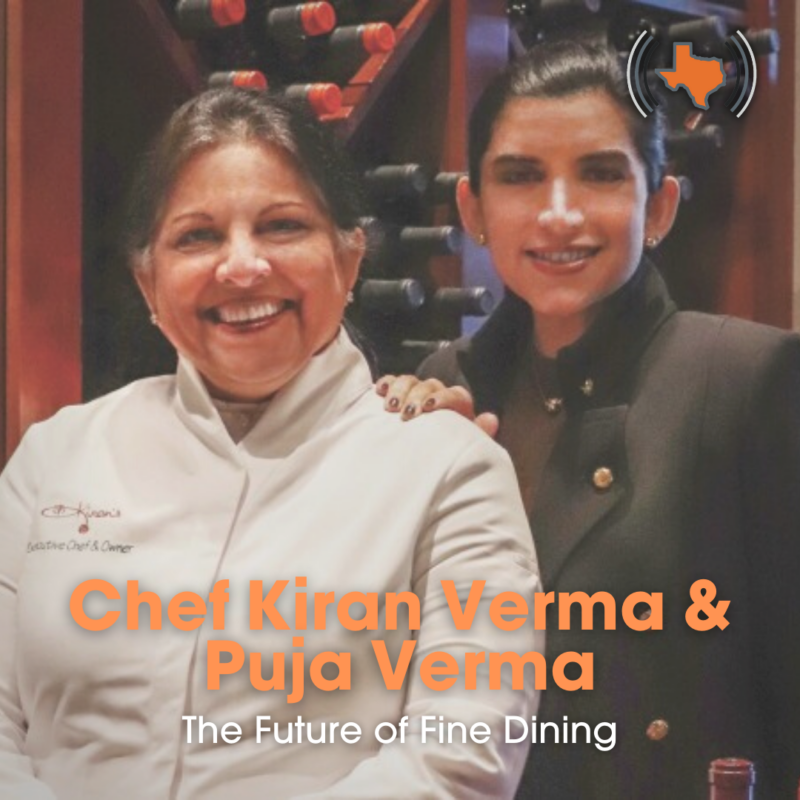
The latest episode of the Building Texas Business podcast features two guests – Chef Kiran Verma, Chef and Owner of Kiran’s restaurant in Houston, and her daughter Puja Verma, Director of Operations and Development.
Chef Kiran is known as the Godmother of Indian fine dining, and Kiran’s is a beloved restaurant in Houston. Alongside her daughter, they share the inspiring story of perseverance and innovation as they introduced food from their beloved culture to the Houston community and beyond.
Transcripts are generated by machine learning, so typos may be present.
Chris Hanslik: Hello everyone. In today’s episode, you will meet Chef Kiran Verma and her daughter Puja and learn from Chef Kiran how, since the age of six, she learned to cook in her mom’s kitchen in New Delhi, India. Then, once coming to the US, she was inspired by early visits to Luby’s for the recipes she still uses today. Puja will tell you how she draws on her experiences learned working in finance in the oil and gas industry to drive the future of the restaurant. Okay, so I am very excited to have you both. It is the first time we’ve had two guests. So, Chef Kiran, thanks for being here.
Puja Verma: Thank you.
Chris Hanslik: Puja, thank you for joining.
Puja Verma: Thank you. Thanks for having me.
Chris Hanslik: So, as you know, we like to talk about businesses, and you’ve had a business in Texas for decades. That in itself is an accomplishment. So, Chef, I want to start with you. Tell us what inspired you to start a restaurant.
Chef Kiran Verma: Well, from my early childhood, I was always very much into cooking. I was passionate about it. I would rather be in the kitchen than in the classroom or with a tutor. Но, of course, like all Indian parents, my parents always wanted me to be a doctor. My mom always had a tutor for me for physics, chemistry, and biology. I wouldn’t attend to those with full concentration; I would be looking at my watch and saying, “When is he leaving so I can go into the kitchen and start the dinner time or do this?” I remember being very interested in the kitchen from age six.
Chris Hanslik: Really?
Chef Kiran Verma: Yeah.
Chris Hanslik: And where did you grow up?
Chef Kiran Verma: New Delhi, India. Okay.
Chris Hanslik: And so, is that the extent of your training? Were you self-taught all the way through?
Chef Kiran Verma: From my mom’s kitchen to your table.
Chris Hanslik: I love it. So, okay, that was the inspiration from six years old, and you just never lost it to this day. I know how passionate you are because I’ve been in the restaurant a few times.
Chef Kiran Verma: You know, cooking at home is not like cooking at a restaurant. Restaurant cooking is totally different. When I came to this country, I was 18 years old, and at that time, Indian food was not available outside your own home. Even to cook at home, there weren’t many Indian grocery stores in 1970. You had maybe Antone’s or a couple of other stores that would carry lentils, and you would innovate the recipes. My biggest innovation, you’ll be surprised, literally used to come from Luby’s Cafeteria.
Chris Hanslik: I would never guess that.
Chef Kiran Verma: So I would go there and I’d have, let’s say, a fish, and I’d say, “Oh my gosh, it’s so bland. What if we just added some spices to this?” I’d come home and I’d try everything I ate outside; I’d come home and try it with Indian spices. That kind of gave me the inspiration to go into cooking at a much deeper level in the restaurant as well.
Chris Hanslik: That’s it. So Puja, you’re not new to your mom’s restaurant, but in the last few years, you actually quit your career in energy and are full-time at the restaurant now. So, at a high level, as the restaurant is today, what do you believe it’s known for?
Puja Verma: High level, I think Kiran’s is known for being the Indian fine dining restaurant in Houston.
Chris Hanslik: What kind of things are you doing to make sure that is known in the community and that you can sustain that reputation?
Puja Verma: You know, we just want to be top of mind all the time. So, you know, whether it’s forming different partnerships with groups, businesses outside the restaurant, doing things on social media, continuing to, you know, follow trends and see what people are gravitating towards and creating and keeping up with those, you know, whether it’s the food or the cocktails and just trying to continue to be relevant.
Chris Hanslik: Good. So, Chef, back to you. At what point did you realize, when you started a restaurant years ago, that this is a business? At what point did you realize there are business things you have to pay attention to, or it will fail—that you can’t just immerse yourself in the kitchen? When did that light bulb go off?
Chef Kiran Verma: So actually, when we started in 1996 or 1997, the first restaurant was called Ashiana. It was in the Energy Corridor. I literally thought it was a fun thing to be a chef or to own a restaurant. I never thought—luckily, my husband had a job, so I didn’t have to work so hard to bring money to the table or be the primary bread earner. I was very lavish in running that restaurant. I didn’t know anything about cost control. Of course, over the years you learn that this is as much a business as anything else. You can enjoy cooking, meeting people, and entertaining, but at the end of the day, you have to cover the payroll, the rent, and the insurance. This goes on and on. I did take many restaurant management courses—short one- or two-day courses—and every time you went to these courses, you learned how even saving five cents on a napkin matters at the end of the day. You start thinking that way. Now, even at home, if I’m not in a room, I’m turning off the lights. I think, “Okay, I saved this much energy.” Your mentality changes.
Chris Hanslik: So as your experience in running the restaurant has evolved, what are maybe one or two of the key lessons you think any business owner should know based on your experience?
Chef Kiran Verma: First of all, always know every aspect of your business. In our industry, you should know how the dishwasher works, how the ice machine works, and how all the stoves work. Those are the basic things. Then you should know the purveyors you buy the food from. Where are they getting your food? How is it coming? Are they in line with the pricing and the quality? Are they delivering what they are charging? You have to be very careful in day-to-day business.
Chris Hanslik: Okay, so Puja, when did you first start working in the restaurant?
Puja Verma: 1998, at our old restaurant, Ashiana. I had just left for UT. My mom buys this restaurant and we need help on the weekends. She calls me and asks me to come and host and be at the cash register. Then I spent my summers working at the restaurant. So I’ve been working in some capacity for many years. That was during college, and then in between undergrad and grad school, I was a manager at the old location next to Highland Village. I did three years there and then wanted to go to business school. I thought, “Once I’m in business school, I’ll figure out whether I want to stay in hospitality or go back to finance.” When I was in business school, I fell in love with the oil and gas industry. I was at Rice, and all our classroom examples were around oil and gas; it was during the shale revolution. I started pursuing a career in that industry. Then, in the last few years, I realized that I needed to go back into the business with my mom and hopefully help change our trajectory. I felt like we were humming along and doing fine, but I was—and still am—hoping to change the curve and make it go upward.
Chris Hanslik: Sure. That’s great. So to that point, what skills or lessons do you think you brought from your business, I guess, MBA education and what you learned in the world of finance and energy finance that you’re doing in a restaurant? What knowledge, skills, experiences are you drawing upon from that?
Puja Verma: Well, I got very good at Excel when I was working in finance, so I’ve been able to utilize those skills when doing payroll. That’s really come in handy. But I think one of the lessons I think about most was from my marketing course at Rice. I certainly took school a lot more seriously as a grad student than as an undergrad.
Chris Hanslik: Probably a lot of people identify with that.
Puja Verma: And I think a lot about the things I learned in marketing and try to apply those in the restaurant to this day—when talking about cost-plus pricing, mission, vision, and strategy. I try not to be everything to everyone. One example I always give my mom involves how a woman was trying to sell a very expensive necklace. She had three types of necklaces: a low, a middle, and a high-priced one. The professor asked what she did to move that high-priced necklace. She actually created another necklace that was even more expensive than that. Then people would buy the first expensive one because they felt, “Well, I know we can’t get the most expensive one, but I’ll get the one right below.” I think about those types of things a lot. They gave examples of what Apple would do for marketing. For example, Apple is known for having white AirPods. I thought about that for our to-go bags—making a distinct white handle, no matter what the color of the bag was. Right now we have a white bag, but we had black bags for a long time and we made our handles white just to differentiate them and make them stick out. Of all the classes, what I learned in marketing is what I really think about to this day.
Chris Hanslik: That’s great. So not unusual, but you don’t see it all the time, family business, right? So you came in to help mom in the business she started. put you both on the spot. So what are the pluses and what are the minuses to working in a family business so close and you know kind of think about we have listeners are probably in the same or maybe thinking about doing the same thing and you know what advice could you impart to them based on your experience and what you’ve learned.
Chef Kiran Verma: I am so happy to have her. I cannot tell you, because you just feel there is nobody who is going to take care of your business and your interests as much as your own family. Also, having children who are more educated than you are and smarter than you are makes you feel more secure. I have been doing this for 25-plus years and I feel I’m getting to that stage where I’m not as fast as they are. I can’t work on Excel; I’ll say, “Can you make squares and do this?” and she has already done it so fast. Knowing that she’s always covering our back and that nobody can take advantage of the business when she’s around makes me feel very secure. The negative is that when it’s your child, you’re constantly worried they’re overworking or not taking care of their family. I feel so guilty and I keep saying, “Puja, go home. It’s time to go home.” If other employees are there, you pay them and it’s fine that they are working. You just take it too personally when you’re working together.
Chris Hanslik: Sure. Well, that seems natural. I will say this, if people are just watching and listening to this podcast, what they didn’t see expression exudes proud mom. So, that’s pretty cool. Puja, how about you?
Puja Verma: She’s definitely a lot smarter than me, so don’t believe what she just said. She’s a heck of a lot smarter than me. I would say to anyone who’s thinking about joining the family business: do it. Just go for it. Some people think they will eventually take it over if something happens to a parent. Someone told my mom, “Don’t wait for that.” I’m so glad they told her that. They said, “What are you going to leave your children with? They’re going to have a business they don’t even know how to run. Get them in the business while you’re still active so that they’re learning from you side-by-side.”
Chris Hanslik: Great advice.
Puja Verma: I would say, I mean, it’s been wonderful. You know, I feel so lucky to have had the opportunity to work with my mom. She’s the best boss. I was trying to think if there is any negative. The negative is that I’m eating too much.
Chris Hanslik: Of her food, right?
Puja Verma: Yeah, I know. That’s certainly a negative.
Chris Hanslik: Add some more salads to the menu. Yeah, exactly.
Chef Kiran Verma: I’m sure many times she doesn’t agree with my decisions, but out of respect, she agrees right then and there. I’m sure I don’t always make the decisions she wants for the business, but I always tell her that the old-fashioned ways are better in many ways. Hospitality involves the pricing and sometimes giving too much food. Even when people can’t eat it all, we come from a culture where the table should be full of food. She says, “Don’t put so much on a plate; they can’t eat it.” We are always packing leftovers. When we are packing food, we are spending on bags and labor. I literally have one extra person who just packs food for people.
Chris Hanslik: For to-go orders?
Chef Kiran Verma: No, it’s not for to-go. It’s after people have finished eating; they always have so much left over that they want to take it home. They say it tastes even better the next day.
Chris Hanslik: So you have one person that’s all they do?
Chef Kiran Verma: That’s all they do at night is pack people’s food, label it properly, take it to the table.
Chris Hanslik: Wow. So that explains the pricing because it’s really two meals for the price of one.
Puja Verma: Well, I think more than that, it’s not about just that they’re gonna, I guess to want to be able to want dessert. We want to be able to, you know.
Chris Hanslik: Fatten them up.
Puja Verma: Yeah.
Chef Kiran Verma: We have three amazing pastry chefs, so we do want to sell desserts.
Puja Verma: But I always defer to her because she’s been in the industry for a lot longer, obviously, and I know she has the experience, you know, so I will always defer to her. Even if I disagree at the end, I’ll go with she has the experience.
Chris Hanslik: Makes sense. Turn the conversation a little bit and you’ve mentioned employees and you obviously can’t run the restaurant yourself. Everyone that’s been there knows you have really good staff. What’s your approach to kind of the recruiting or the interview process to trying to hire staff that you think will be a good fit for your restaurant, which means for your customers?
Chef Kiran Verma: It’s not an easy process. To run such a big restaurant now—we are almost double the size of what we started with in this location—it’s been challenging to find appropriate employees for that kind of job. If you are looking for a bartender, first you have to see if they have experience in fine dining and can hopefully make drinks under pressure. Then, they also have to get along with the team. That is such an important thing. If they don’t get along with the team, you’re just wasting your time and money, because within a month that employee is going to leave or we’ll have to let them go. You have to feel out their nature and background. Sometimes under pressure, we have hired employees and made the wrong choices because we were having a hard time finding anyone. We just said, “Okay, we’ll train them; at least they have two hands and a warm body.” I’ve done that for the kitchen as well. It’s like a revolving door. When you have that many employees coming in and leaving, it’s not a good thing because you’re constantly wasting money, even during the training period.
Chris Hanslik: If you’re having to take time to interview and then you’re on board and train, that’s time and money.
Chef Kiran Verma: It’s been very challenging because I feel people these days think they should work the least number of hours and get the maximum money. We all want to do that in life, but it’s not always doable. Literally, our dishwashers’ and bussers’ salaries are almost time-and-a-half what the normal standards should be. When you know your food cost and other expenses, payroll cannot be 50% or 60%. If it reaches that, you’re not going to be in business. To retain employees these days, you’re constantly raising pay. If they say they don’t want to work anymore or they have another job, you just offer more than the industry standard to retain them.
Chris Hanslik: Right. Well, it sounds like what you’re alluding to are some of the consequences and realities that all businesses have faced, especially in the hospitality industry, you know, since COVID and the great resignation, right, in the last 18, almost two years now, right, that this is what everyone’s dealing with. It sounds like it’s been no different for you.
Puja Verma: Yes. No. Exactly. It’s certainly been, it’s been harder to find front of house staff, which is really where my focus is on finding the right, I’m finding, you know, the servers, bussers, bartenders, managers, managers. But, you know, I’m hopeful. I think we’ll get through it.
Chris Hanslik: What, I mean, is there anything that you’re doing to try to I don’t know if it’s changed the way you go about it, but any strategies around improving the employee experience so that I get that you may have to pay a little more, but also make the environment one that they just enjoy being a part of. So maybe they’ll take a little less pay because it’s more employee friendly. Is there anything you’ve tried and it didn’t work or that you’re trying now that you think might work?
Puja Verma: Well, I think something we always did, but are now doing for longer periods, is training where they can spend more time in different parts of the restaurant. This is especially for staff who join us and are not familiar with Indian food. They’ve worked in fine dining, but this is a new cuisine and the words are in Hindi. They spend more time in the kitchen and do more tastings. I give them more of an opportunity just to be with my mom; they’re excited about that and go through the menu with her. She’s fun to hang out with. Hopefully, all of that will contribute. But it’s tough. There are a lot of great restaurants in Houston. I think the restaurant industry is struggling with a disruption. They say Uber and Lyft disrupted taxis; takeaway has disrupted the seated dining experience. We have to work around it.
Chef Kiran Verma: And takeaway business has increased so much, but it doesn’t bring in that much revenue because delivery services take 20% or more. Also, for me, I feel like I could do a beautiful sea bass that just came out of the oven, but then you pack it in a black plastic box rather than on a plate with garnishes. It takes something away. When you eat it through a delivery service three hours later, people might say, “Is that what I got for $44? That little piece of fish?” It doesn’t look the same. But that was the only way we could stay in business at the time. Now takeaway has added almost 20% to 25% to the bottom line.
Chris Hanslik: I would say the good news is, right, if you’re filling the restaurant up and still have those who just want to stay at home, you’re increasing your revenue potential without taking up any more space.
Puja Verma: Yeah.
Chris Hanslik: As long as you have the kitchen capacity.
Puja Verma: Right. Exactly.
Chris Hanslik: So that does, I can see where that would add to your profit. Going back to employees, you said something that I was going to ask to see what your experience is. Hiring is imperfect, right? You’re going to make mistakes. My experience has been, the sooner you figure out there’s a mistake, the sooner you act on that, the better for your business and for the culture of your business. How has that been for you? What have you learned from?
Chef Kiran Verma: So now, actually, as soon as we feel like it’s not a good fit, we do
Puja Verma: We part ways, and we make that decision a lot faster now. We think about the fact that we’re wasting our time and their time. If we know that person isn’t going to work out long-term, and we get that sense early on, we’ll make that decision right away.
Chris Hanslik: How would you describe the culture of?
Chef Kiran Verma: As much as it sounds frustrating to struggle for employees, if you look deeply into it, I have employees who have been with me for 20-plus years in the kitchen. When they are there, I am carefree regarding those sections. It feels like they are family. When they are sick, we try to take care of them and their families. I appreciate what they do. You’re always appreciative when your kids do a good job, and I appreciate them, but they also know when they haven’t done a good job. It works both ways. We just hired a kitchen manager and he said, “They all love you, but they know you get upset when things are not done your way.”
Chris Hanslik: High expectations.
Chef Kiran Verma: Very high. And I have high expectation out of me, my children, my employees.
Chris Hanslik: Sure. So Puja, staying with culture, when you joined kind of full-time a few years ago, was there, do you feel like there’s anything that you’ve done to kind of help enhance the culture or did you think it was in good shape and you’re just kind of in a maintenance maintaining mode?
Puja Verma: I tried to improve employee retention. It was hard for my mom to be in two places at once, so she was very focused on the kitchen, and we had high turnover in the front of house. I’ve tried to focus on keeping a core team and bringing in people who will stay with us long-term.
Chef Kiran Verma: I think you’re also very diligent in your interviews when you hire people. She looks at it much differently than I did.
Puja Verma: I think just working you know when you have you’ve had jobs yourself, you know, and I’ve worked in different places, you certainly think about the fit going both ways. And you think a lot about that. And I make that very clear to anyone we bring on that it’s important that they also feel like this is a place they see themselves and what concerns they may have. You know, people would come in for an interview and they’re like, well, I’m open to being a bartender or server, you know, and it’s like, but really tell me where are you going to be happy? You know, what is your passion? And really probing more.
Chris Hanslik: I think you hit the nail on the head. I mean, so many people miss that because what we talk about up here is we’re in a relationship together, right? And relationships are two-way streets. And I think so many times, Just because it’s corporate America, it’s a job. People don’t think of it that way. It’s just a job where I show up to do something and I get a paycheck. But even if that’s your mentality, you’re really in a relationship with your coworkers, with the company. Yeah, certainly. And relationships only work best when they’re mutual and mutual respect and mutual interest in that relationship continuing. So I think it’s great that you brought that perspective along.
Puja Verma: Thank you.
Chris Hanslik: So you’ve obviously been wildly successful. I know there’s been setbacks and failures along the way, so can you think of, and this is kind of to both of you, a failure that you’ve encountered along the way that you’ve now looked back and go, man, I’m thankful that I had that experience. This is what I learned from it. This is how we got better.
Chef Kiran Verma: When we bought the first restaurant, Ashiana, the front looked so pretty, but we didn’t look deeply into the kitchen equipment, air conditioning, or anything else. As soon as we wrote the check, the air conditioning and ice machine broke. We were spending all our time and money on maintaining old equipment. We could have failed because we didn’t have much money left for repairs. We took a loan from the bank and changed all the AC units and kitchen equipment, and then we were set for seven or eight years. Now, whenever we have a repair, I always ask if it is better to repair or buy new. You have to get deep into the problems so you don’t have service people coming and going all the time. Maintaining kitchen equipment has been my biggest challenge. Maybe because I’m a woman, I feel like I don’t know the engineering of these things, but you have to be careful because they can drain your funds.
Chris Hanslik: And so it sounds like. Doing better due diligence on the front end, right? Yeah.
Chef Kiran Verma: Buying good quality equipment.
Chris Hanslik: And then maintaining your equipment. So that you, in any business, if you’re relying on equipment, you have breakdowns and you can’t produce. Or you have shutdowns. How about you? Maybe it didn’t occur at the restaurant, maybe it was in your prior career.
Puja Verma: Yeah, a failure that I’ve learned from. I think there have certainly been occasions where I’ve not managed my time properly for something and I’ve missed something that was important. And I just keep learning from that, you know.
Chef Kiran Verma: A lot of times, we aren’t able to send menus or pricing on time. People are constantly asking us, and sometimes you miss a deadline because there is just so much to do. She’ll say, “I wish I had done this in time; I wish we could have gotten more business out of it.” Not missing a timeline is a big thing to learn.
Puja Verma: Or things for the business, right?
Chris Hanslik: So when you think about where you are with the business, what are your goals for this year and maybe the next three to five? And are they different or are you all aligned behind them?
Chef Kiran Verma: We do want to of course continue this business for quite some time and some capacity over there. But a lot of times I do think hopefully someday we can find some more younger people to run the restaurant with us. That would be great.
Chris Hanslik: Said another way you want to retire one day and so Puja is a retirement plan for now.
Puja Verma: Right? As soon as I learn how to cook.
Chris Hanslik: Okay.
Puja Verma: No, I mean, I think we just for this year and for the next few years, just continue to, you know, to be top of mind, to grow the business in terms of exposure, to take on different things. I mean, I want my mom on TV in the next few years. I want her to have a cooking show.
Chris Hanslik: Awesome.
Puja Verma: Yeah. That’s my goal to get a cookbook out.
Chris Hanslik: Okay.
Puja Verma: Those are certainly some goals in the next couple of years that we, that I’m working towards.
Chris Hanslik: That’s great.
Puja Verma: I want to retire and she wants me to work harder. I want to get her in the grocery store. You know, there’s just lots of different things that I’m working towards.
Chris Hanslik: That’s great. That’s exciting stuff. So we’ll thank you all for sharing all that. I’ve got a few things that are less about the business, more about you. You may have already answered this, Chef, because you said since you were six, you wanted to be in the kitchen. But the question is, what did you want to be when you grew up, when you were a little girl?
Chef Kiran Verma: A doctor. That was always beaten into your head. Yesterday she reminded me, “Mom, that’s funny. Your mom said that to you, and you said that to me.” She said she was going to be a pediatric cardiologist growing up. That’s what she told everybody. Just the Indian way.
Chris Hanslik: I ask everyone this that comes on the show. So do you prefer Tex-Mex or barbecue?
Chef Kiran Verma: Barbecue.
Chris Hanslik: Alright. Tex-Mex. Okay. Good. There you go. Y’all split the baby. Okay.
Chef Kiran Verma: You know I had a barbecue restaurant.
Chris Hanslik: No, you didn’t.
Chef Kiran Verma: I did. In 1977.
Chris Hanslik: So that was before your first Indian restaurant?
Chef Kiran Verma: Yes.
Chris Hanslik: And what was it called?
Chef Kiran Verma: It was on Southwest Freeway and Hellcraft. And in those days there was a newspaper, Houston Post.
Chris Hanslik: Sure.
Chef Kiran Verma: We became the headline Indian vegetarian young couple opening a barbecue restaurant. And, you know, in those days they used to give star and we had four stars.
Chris Hanslik: Really?
Chef Kiran Verma: For a barbecue restaurant. My inspiration came from Luther’s; in those days there was a restaurant called Luther’s. I remember Luther’s. I went and worked there and got so motivated to open my own restaurant.
Chris Hanslik: How we darn, I never knew that story. Do you still barbecue some at home?
Chef Kiran Verma: I do, but not at home anymore because I’m here 12 to 14 hours a day. But some of our bar bites menu has barbecue ribs and things like that.
Chris Hanslik: Okay.
Chef Kiran Verma: So, but those recipes are still in my mind and I still enjoy even in my, if I’m not cooking and thinking about those recipes, I get so happy. I just think there is nothing like making a good barbecue.
Chris Hanslik: Okay. So this may be the hardest question I ask you because you work all the time. If you could take a break and go on like a sabbatical, where would you go and what would you do?
Chef Kiran Verma: There are two places I would love to go. I’d go to India on a food journey. Seeing family is always part of it, of course, but I’d take a longer vacation because India has so much to offer in different cuisines. South Indian, North Indian, West Indian—every cuisine is so different. Growing up, I didn’t experience that much. It would be great to take those tours and incorporate some ideas into my cooking. Another place would be Mexico. I want to eat really good, authentic Mexican food. We work with a lot of people from Mexico, Guatemala, and El Salvador, and these employees create something from their hometown for employee meals. It’s fun! When I go out to eat in Mexican restaurants, sometimes I feel the food they make is much lighter and fresher than what you get in other restaurants.
Chris Hanslik: Yeah. That’s really neat. Puja, how about you?
Puja Verma: I would, so for my honeymoon I went to Turks and Caicos.
Chris Hanslik: That’s a good spot.
Puja Verma: I can’t wait to go back. That’s where I would go if I had some time off.
Chris Hanslik: I think I’d go with Puja. The food journey sounds great but the beaches at Turks and Caicos are pretty remarkable.
Puja Verma: It was unbelievable. I can’t wait to go back.
Chris Hanslik: I’ve been and I would go back for sure. Well, ladies, thank you so much for taking time to come on and share your story. So consider y’all friends and love visiting the restaurant and thank you for always taking care of us when we’re there.
Chef Kiran Verma: Thank you. Thank you for your love and support to the restaurant. Yes, we appreciate it. Thank you.
Chris Hanslik: Okay, take care. And there we have it. Another great episode. Don’t forget to check out the show notes at Boyarmiller.com forward slash podcast. and you can find out more about all the ways our firm can help you at BoyarMiller.com. That’s it for this episode. Have a great week and we’ll talk to you next time.
With a deep understanding of your business alongside clear and honest communication, we help clients face challenges fearlessly.
Learn more about our services and how we help clients.