Cross Icon
Ep 040 – Growing a Wine Business from the Ground Up with Ryan and Crystal Waugh

Ep 040 - Growing a Wine Business from the Ground Up with Ryan and Crystal Waugh

Growing a Wine Business from the Ground Up with Ryan and Crystal Waugh

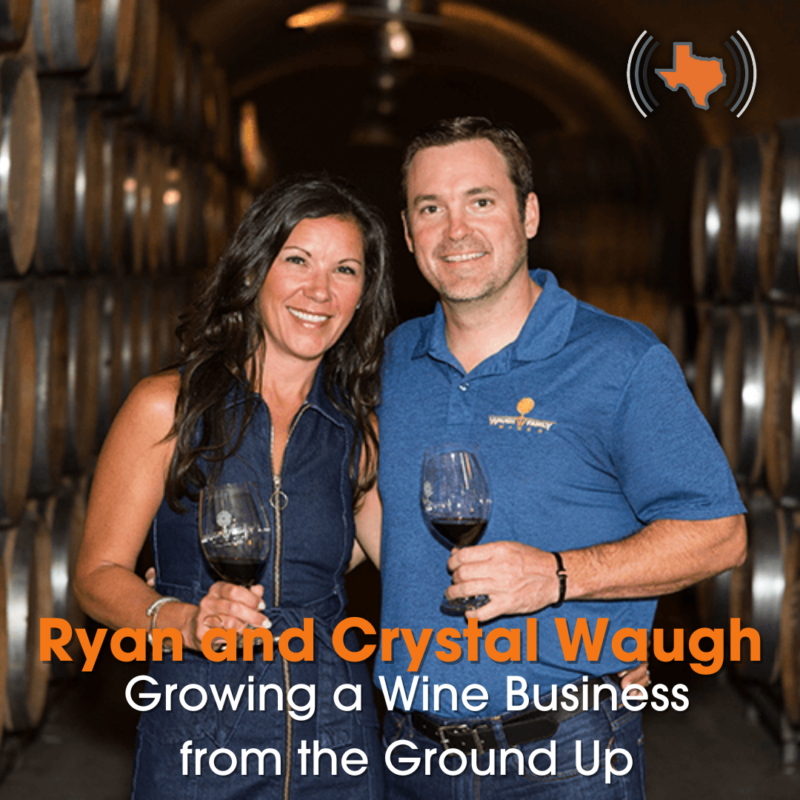
Cheers to our 40th episode! To celebrate we hosted a live event where we talked to Ryan and Crystal Waugh of Waugh Family Wines to share their story about how they started their wine business.

Their inspiration to get into the wine business is not only unique, but one that has a bit of romance attached. Hear Ryan share how meeting Crystal amplified their business to the next level, how Crystal has crafted a unique B2C model, and a few wine tips that you won’t want to miss.

Transcript

Transcripts are generated by machine learning, so typos may be present.

Chris Hanslik: All right. Welcome everybody. Welcome to Building Texas Business Live. So honored tonight; wanted to have all of you here, but especially to have Ryan and Crystal Waugh, good friends of ours, here with us tonight to share their story. We started this podcast a year and a half ago. This is episode 40. Landmark! And so it’s all about hearing the stories of entrepreneurs and business owners. So sit back, enjoy your wine, and we’re going to learn a little bit more about Ryan and Crystal’s story. Thank you both for being here.

Crystal Waugh: Thank you for having us.

Chris Hanslik: Thank you for having us.

Crystal Waugh: We’re thrilled. This is fun.

Chris Hanslik: Yeah. So let’s, I mean, I always start the podcast off asking someone what you’re known for. So that’s, we kind of know what you’re known for. But the other part of that question is what inspired you to get into the business you’re in and yours is pretty unique and special. So Ryan, can you start with what inspired you to be a winemaker and start a winery?

Ryan Waugh: Yeah, well, I brought a special prop. Brought a display. Awesome. So I grew up in rural Oregon, and I got a scholarship to Santa Clara. I wanted to be a doctor, so I was in the biochemistry program there. In my freshman year, I met a girl—not Crystal. We’ll call her Courtney, because that was her name. I met Courtney and her dad, I think, didn’t really know what to do with a young man from Oregon. It was about a week before my 18th birthday and he looked at me on a Saturday afternoon and he said, “Hey, would you like to open up a bottle of wine from the year you were born?” I’ve made it a point in my life to say yes to everything, unless it’s illegal. Thank you for clarifying that. I’ve never done anything illegal.

Chris Hanslik: Did I tell you we were recording this? Yes. Right.

Ryan Waugh: I’m a big yes, right? Because life and experiences, there’s so many things to experience and saying yes just feels better than no. I’ve just done that my whole life. So I said yes to this even though I’d never had wine. My family weren’t big drinkers, and definitely not wine. We went into his cellar and he said, “Pick out a bottle of wine,” and I went over to this case. It was an unfinished cellar, the underneath portion of his house. I went over and just picked out a bottle, and I looked at him and said, “Hey, what do you think of this?” and he goes, “Man, I have no idea. I drink vodka.” I was holding this bottle thinking, what is happening right now? I’m underneath his house and I’ve got this wine. And he goes, “Grab two.” I was like, “OK.” We take two bottles upstairs, we open it, and he starts swirling and he’s smelling it, so I’m awkwardly swirling. Remember the first time you’re swirling? I put my nose in that glass and my whole world changed. In that moment everything went dark. Ted was no longer there. It was like a movie where everything went dark and it was me and this bottle and this glass of wine. It was super infectious to me and I had to figure out what made this. He let me keep the bottle, and from there, I ended up going to work in a vineyard. That was my job during college. My mentor worked at a winery in the Santa Cruz mountains. I remember back then in the 90s, you didn’t have Google, so I had to go through the Yellow Pages wineries. I started at A and I called them all. It wasn’t until I got to S, I got to Savannah-Chanelle, and I dialed that number, and Michael McNeil picked up the phone. I asked him if I could get a job. And he goes, “Oh, yeah, sure. Why don’t you come up here?” He threw me out in a vineyard, and that was 28 harvests ago. So that’s all I’ve done in my career is grow grapes and make wine. I brought that bottle for everybody to see. One of our customers, who are amazing, are our “Fockers.” We call them the Fockers. You get Focked, and you become a Focker. It’s all great, but that stands for “Friends of Waugh Club.” Chris is one. Thank you for clarifying what it was before you said I was one. You’re welcome. Anyway, one of our customers accidentally broke it in 2003, but my beautiful wife put it into a shadow box, and this sits in our house when you walk in; it hangs in our entryway. It’s always a reminder. Every wine you’re ever going to have, every time I grow grapes, every time I taste a grape, every time I do anything in winemaking, I always think about that moment with that wine and try to emulate that in the best way I can. It doesn’t have to just be Cab. When I’m making Pinot or anything, it doesn’t matter, because it’s a feel. Wine is the way it feels on the palate. That’s the fun thing about wine. The cool thing about wine is not the alcohol, right? That’s why we drink spirits. What we really love about wine is all the stuff—the aromas, the color, the flavor, the feel of it. That’s what makes it so amazing and remarkable. But anyway, this is how it started.

Chris Hanslik: And that’s a bottle of Stag’s Leap?

Ryan Waugh: This is a 1976 Stag’s Leap Wine Cellars Cabernet Sauvignon, made by Warren Winiarski. This was the year that there was a very famous tasting in Paris, known as the “Judgment of Paris,” that they put on in 1976. They took the most expensive Chardonnays from Burgundy and the most expensive Bordeauxs from Bordeaux. Then they took the Napa Valley Chard and the Napa Valley Cabs and they did them double-blind. So nobody knew what they were tasting. Both the Chateau Montelena Chardonnay came in first and the 1973 vintage of Stag’s Leap Wine Cellars won that tasting as the best Cabernet in the world. That’s what shot Napa to the moon, and it hasn’t stopped. Which is wild and super inspiring. There you go.

Chris Hanslik: Okay, so that was the inspiration. That’s my baby. How did you get, I mean, so then you have to start a business, right? Oh, thank you. Easy now. Get excited. You start this business, this winery. And I know having in the early days, you then meet Crystal. So tell us maybe a little bit about what it was like to just go on your own to start something from scratch. And then how does Crystal come into the picture? And then maybe you can share, Crystal, a little bit about your role and how y’all… Being in a family business is one thing, but husband and wife working together all day every day is a whole other ball of wax, right?

Ryan Waugh: Well, it’s been 18 years, and I would probably still be the equivalent of a struggling actor or writer in Los Angeles if it wasn’t for Crystal. It was March 5th of 2004. I started out in 2000 making wine in a garage in a house that I was renting in Napa, a real terrible place. It was like termites holding hands. Built in the 50s, it was awful. She only stayed there one time, and then had to move. Anyway, I got asked to do a tasting at the Villagio, which is a very famous hotel in Yountville. I’m making maybe 300 or 400 cases at the time, and they invited me to pour my wine on a Friday night for guests to get exposure. I didn’t have a tasting room, didn’t have a winery. I was just making wine. So I’m there, all set up, and this group of ten girls walk in. They’re super loud and everybody’s going crazy. The bride walks up to me and she says, “Oh, I’m getting married in a couple months and I’ve got all my girls here at a bachelorette party.” I was like, “Oh, sweet.” I’m like, “Hey, Zinfandel!” She comes up for another glass. I’m like, “We’re celebrating!” She comes up for a third glass. I was like, “Wow, she really likes this.” It turns out that she went back to Kathy Tortomasi. She goes back to the group and she wants to come up for a fourth glass, but she’s embarrassed. So she’s asking all her girlfriends, who hasn’t been up there for wine? One of them hadn’t been up there, and she came up and asked for some Zin, and we got married a year later. That’s how I met Crystal Kittle, Crystal Waugh, sweet thing, and 18 years later… it turns out she changed my life in many ways. Most importantly, personally, I was a little lost. I’m a very passionate person, and sometimes you can go off course a little bit. I mean, I am an artist, which means I’m a little crazy. Crystal is not. She is my center. She’s my rock. She’s everything. When I met her, I was selling wine everywhere, doing private tastings and wholesale. I didn’t really have any focus. I just loved growing grapes and making wine. She came in and stabilized everything. We went from 300 to 400 cases to the 3,000 to 4,000 that we are now—almost all direct-to-consumer all because of Crystal. We have a lot of Wine Club members and all of them have Crystal’s cell phone. They all text her. She manages all their accounts. She knows their kids, their cats, their dogs. She is a total badass.

Chris Hanslik: Well, that’s a great segue. I want to talk to the badass now. You should. So Crystal, how bad was it when you stepped in? What, so what were some of the things you did to help organize this business? I mean, and what experiences you had before that, doing that?

Crystal Waugh: Well, I didn’t have any professional wine experience. I had professional happy hour experience, like maybe a lot of y’all do! So I drank wine, loved wine, and obviously went on this Napa trip, but I started my career at Neiman Marcus. I went through their executive training program back in January of 1994, so that dates us a little bit. I did that whole track. I did the buying. I did store management. Then instead of going back into buying, I skipped into HR. I went into recruiting because I love people and interacting. I love selling the company that I worked for and the wonderful programs. That whole customer service aspect was huge. I learned that all of that really transitioned over to what we do with Waugh Family Wines. I graduated from A&M in December of 93 and moved to Dallas. I’m from Houston—I grew up here—but I moved to Dallas for the job. When I met Ryan, I was still with Neiman Marcus. I was there 11 years. Who knows if I would still be there? Things happen. Did anybody ever think I’d move to California? Probably not, but y’all know about the vacation that I took and met him and moved out there. When I did move out there, I originally went to work for Williams-Sonoma, so I had to go find another great company, and I did corporate recruiting for them in San Francisco. It wasn’t until January of 2009… you know, I was the financial stability. As he’s talking about, what we do is crazy. It’s farming and winemaking, and whatever you make, you have to sell if you’re going to live. If you want to grow, obviously you put more into it. It was really nice to have that corporate stability for a while. I did the whole commute back and forth between Napa and San Francisco. That was brutal. I understand the traffic situation! Once I got on board, we started changing our focus. He doesn’t give himself enough credit; he really doesn’t. He had done amazing to this point, but it was mostly wholesale then and we were only maybe 500 cases. We flipped the model together—he gives me all the credit, it’s not all me—but I focused on the direct-to-consumer. Obviously the margins are very different. We had a great base to work with because of what he had already. This was in 2005; he started in 2000. There was a good four to five years of a customer base that Ryan had built. We utilized that and started growing our wine club. To this day, we’re probably 92% direct-to-consumer, primarily wine club, and we do a little bit of wholesale. That’s the main thing that I did. It was really just customer focus. He’s always been interactive with the customers, even before he met me. I gave him the ability to go focus in the vineyard and do what he loves: grow the grapes, manage the vineyards, and make the wine. He’s great at selling it and loves doing tastings, but that’s where he wants to be. I gave him the ability to focus more of his time there to perfect his art while I was managing and working with customers, which I love because I was a recruiter and love people. It just worked out really well.

Chris Hanslik: I love wine and I think most people here do so what y’all do sounds like the coolest job in the world and I’m sure like anything when you do it every day maybe not so much but what was the biggest maybe surprise for you when you stepped into the wine business to go in like oh my gosh oh my gosh I’d say I didn’t you know

Crystal Waugh: What everybody kind of sees is what I saw before too, which is like the sexy part of it. It’s drinking that bottle of wine, having that glass of wine, you know, making memories with people that you’re hanging out with, which is wonderful, and that’s what the end consumer should be doing. That all of the work that goes in behind the scenes, I mean, it is a very physical very demanding, very complicated, very hard, difficult job to be a grape grower and a winemaker. Not all winemakers grow their own grapes. Not all grape growers make wine. But this one does both. So between the two of us, we do everything from literally farming to end consumers. But for me, the biggest surprise was just all that went into it, which there always has to be behind the scenes. You just don’t know what it is. I just didn’t realize how physical it was. Like, you know, your back and your knees and your elbow.

Chris Hanslik: Yeah. So then, you know, thinking about the business itself. I mean, Ryan, what were some of the lessons you learned that going from that kind of artist mentality and all I just want to do is what I, my passion and my love to, I need to have some discipline about some things to actually be able to make money. What were some of the lessons you learned that helped you focus on the making money part so the business could be sustainable?

Ryan Waugh: How do you lose your Not lose. How do you set aside your love and your passion? Like that’s my, I get up in the morning and that’s what I lead with and that’s hard. I mean you can’t be emotional with the numbers. They don’t give anything back to you. You know what I mean?

Chris Hanslik: I mean they feed you.

Ryan Waugh: When you’re looking at P&Ls and balance sheets it’s not like you’re getting any love from them, right? You know what I mean? And so that was really hard but I mean I would say The biggest lesson, and I’m not kidding, I know we’re doing this podcast with our favorite attorney, but I never had one. And I should have had a lawyer. Should have had a good one, but one would have been great. And I failed to… Michael McNeil, who’s my mentor, I got caught up and I’m really good at it. Like, I’m really good at it. And so I just failed. I mean, I just didn’t set things up properly. I didn’t do the right thing for our business. So I’ve been through lots of different partnerships. The one thing I’ve never done, and I’m not sure why, I never put our Wah Family Wines business in jeopardy into anything that we’ve done. We’ve only ever been the owners of it. But I’ve done all these other things early on and failed miserably, like really bad.

Chris Hanslik: So is that picking bad partners?

Ryan Waugh: Yes. And I’m not sure it’s the partners themselves. I had a lot to do with it, too. When you don’t sit down and have the proper agreements in place, it means you probably didn’t have the proper conversations that you needed to have. Right in order to formulate a plan and structure that makes sense I Mean that’s and I’ve done that at least two like epic fails I mean, they’re now funny, and we can laugh about them, Crystal and I, but they were not funny.

Chris Hanslik: It was not fun. Time heals all wounds. But you bring up a couple of good points. We tell clients all the time, if you had this entity you started, it’s not always good to bring in partners. Or even key employees, there’s other ways to incentivize them, but maintain ownership. So you at least did that right in the key part of your business.

Ryan Waugh: I did, and honestly, I don’t know why.

Chris Hanslik: Sometimes lucky. Yeah, luck. A little bit of luck, I think. Whatever. Yeah. The other thing is having that hard conversation up front, because on the beginning of any venture, everyone just gets along. And we see people try to save money on the front end by not hiring a lawyer and just putting it together. And I think the phrase we use up here is if you invest a little bit up front, it’ll save you 10x on the back. Yeah. When things go bad and you did legal Zoom and that agreement doesn’t cover half the stuff that you need, It’s a 10x legal bill. Do you know LegalZoom? Oh, I do. Oh, I do. Close that account like 10 years ago. Boom, no LegalZoom. Crystal, how about you? I mean, you obviously, Crystal, you had a business background, a corporate background, but then you stepped into this kind of effectively a startup family-owned business. What were some of the lessons learned in having to manage and run a small company?

Crystal Waugh: I mean, for me, we obviously have a lot in common, but we are very different. So he’s Mr. Risk Taker, Mr., like, just wants to say yes to everything, and I am very conservative, and I came from a corporate background. So I’m used to structure, and things work in a certain way. And so, I mean, jumping into that was, there was a big learning curve for me, jumping into that, and it was scary, I’ve got to say. We decided it was in 2009, of course, like that’s really kind of a terrible time for me to leave the corporate job, actually, for thinking back on dates now.

Ryan Waugh: Lehman Brothers dies in September of 2008, and she leaves her job in January of 2009.

Crystal Waugh: I mean, what could possibly go wrong? Geniuses. Geniuses right here. That was all about it. What a great idea. What a great idea. So here, Donald took any advice from us, but it just was a… We lost all our stock in Enron, so F it. It’s fine. I don’t know. It was hard for me to take that leap of leaving the corporate world and jumping into this, but I mean, I desperately wanted to be involved in it on a day-to-day basis. I mean, I was kind of involved in it from a distance, but I was in San Francisco all the time and he was in Napa. That’s very difficult. He was in jeans and you were dressing up. Yes, I was dressed up and I sat in traffic for four hours a day. Yeah, he doesn’t have a blazer. We talked about this. There’s no suits. But anyway, it just, yeah, for me, my biggest challenge was kind of adjusting to this. I don’t, the unknown was, I mean, not that you ever really know. I mean, we don’t, none of us know what’s going to happen tomorrow necessarily. I mean, you do in some aspects of your life, but really it’s like the unknown. your financial well-being. I’m not going to say it makes you work harder because I worked just as hard, but for me it was just scary not knowing. I’m also that type A personality. That’s why I was always in the corporate job, which I still love and adore and I’m not in it anymore. I still appreciate that, but I have learned to really appreciate this environment and I think I’ve thrived in it and I definitely think because I’m so conservative and because I had that structured background, that’s what really helped me to ground for us to kind of meet in the middle and him to bring me out of like it doesn’t always have to be like this and this and I’m like, it doesn’t always have to be like just whatever, anything, you know? But that was the most challenging part for me and figuring out how to function successfully in that environment. I don’t know exactly how I did that, to be honest with you. It’s just day to day. You learn as you go. You just survive. You learn day to day.

Ryan Waugh: We have never had a conversation formally about our roles. in the company. We don’t have weekly meetings, or we don’t have meetings about, oh, you’re doing this, you’re doing that. It’s very clear what each of us do, but it just happened organically. I grow grapes, I make wine, I make vodka, I do the whatever, we’re there, and then I step into the sales. But she does all the backend and all the customers and all the, I mean all of that work, all the shipping, all the… I mean, it’s crazy. And we both look at each other. We’re like, I couldn’t do that job. I couldn’t do this job.

Chris Hanslik: I couldn’t do my job. You said what I was thinking. You both played each other’s strengths and allow those strengths to flourish.

Crystal Waugh: Yes. And you just kind of figure it out. Without formally discussing it. Yeah.

Ryan Waugh: So it’s hard to give. It’s wild. And we think about that a lot. We’re like, man, we’re super lucky because we’re with each other all day every day. All the friends are like, how? And I still can’t get enough.

Crystal Waugh: How do you work with your spouse? I don’t know. It just works.

Ryan Waugh: Because you drink wine all day. No. People think that’s what we do, but that’s not right.

Chris Hanslik: OK, so now we’ll talk a little bit about a transition that led to us meeting one another. And that was like so many businesses that we’ve seen over the last couple of years. You’re in California, and you moved to Texas. We’ve had a great fortune to help a lot of companies in that transition. You included. So tell us. What led to that and how is that transition going?

Crystal Waugh: I’ll start with what led to that. First of all, they say you can’t take the Texas out of the girl. And we always come back. It’s a fact. I didn’t know we were coming back, but honestly the conversation started in 2017. If y’all remember, I mean there have been so many fires you might not remember, but the big fire in 2017, which was kind of the first one in Napa, the first big one in Napa since like many years prior. The 80s? Since the 80s, since it really surrounded Napa, jumped a highway, went into Santa Rosa. And I mean, we were affected by it not only as being a part of the community because it was just terrifying, but also the winery facility that we built. The entire property burned down. It was a 42 acre parcel land and the fire actually started. It was called the Atlas Fire, the first one. It was called the Atlas Fire. Yeah. It started on Atlas Peak, which connects to Soda Cannon, which is where we were. And so the entire thing burned. We went up, we were panicking. It was on his birthday in 2017. We went up there the next day. Yeah. Isn’t that crazy? We walked out of dinner and just everyone said, come outside. There’s ash falling. It was like raining, but it was ash and we knew it was bad. So we went up there the next day and it was just so devastating. It’s hard to explain. We literally started our conversations then. I’m like, what would it I don’t know, what would it look like if we moved somewhere else? I mean, the only other somewhere else would be here. So what would it look like if we moved to Texas? And so we started the conversations then. We had lots of in-depth conversations about it in 17, and not even knowing that fire season was now a thing. Like, it wasn’t just an isolated thing in 17. It’s like every year since, there’s something. And it’s all over California, and it’s all over other states as well, with the way things are going, how dry everything is. 18 fires again. I mean, it just, it really has started affecting our quality of life. And also it was very scared from a business standpoint as well. And it still is. I mean, we’re constantly watching that, but we talked about it every year. In 19, we said, let’s bring the kids. We’ve got two boys that are 16 and 13 now. So let’s take the kids to Texas. Let’s go to an A&M game. So we took them to the A&M Alabama game. We took him to the A&M Alabama game in 19 and we were like, okay, so we started talking about actually moving to College Station. We should, we could live here. We had the conversations again, and it wasn’t until 2020 that we said, okay, COVID happened. So a lot of things happened. The fires are the things, is the thing that started the conversation. But then as we started having more conversation and COVID happened, that was a strange, that whole thing was just strange. And we were all cooped up forever. Y’all weren’t cooped up as long as we were, but we were cooped up forever. for like a year and a half. Winery shut down. Your livelihood shut down, all the restaurants, everything was shut down. And then we just started talking about, like, what else is not going great here? Like, okay, the regulations.

Chris Hanslik: How long was that list? Oh, man.

Crystal Waugh: Well, and then you start really digging into it.

Ryan Waugh: At the top was grapes and weather.

Crystal Waugh: Yeah, that’s a good list. Yeah, so then it was that regulations, which you can talk more about, but also school like the state kept taking money away from education and we’ve got two kids that are in school so there were a lot of considerations that we were talking about it wasn’t just the fires but that’s what started it and so then we like we were serious about it at that point we talked about it at nauseam since 17 like literally we had this conversation probably once a quarter I’d say, yeah. So regulations-wise, though, you can kind of just give a tidbit about, in terms of running our business, like not so all this is friendly.

Ryan Waugh: Well, then we were taking a bit, 2020 is a whole new world, right? Like, oh, you can do things remotely. Like, I wasn’t sure our Fokkers would like us living somewhere else. Why are you leaving your vines or the wine or whatever? But it’s a whole new perspective for everybody, the workforce, consumers, whatever. Everybody looks at things a little bit differently. I’m like, I don’t know, maybe we can do this. So we kept the house there, and we moved. Actually, we arrived Christmas day of 2020. The boys and I had never seen the house, nor had we ever been to Magnolia.

Crystal Waugh: That is trust. That is trust.

Ryan Waugh: And we showed up Christmas morning. We’re like, hey, new town, new house. And it was great. And we’d spent that year all the way through the 21 harvest, like, can we do this? Can I do it remotely? Can I be a vacationing winemaker? And it turns out it’s the greatest thing ever. And I should have done it 10 years ago. And I get all the wonderful things that you all love about wine and that I love about growing grapes and making wine. I get all the fun stuff. And I don’t have to deal with any of the negativity that surrounds it out there. Because there’s a lot. I mean, there’s just a lot going on out there. And I don’t have to deal with it anymore. And it turns out, I was a little upset early on, because what I learned really was the vines really don’t need me. I took that personally for a handful of months. And it turns out the wine really doesn’t either. Because once we make the wine, it sits in barrel and does its thing. I don’t go in there all the time. I try not to upset them. I play them music during harvest while they’re aging. And I do all their shit. OK, well, it depends on the varietal.

Crystal Waugh: They’re naked ladies. Definitely naked ladies. Definitely the barrels hear that, for sure.

Ryan Waugh: It’s pretty eclectic, my musical interests. The whole point is what you want is energy to the wine. That’s what we focus on, and it rewards you back. I love it. I love it.

Chris Hanslik: So tell us, what are you doing or how has your business expanded or grown since moving to Texas? What are some of the new opportunities that you’ve taken advantage of? What are some of the ones maybe on the horizon that you see as opportunities?

Ryan Waugh: That’s a great question. It’s been awesome. What we found was that leaving the West Coast and being in Houston, we are remarkably closer to our customer base, physically. So I’ve already done day trips to Miami, day trips to Chicago, day trips to Kansas City, like there and back, seeing Fokker’s and accounts and whatever and things. I’ve seen more people, you know, in the last two years than I did. And let’s take COVID out of it. But even before that, in the previous probably five years, before COVID just because of location and how fast I can get to people.

Crystal Waugh: And it’s awesome.

Ryan Waugh: And then we’re getting back to our sort of grassroots of, because relationships is everything to us. Like our entire business, everything is all relationships. And People that I met 20 years ago 15 years ago Matthew Pridgen We got to who I first met at Mark’s on Westheimer. We all ever went to Mark’s I did a wine dinner for them in 2005 I made their wine from oh five to nine marks What if you ever had a marks bottle of wine I made that stuff I said stuff.

Chris Hanslik: Thank you. That’s a big deal for me. Look at you keeping them in check. She’s a professor. She has to do this with college students all day. Makes sense now, doesn’t it?

Ryan Waugh: Totally does. Totally does. So we’ve been doing, we’ve been reconnecting with people. We’ve been doing a lot more, a little bit more wholesale. We’re lots of different opportunities. People want to do tastings and they want to do things with the wine and they want you to, I mean, it’s fun. I got to, I met Avery over there. I went to a W set class. I couldn’t do that in Napa when I’m there doing everything that we’re doing. So, you know, there’s all sorts of… cool opportunities and stuff. I’m doing private label things for all sorts of different groups and restaurants and whatnot.

Chris Hanslik: So that’s all great. I know you’ve also expanded out of wine into vodkas. Tell us just briefly about the vodka, Snap Vodka. You see he said briefly. Briefly and keep it clean.

Crystal Waugh: Never mind, just tell us briefly. Just tell them how you make the spirit.

Ryan Waugh: Crystal owns a distillery called Texas Ferments. It’s in College Station. She owns a winery and a distillery on the same piece of property. She was able to get the permits, get two buildings built, and start. I do all the formulations for her vodka. It took six months to do that. In nine months, we were able to accomplish what took 15 years in California, and I am not kidding you, millions of dollars. Nine months and $50 grand. I’m not kidding you. Because we were in Texas. That’s the calculus.

Chris Hanslik: Yes.

Ryan Waugh: I know. We have the same rights, the same everything as you would have in California, but in College Station it was $50 grand compared to $2 million. It’s ridiculous. They stay out of our way. I just file the monthly reports. I’ve never even seen a building official. I submit my stuff and that’s it.

Chris Hanslik: If there’s no better commercial for it that Texas is business friendly, that’s it.

Ryan Waugh: It’s ridiculous. They stay out of our way. I just file the monthly reports and whatever. I’ve never even seen a building official. I’ve never even seen one. I submit my stuff and… You go to anybody in trouble. I know, invite anybody.

Chris Hanslik: Mine was COVID, so they were doing things through… I hope the Billy inspectors in Bradford County don’t lose their job for that. Are there any here?

Crystal Waugh: I’m not the one that didn’t show up. But they might listen, I don’t know. Yeah, Eddie, we’re just gonna… So good.

Chris Hanslik: And if any of y’all took part in the drink we had tonight, in addition to the wine, there was a Snap vodka. drink there. So hopefully we can start getting it here in Houston soon. I know you’re working on that.

Ryan Waugh: Oh, yeah. You can get it at Moxie’s. You can get it at B&B Butchers. I’ll go through the whole list of where you can get the wine and the vodka.

Chris Hanslik: You can get it at Spex on Smith Street.

Ryan Waugh: Yeah, Spex downtown.

Chris Hanslik: Yeah, downtown. You can. So another great story to tell, I think, because you two obviously are proud, successful entrepreneurs. It clearly rubbed off in your offspring because One of your kids, at least, is an entrepreneur now, Carter. Tell us a little about Carter’s venture because we’ve helped him too with his flip crits. So give us a little quick vignette about what that is and where they can be found.

Ryan Waugh: In 2017, Carter was eight years old and we were on a vacation and he came to me with an idea and he said, Daddy, I hate my crocs and I hate my flip-flops. I’d like to make a flip crit. And I said, what? His nickname is crit or critter, crit for short. And I said, well, you got to put together a business plan, buddy. And he goes, what’s the business plan? And I said, well, you got to write the reasons why. Why are you going into business? And then who, what, where, when, blah, blah, blah. You got to write down, how are you going to make money? Like, what is this thing about? What are you doing? Anyway, he went and did this three page little business plan. Hilarious. But there was a lot of substance in there. And I sent it off to, I’d learned a lot of things, and I sent it off to our IP lawyer.

Chris Hanslik: And his name is Chris. Yes, different Chris. It was really wild.

Ryan Waugh: And Chris came back two days later, and he’s like, you’re not going to believe this, but I think your son could get a utility patent on the design of his shoe. And I said, what? And he goes, yeah, not only that, he’s created some words that have never been created before. So we could protect those. And I was like, yeah, do that. And so Kritz was born. Carter owns the word adventurability. He owns sugar foam. He owns all sorts of stuff. And he has a utility patent on the chute. Anyway, Yada, he sells in Nordstrom. You go to crit. Yeah. If you Google crits, you’ll see the first thing that comes up.

Crystal Waugh: Nordstrom comes up first.

Ryan Waugh: It’s crits.com.

Crystal Waugh: Yeah, crits.com.

Ryan Waugh: Anyway, he’s a cool little dude, and you’ll see his videos and all his stuff.

Crystal Waugh: He’s 13 now.

Ryan Waugh: He’s awesome. We are in, and in all fairness, what we’re trying to do is onshore all of, all of Kritz because we kind of got crushed in. His design is a cement construction, so it’s pieced together, lots of different layers and pieces. Vibram outsole to, you know, all the different pieces. His EVA foam is made out of sugar cane. by-product sugar production out of Brazil. But all those materials went to southern China and we actually went over there twice to the factories and Carter worked with everybody and his designers and everybody that helped him, all his mentors are here in the U.S. And we’re bringing it back to the states and working on the new round of crits that’ll be coming out. Because our wine and the vodka, we now, everything we do is made in the U.S.A. Everything except the cork. Because we don’t grow any cork trees in the U.S. So the amaranth is our supplier and they’re incredible, but we got to get the corks from Portugal. But everything else, all the glass, all the, I mean, everything that we do all comes from the U.S. now. That’s great. Yeah.

Chris Hanslik: All right. That’s amazing stories. So we’re going to get a little bit fun and kind of try to wrap it. It hasn’t been fun already? I got long faces. It just goes by so fast. I know. So I want to know from both of you, what was your first job?

Crystal Waugh: Like ever. Oh, ice cream. I scooped ice cream on Dairy Ashford. Baskin Robbins? No, it was called Yogurt and Cream. Was that Westheimer or Breyer Forrest? Anyway, it was one of those. And I was 15. I don’t know if that was legal.

Chris Hanslik: Back then it was. I don’t know.

Ryan Waugh: Anyway, $4 an hour was great. Newberg Pizza Parlor in tiny little Newberg, Oregon. I was a dishwasher and I cleaned the restaurant.

Crystal Waugh: He’s really still good at dishwashing.

Ryan Waugh: I am. It’s actually, it’s cathartic for me. I do love cleaning. It’s part of, if you make really good alcohol, you tend to clean things really well. Be careful.

Chris Hanslik: Really clean. And always be very clean. Very sanitary. Nothing else about the night.

Ryan Waugh: OK. Takes a lot of beer to make great wine. It’s important.

Chris Hanslik: All right, Crystal, since you’re the native Texan, Tex-Mex or barbecue?

Crystal Waugh: Oh, Tex-Mex. Queso.

Chris Hanslik: Tex-Mex. Queso.

Crystal Waugh: Nobody knows what Queso is in California. It was very difficult for us. How’d you live that long? I made my own.

Chris Hanslik: Yes, you made your own.

Crystal Waugh: I had customers bringing it in for me. They did, like on dry ice. Back in the day. Back in the day.

Chris Hanslik: But you could do that.

Crystal Waugh: I know, it was desperate times.

Chris Hanslik: Where’s your favorite Queso then?

Crystal Waugh: Oh man, oh gosh, you can’t ask me that right now, because, oof. Okay. Okay, I can’t, I don’t know.

Chris Hanslik: Do you want to embarrass anybody?

Crystal Waugh: Yeah, I don’t know, there’s a lot of, yeah.

Chris Hanslik: Okay, all right, so now let’s do some wine education. So I brought a prop. In a pocket. In my pocket.

Crystal Waugh: So, the cork. Okay. Yes.

Chris Hanslik: Okay, lots of questions about the cork. Do you smell it or not, or does it really matter?

Ryan Waugh: You absolutely can, I do.

Chris Hanslik: What do you learn from it by doing that?

Ryan Waugh: There’s really just one thing I’m looking for. So there is a compound called trichlorine anisole We all know it as TCA if you’ve ever heard of this or if you’ve ever heard the term the wine is corked Okay, so there is a There’s a compound founded nature. You can also get it if you use any bleach Materials in your winery don’t ever do that Or your distillery. Don’t ever, no bleach. But it’s something that can be found in nature, and it’s found in cleaning products, bleach. And if it is inside the cork. And you put that into the wine. When it connects with the wine, it will turn your wine into what smells like a dirty, disgusting dog. Or wet moldy wool. Or just like nasty. And we call that TCA or corked. So if you get a hint of it, that’s why they open up a bottle at the table and then pour a little bit for you. It’s not whether or not you like it. Listen, you bought that. Just because you don’t like the wine, you can’t send that back. If it has a flaw in it, if this TCA is in there and it’s off, then you’re going to know, because it’s nasty. You smell it. Well, it can be faint at times. It’s not faint if you smell the end of that cork. If you put the end of that cork up there, you’re going to know. Sometimes I’ll just grab the cork and smell it and be like, yeah. Now, there’s anywhere between 2% to 5% of all wines are corked with TCA, and that’s coming down every year because we’re doing different things. Like, we were one of the very first wineries to get into ND Tech corks. So this came out of technology from the Ameremes. This is awesome. We pay for this. Every single cork goes through a machine that locks it into a chamber, and then It sucks out all of the air and the cork expands and then this machine just analyzes every single square inch of that cork and tells you whether or not it has any TCA. And then it comes out and they print it on the cork. It has an identifier so that if you buy a $125 bottle of Wacab and we sell it to you, you open it up and you’re like, whoa, that’s corked. AMREM reimburses, we send you a new bottle, which is great, but they reimburse us for the total value of the bottle of wine. So that’s called insurance. Which I also learned. was really good to have.

Chris Hanslik: Yeah. OK. So that’s it. I mean, what can you learn from maybe the how much red or?

Ryan Waugh: Yes. That tells you right there that if the wine has not bled through the cork, that means it has been stored in the proper temperature. Right? So if the cork has any flaws in it whatsoever, and you put that wine direct sunlight, or you put it in any temperature that’s going to rise, the wine will go straight up that cork, patholysis resistance, just like water. And so you’ve got to look at that. Is the cork compromised there? That could probably tell you more than likely it was sitting in a temperature that it didn’t enjoy.

Crystal Waugh: It’s not hot here, though. I don’t know why that would happen.

Ryan Waugh: It could be on the, don’t leave it on the top of your refrigerator. You know, I mean, there’s, you know, wine likes to be, I’d say it’s got to be under 70 degrees. I’m not telling it’s got to be 55 degrees. You don’t have to get a fancy cellar. You don’t have to do whatever you want to do. You can put it in a closet. A lot of us have a closet that never reaches 70 degrees or whatever. If you want to do that, I’m not going to tell you, you’ve got to build some fancy thing. But temperature fluctuation will destroy your wine. It doesn’t like to just go up and down. And too hot, wine will push right through the cork, and that’s what you’ll see. Gotcha.

Chris Hanslik: Very good. OK. Another question. Legs. Yes.

Ryan Waugh: Right? We’re still filming. I know. Oh, sorry. I’m not close enough to her. I don’t like this.

Chris Hanslik: What does that tell us? Yeah, easy.

Ryan Waugh: We’re still filming. I know. I’m so close. Oh, sorry. I’m not close enough to her. I don’t like this.

Chris Hanslik: You are fine. Tell us what we can learn about legs and wine.

Ryan Waugh: OK. So legs are funny. They are not the indicator of quality. The biggest myth is that people look at the legs and then they determine the quality of the wine. Just don’t do that. It’s very embarrassing. If you’re going to do that, do it with other novices. Do not do it in front of any winemaker. You can do it in front of some Somms, because they don’t know either! Totally kidding. What it’s really going to tell you—the reason we use them—is to try to determine, if we’re doing a blind tasting, something about the wine. The width of the legs and how fast they run is going to tell you how much alcohol and potentially how much sugar is inside of the wine, which will then tell you something about whether it is Cab, Pinot, Merlot, whatever. If they’re real thin and they run real fast, it’s likely high alcohol. If they stick to the side of the glass, it probably has something in there that could potentially be not natural, like an additive or added sugar. There’s lots of different things that people add to wine. We do not. We don’t use pesticides. We don’t use herbicides. We don’t irrigate. We are naturalist. There are more things we don’t put in the wine than we actually do put in the wine now. But that’s all it’s going to tell you: how much alcohol is in there and potentially sugar content. Then you use it if you’re trying to identify it in a blind tasting. Otherwise, don’t. “Look at the legs on that, it’s such a great wine.”

Crystal Waugh: I hear that a lot, actually. I do hear that a lot.

Chris Hanslik: Okay, so then, lastly, since we’re in Houston, where around here can we find your wines?

Ryan Waugh: Our wine, yes. We don’t do any retail, so I’m sorry about that, but I brought my handy list so we didn’t forget any of our partners.

Chris Hanslik: Well, in addition to the, I guess, QR codes where you could go to their website and sign up to be a Fokker.

Crystal Waugh: That’s correct.

Ryan Waugh: Yes, you are a Fokker and get Focked. You have access to everything.

Crystal Waugh: And we have fun in case y’all didn’t notice.

Ryan Waugh: Yeah, it’s pretty fun.

Crystal Waugh: Just a little bit.

Ryan Waugh: So you can go to some of our favorite places. B&B Butchers, you can get Crystal Bubbles by the Glass at B&B. It’s kind of cool. Uchiko, that just opened. Moxies, we’re the only Zinfandel by the Glass at Moxies. We’re also the only Cabernet Franc on the list at Moxies. You can also get the Snap at Moxies. They have a new Gingerbread Snap for the holidays that’s launching at November 16th. Super cool. Bricks Wine Cellars up in Vintage Park off at 249 has three or four of our wines. Woodlands Country Club, Carlton Woods Country Club, I think they have six of our wines at Carlton Woods. Red Flame up in Magnolia, that’s our cheers, that’s where we hang out. Rail and Rye and Nava Soda, 1860 up in College Station, Texas A&M Hotel and Conference Center now has our wine, and the vodka up in College Station, Ocean Prime in Dallas, there’s three Moxie’s locations in and around Dallas up there, and Dallas Petroleum Club if you happen to go up there. They pour our wines by the glass. The pinot by the glass. And then they have our cab, which is kind of cool. And then the vodka specs, we said, our liquors up in Cypress and Spring, they have three locations, Tasting Point in Magnolia, Captain Brad’s off at 249, they’re awesome. You should go see them.

Crystal Waugh: And then our house. Yes, and then our house. My cards are out there, y’all can just let me know.

Chris Hanslik: And Boyar Miller. Yes, and Boyar Miller. They’re socks now. And Chris’s house. So yes, we have a good stash in our server room which doubles as a wine cellar. It’s the right temperature. I just want to thank the two of you for agreeing to do this and coming to share your story. This has been amazing so far.

Ryan Waugh: Thank you. Well, I appreciate you. Thanks for having us. And thank you all for coming. We got to meet Steve and Jett and Mr. Miller. This has been really awesome. And got to network with such cool people. And appreciate you all welcoming Crystal back.

Crystal Waugh: Yes, thank you.

Ryan Waugh: And letting me tag along.

Crystal Waugh: He’s like an honorary Texan. There you go. There you go. We just got to get back in the booth.

Chris Hanslik: I appreciate you. So we have time for maybe a question or two from the audience. If anyone has a question. If you do have a question, go to the back. We have a microphone so we can hear it. But if not, oh, we do. There is a question. OK, here we go.

Ryan Waugh: Now I’m nervous. No, you’re not. You should be concerned.

Crystal Waugh: I saw her double-fisting earlier. Now you should really stick it to him. Sure.

Chris Hanslik: No shame in double-fisting. We are a firm of hospitality. You hear a lot about vintages and the year of the fires got a lot of attention and you don’t want to buy a 17 because the grapes smell like ash or whatever. What can you tell us about your wines and vintages and are you blending through so that you’re not catching the off years or how are you managing the weather around vintages? It’s a really good question. It’s a great question. Yeah, see? Yeah.

Crystal Waugh: Awesome.

Chris Hanslik: You should, but listen to the answer first.

Ryan Waugh: That’s so good. That’s a great question. I’ll specifically talk about the first part of that question, which is the smoke taint. And in 17, this is, again, a major myth, right? So it was a very warm year, much like this past year. The fire started on October 8 in 2017. 90% of all the Nifura vines and the fruit that comes off of them, all the stuff we drink, had all been harvested 90% prior to October 8. No issue with 2017, zero. No real issue in 18. Didn’t really have an issue in 19 because all the stuff happened late. It wasn’t until 2020 hit. And the irony of that was Napa and Sonoma itself never had any fires in 20. It was while the fruit was on the vine. It was all coming from outside the counties, different states.

Chris Hanslik: It could be two hours away, three hours away.

Ryan Waugh: But the way the weather patterns were going in the air came in and it dropped the smoke. right down to the ground. And what happens at, once vorazion, so vorazion is a term everybody probably has heard, but all it means is that’s the time in August where the grapes turn color, but the skins like thin, like they thin down to a millimeter and a half. And if you get smoke down right in there, it just sits. Then it can incorporate itself. These smoke compounds can incorporate themselves into the skins of the grapes. That you got to be. And so in 2020, we did not bottle A1. Nothing. 3,000 to 4,000 cases a year, nothing. A whole vintage just lost. And you panic a little bit. Our lawyers are great. Our CPA is really good. And you figure out how to get through that. But I guess this kind of goes back to how we manage vineyards. So there’s two different ways to manage a vineyard. You can manage it to your business plan. Or you can manage it to its natural balance and equilibrium. And that’s what we do. I’m not saying one’s better than the other. If you want to make consistently high quality, like really high quality wine, You can’t manage the vineyards to your business plan. And what I mean by that is, like, your distributors in Florida and New York and Illinois and California and Texas are telling you, I need X, Y, and Z cases. And you’re like, oh, OK, well, so the vineyard needs to produce this. But the vineyard doesn’t want to produce that here. So then you make it. And this is the cool thing about vinifera varietals. They are so amazing. You can essentially make them do whatever you want. You can produce as much fruit, you can produce as little, you can manipulate the hell out of them. And they will allow it. And it’s pretty remarkable. What we do, my dad said, you’ve got to have the testicular fortitude to stick to whatever your plan is. So you’ve got to grow a pair. And you’ve got to maintain some balance. And so what that means is, when the vines wake up in the spring, they want to push a certain amount of fruit. It might not be the quantity that you want. But if you let it go, you’re going to make consistent quality wine. But the problem is your production goes like this. And the wholesale market doesn’t like that. Direct-to-consumer market loves it. Because in the worst vintages ever, 2011, right? Everybody bashed it. In my entire career, 2011 was the worst by all the writers. The worst thing ever. And yeah, we were supposed to make 2,500 cases that year, and we made 800. How do you survive? Well, you’re selling all of that direct-to-consumer. And you work it out. And the quality just stays. And so when your customers, when you constantly deliver every year and you constantly deliver, they notice. And we always put the case production on the back of every bottle so they see it. Oh, this one was $275. It must have been a great year. This one, $98. Oh, geez. But when they open it, they’re like, oh, yeah. Wah. So you’re not sacrificing quality. So two different ways. You just have to figure out what your business plan is. Ours is consistent quality.

Crystal Waugh: How many people do you think, I mean, this is ridiculous because you don’t know this, but I mean, just in general, there’s a lot of 20s, 20 vintages that are out there. Should they be concerned, do you think? I mean, what’s the deal with that? They might taste OK, but they might have some compounds in them.

Ryan Waugh: Yeah, because it’s not everywhere. Napa and Sonoma took a beating. It really did. Now Napa and Sonoma, if we put this in perspective, just in California wine production, Napa and Sonoma is 4%. 4% of the entire state is both of them combined. That’s astounding. It’s very small. So it’s nothing to totally be concerned about. Plus, UC Davis gave us a bunch of protocols that you could use to try to mitigate the impact from the smoke particles and the taint. It’s just, I think you’re fine. If you find one, I trust my industry, even the high-producing volume producers. I trust them because that stuff is very hard to do. I might bash a certain producer because I don’t drink their style. I don’t like that. But I won’t bash them for their business. It’s very hard to make millions of cases of things even taste good, and let alone do it, make it the same every year and do that. It’s very hard. Just as hard to make our wine as it is to make a million cases of something. So lots of respect for this industry. And I really don’t think they’re going to put something out there. That’d be an outlier. if somebody pushed something that was just really garbage.

Chris Hanslik: Good question. One more. I am the wife and mother of three Aggies, and one of whom is named Ryan. Welcome to the great state of Texas. My question is, as you know, there are many Texas wineries, including one that shall remain unnamed in Bryan College Station. Have you ever thought about growing grapes in the great state of Texas, and how do you feel about the soil conditions, et cetera?

Ryan Waugh: Great question. For the winery that will be unnamed, I am meeting Paul next week.

Chris Hanslik: In your question, you bring up something that’s a really good point because soil is probably the thing I think about least.

Ryan Waugh: Because vines, these things are, I mean, just straight up magical to start. They do not need, when we all think of farming, we think of like… really rich soil and you’re thinking you know stuff you dirt you can get your hands on you do all that but the irony is some of the greatest vineyards in the world have no soil whatsoever right they’re in all types of rock or clay or nasty stuff i mean just things that you like walk through and you’re like what i mean if you ever walk through parts of northern burgundy or right bank left bank bordeaux or you know all sorts of parts of nappa I mean, Napa Head, the cool thing about Napa is every single soil type that you and any soil engineers in here, you’re probably going to know this, every single soil type that exists on this planet is found in Napa and Sonoma. Every single one. It’s a phenomenal place, but it’s not a rich, soily thing. You know, the climate and the weather, super important. And then on top of that, when you get certain weather events is what is really impactful. People always ask me, what makes Napa and Sonoma? And all these random places where the greatest wines in the world, they’re just a very small percentage of our land mass in the world, where you make the greatest wines. And they get what you’re supposed to get when you’re supposed to get it to grow these things. So then transitioning to Texas, that doesn’t happen here. OK, now with that being said, These vines are awesome. So if you go up to the Panhandle, because most of the great wines in Texas are not grown in Fredericksburg. That’s where we go to enjoy and we go to see the wineries and drink the stuff. But the stuff that wins the awards in Texas. Because we’re the fourth largest producer of wine in the US.

Chris Hanslik: It’s a big deal.

Ryan Waugh: All of those vineyards are up in the Panhandle. They’re all up near Oklahoma. I mean, almost all of them. I mean, all use spectacular for what they are, right? But you want to just be yourself, right? It’s never going to be any other region, right? New Mexico has become one of the hotbeds of the greatest sparkling productions in the United States. things are evolving and it’ll change and you don’t become the fourth largest producer in the U.S. because you just make crappy stuff all the time, right? So it’s gonna get better and better.

Chris Hanslik: So what you’re saying is you can’t make California wine in Texas, right? I can’t.

Crystal Waugh: Not yet.

Chris Hanslik: It’s different.

Crystal Waugh: But he appreciates all wines for what they are, where they came from and how they’re made and

Chris Hanslik: Very good. All right. So we are going to wrap this up. If you want to have additional questions with Ryan or Crystal, the bar is still going to be open back in the lounge. Before we do that, we did have a raffle. So we have winners of the raffle. Okay. So we had a vodka, snap vodka basket. That goes to Chasity Cooper. By the way, you had to subscribe to the podcast to be registered for the raffle. You can still register, subscribe to the podcast. I would encourage you to please do that. There’s QR codes at the tables around you. Please listen. As I said, this is the 40th episode. We have tons of great episodes to listen to, tons more on the way. Second raffle item goes to Sharon Scott. Look at that. That was wine. That was wall wine. That’s wine. Oh my gosh. How fun. Keep in mind on the way out we have wine tumblers. Please take one and enjoy wine in that. And then I want to thank my amazing team who put this whole thing together.

Crystal Waugh: Oh yeah, they are amazing.

Chris Hanslik: Josie Morgan. Drew Carpenter. and Jimmy Johnson. They helped set this whole thing up as well as our friends at Savage Brand. So thank you for all you do. The first time we’ve done this here and it won’t be the last. This setup is amazing. So if you can subscribe, as I said, and write a review of the podcast, we’d appreciate that. So I’ll see you all at the bar. It’s still open. Thank you all for coming. And there we have it, another great episode. Don’t forget to check out the show notes at Boyarmiller.com forward slash podcast. And you can find out more about all the ways our firm can help you at Boyarmiller.com. That’s it for this episode. Have a great week and we’ll talk to you next time.

We provide clarity for complex problems.

With a deep understanding of your business alongside clear and honest communication, we help clients face challenges fearlessly.


Learn more about our services and how we help clients.