


With a deep understanding of your business alongside clear and honest communication, we help clients face challenges fearlessly.
Learn more about our services and how we help clients.



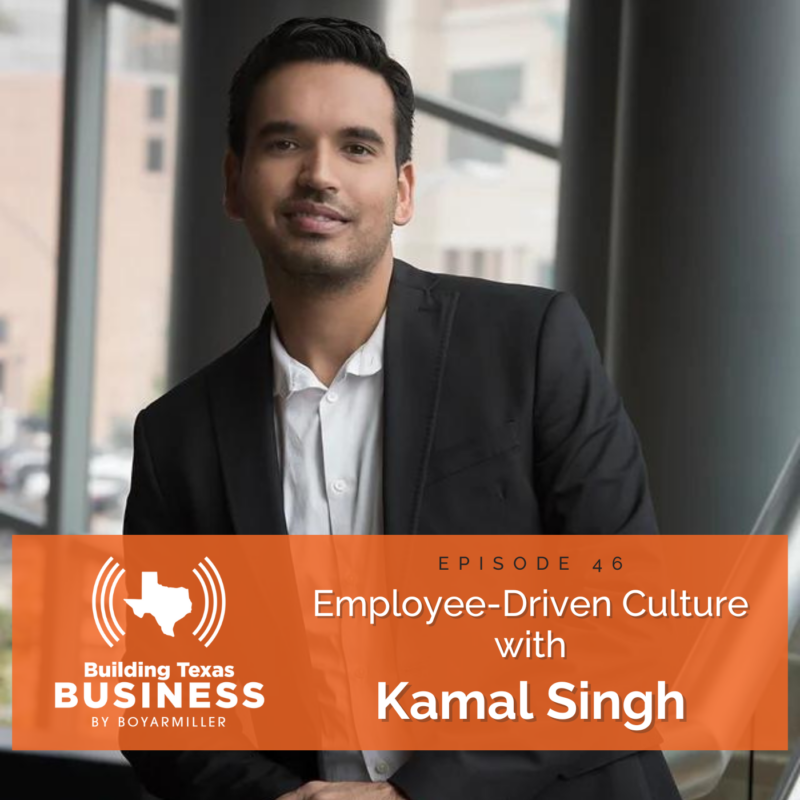
Kamal Singh, CEO of Emerge! Inc., joins the Building Texas Business podcast. He shares how he bought his first restaurant in 2009 using his savings and how that helped him scale to his next buy-out. His main focus was businesses he could scale – through franchising young brands, and turning that business around without capital.
Hear how he has grown Emerge! into 130+ stores in four states with over 5,000 employees by focusing on being an employee driven company that provides inspiration and autonomy to its people.
Transcripts are generated by machine learning, so typos may be present.
Chris Hanslik: In this episode, you will meet Kamal Singh, CEO of Emerge. Kamal immigrated from India in 1999 and 10 years later bought his first restaurant. You will learn how he has grown Emerge into 150 stores in four states with over 6,000 employees by focusing on being an employee-driven company that provides inspiration and autonomy to its people. Kabal, I want to thank you for agreeing to come on the podcast. It’s great having you.
Kamal Singh: Thank you, Chris. I’m honored. Thank you for having me.
Chris Hanslik: So you’re the CEO of Emerge. And I want to start by just having you tell our audience what is Emerge known for.
Kamal Singh: Yeah, so founded in 2009, we are in the quick service restaurant space. We own and operate close to 150 restaurants. We are in Texas, Arizona, and we just did another acquisition and now we’re also in New Mexico and Colorado. We operate brands such as Taco Bell, KFC, Pizza Hut, and Sony Drive-In.
Chris Hanslik: Well, what was your inspiration for getting into this kind of fast service restaurant?
Kamal Singh: You know, it wasn’t particularly getting into the restaurant space. I think it has a lot to do with my upbringing, just a typical immigrant story. We moved to U.S. in 1999 from India. I went to high school here. I went to Jersey Village High School, north side of town. I’m a historian through and through. I went to University of Houston, 09, graduated with bachelor’s in accounting. And pretty quickly, I found out that I just didn’t want to do the corporate grind. I wanted freedom. I wanted to do something on my own. And I just want to tell you a quick story. This is when I was working at Deloitte and Touche. I did audit work for them. And one of my college buddies, he knew I wanted to go out and do my own business. And he shared an email with me there’s about seven lenny sub shop that were going in bankruptcy this is back in oh eight oh nine during the financial crisis. And he knew i was looking to do my own thing and he forwarded this email and basically with seven franchises that were up for sale here in the surround in the houston and surrounding areas. And he said, hey, man, give him a call and see if you can pick up a franchise or two. And I made the call to the franchisor. And luckily, they said, look, if you pay us the $25,000 franchise fee, you can have one restaurant. And this restaurant is off of 59 in Chimney Rock. So I had some college savings saved up through internship and throughout college. So I bought my first restaurant in 2009 with the savings that I had $25,000. I did it well. Looking back at it now, it wasn’t probably a good deal. You’re talking about the restaurant was losing six figures. I signed a personal guarantee. As you know, you don’t do that in our business. Lease liability on top of that, long-term lease liability. But sometimes when you don’t know, you don’t know.
Chris Hanslik: As I said, sometimes it’s better, right? You just need to work hard and you knew you had to make it work.
Kamal Singh: I didn’t have that checklist that we have now of due diligence, the checklist that we go through. So I jumped right in into that one restaurant. I made it work. I remember the first couple of weeks, all I had was the $25,000. I didn’t have any working capital. Remember, you know, you’ve got to pay the food vendors. You’ve got to pay the employees in the first couple of weeks’ biweekly paycheck. In our business, the important costs are your food and your labor. Food is what it is. You can manage it here and there. Labor is where you can save on. I remember for months I worked open to close just to try to save on labor. I would open the restaurant myself and I would bring people on for lunch because lunch was our busier day part because it’s a sandwich sandwich business. And then I would close a restaurant myself just to save on labor. That’s kind of how I put the working capital together. And then, you know, about 18 months later, there was another franchisee in the same brand Lenny’s that was that was struggling. Got the opportunity to buy him out at a decent price. So until about 2009 to about 2015, I did a lot of smaller concepts. I did Auntie Anne’s, Baskin Robbins, Cinnabon, Nestle, Toll House. And Target, my target sellers were franchises that would just buy these businesses for their spouses or franchises that weren’t really involved in day-to-day operations. And then they weren’t really doing well. They didn’t know what they got themselves into. I would get in, turn the business around, I would buy a cent on a dollar, and then flip it for a high multiple. That’s how I sort of put my capital together to get into the bigger brands. But Chris, the goal always was to get into the top tier brands, which is Inspire Brands, Sonic, and the young brands. KFC, Taco Bell, Pizza Head, because you can scale, right? It’s a business. You can scale these businesses versus the smaller brands. It’s more about cash flow. You can only scale it to a certain level. It’s harder to grow with those brands. It’s hard to get them financed. Those brands are really hard to get financed, right? There’s only SBA loans you can get on those brands. So in 2015, I finally got the opportunity to become a franchisee of KFC and Taco Bells in the Louisiana market. You know, again, that was a turning around story. Had to get into those restaurants, really work hard at them, create equity in that business. That was my first business that I did with the SBA loan as well. I didn’t really have the capital to go out there and do non-traditional financing. So did well there, made my name in that and within Young Brands turning that business around. And then worked my way back here in Houston, bought another franchisee, another nine restaurants of KFC and Taco Bells. And that acquisition was special. Anytime you can own restaurants in your hometown, that’s just special. You can go out and visit those. You can touch the restaurants. You can touch the assets. You can meet the teams, right? You can inspire people. And then from there on out, I won’t bore you with the entire story. We ended last year almost close to 150 restaurants, like I mentioned, four different states. And I think we’ll probably hit a couple hundred restaurant count by the end of 2023. And I’m real proud of our history, what we’ve accomplished in a short amount of time. And you know, we’ve done it without Outside Capital. It’s very hard to do this in the span of seven to eight years without Outside Capital. I’m real excited about the teams that we’ve built, the camaraderie that we’ve got. I’m super excited about what the future holds for Emerge.
Chris Hanslik: That’s great. Lots of things that you shared that kind of love in that story. So one, You show up with your family from India in 1999 and 10 years later you own your own deli. You couldn’t have foretold that in 99 that in 10 years you’d be there. That’s pretty cool just in itself. Second, I get this two-fold inspiration, this itch to want to be your own boss and have the flexibility and freedom to maybe own and grow your own thing. You also mentioned you had that bigger goal of working your way up to get into the bigger brands. We’re gonna ask you, so you got stores through four different states. How many employees are we talking?
Kamal Singh: We’re talking about north of 6,000 now. And when we started the business, this is not the way the book was written. And I want to step back to something else I want to share. There was one particular restaurant. This is a KFC Taco Bell off of Beltway and West Road. When we moved to US, we had one vehicle. Everybody worked odd jobs. And I have vivid memory of dropping my sister. My mom or my dad would drop her off, and we would pick her up. And she worked at the KFC Taco Bell. Well, Chris, today I’m the franchisee of that restaurant. I own that restaurant, man. That was probably one of my proudest moments when I got to buy that restaurant. I took a picture in front of the restaurant. I sent it to my sister. And when I got to visit that restaurant the first time as an owner, I went back to the house, and I usually get along, I speak to everyone when I go back to the house or the restaurant, I spoke to the manager, I was talking to one of the cooks, and the cook had been there, and this is, I bought the restaurant in 2017, and the time period that I’m talking about when my sister worked at that restaurant, this is 2001, 2002, the cook had been there since that time. I don’t know if she exactly remembered who she was, but that was probably one of my proudest moments that I remember coming to this restaurant. I remember my sister used to get an allowance of $5. at the end of the shift and she would bring food home with that $5 and we used to eat, I remember, whatever meal that was. So yeah, it’s just one of my proudest memories.
Chris Hanslik: That’s a great story. So let’s go back. There’s got to be some Lessons you learn you spend your 25,000 college savings and you start running a business Looking back now. It’s like what would you tell someone that you know kind of takes that big leap of faith? Be ready for this, you know that what’s the unknown or the unexpected? What was that kind of takeaway that you now carry with you and try to pass on?
Kamal Singh: Yeah, I think being an entrepreneur, you got to take the challenges, right? It doesn’t come easy. You’re going to make mistakes. You know, one of the things as I look back early in my career, I think I probably wasted about three to four years. I think as entrepreneurs, when you want to get in, you always want to shoot for the stars, right? You want to get there faster. But there’s just no magic pill. You’ve got to put in your time. I’ll give you a real life example. It took me about almost Seven eighty years to get into the top tier brands and remember i used to go to a lot of the conferences i wanted to get into these want to get into pizza at kfc taco bell. And what i didn’t understand was that there’s a lot of competition around right it’s hard to get into these brands. Do you need X net worth? Do you need X experience? Why would somebody let me be part of these big brands when I’ve got one Lenny sub shop or two Auntie Anne’s? So I think it’s something that I could share with an entrepreneur is get a seat on the table, right? Instead of trying to reach for the moon, get a seat on the table, prove yourself, and then work your way from there. Be persistent, be determined. And that’s just something that I think I sort of wasted my time, you know, spending about three to four years of just
Chris Hanslik: Chasing out for these big brands when I could have just focused on the other things, but I finally got there Yeah, I wanted to be kind of I guess proved yourself through your work Yeah, so that you I guess you have that resume or that experience to show up and people will listen Yeah focus on the mission.
Kamal Singh: Let’s focus on the mission that you have in front of you versus Because grass will always be greener on the other side, right? Let’s focus on what you’ve got do it. Well do it, right? and do with integrity. And if you have the mission and the vision to be great, you’ll get there.
Chris Hanslik: So there’s to me, there’s a lot to that we could go into something that I think is unique for an entrepreneur, maybe in what you’ve built, the 6000 employees. So there’s a couple things there. They want to talk to you about we can break those down. One obviously is culture, right? What have you done? And what are you doing to build like culture and what is it? And I think part of that will be this other subject and that is employee recruiting and retention. I mean, because with that big of a workforce, you have to manage your turnover or it’ll just kill you. You’d be interviewing and doing stuff all the time, right? And onboarding all the time. So however you want to take those, but I’d love to hear that employee retention, attraction, integration, and how that fits into the culture and how you built that culture.
Kamal Singh: Yeah, let’s talk about culture, right? Look, you know, our restaurant, let’s just be honest, it’s not very sexy, right? It’s when, you know, majority of the population is enjoying their weekends, our restaurant operators are working, right? So while some organizations can get away, they don’t have to have strong culture. In our restaurant space, we have to have strong culture. And the way we do it is, you know, we really try to sit down and boil down to Our jobs or our restaurant operators, it can’t just be about turning the switch on, walking into the restaurant, turning on the fryers. Life has to be more than that. Well, let’s talk about it, right? So one of the things that we do really well is recognition. We inspire folks. Chris, I can’t tell you how many times I’ve walked into restaurants and I’ve heard stories of or I’ve seen stories of A crew member that started off at $7.25 minimum wage, $8 minimum wage, and now has become journal manager, or they’ve become an area supervisor, or a market coach making six-figure salary without a college degree. So what we talk about internally is let’s leave a long-lasting legacy. Let’s inspire people. Our lives just can’t be about serving the next burger, serving the next taco. Let’s change lives. I’ve heard stories about how somebody grew from a crew member to an area supervisor, and now they’re able to afford their first house, right? Those are stories like that, man. It’s gonna make you feel great. Yeah, and that’s sort of try to cascade that down to our employees, to our area coaches. Let’s find those folks, because in our business, people come from all paths of life, right? Right. broken homes, right? They’ve never been given an opportunity. This is their first job. You know, you walk into our restaurant, Chris, we’ve got posters where we show you how you can grow from a crew member making X amount all the way to somebody that could be leading an entire market making X amount, right? Without a college degree. And we spend a lot of Money and resources training and developing our folks so in talking about culture if you look at the name emerge right. You know if this and i won’t take all the credit my see and myself we were thinking about what do we want to name our company right why emerge. Yeah, at first we came up with Yum companies because we were operating KFC and Taco Bell at that time and we almost got sued by Yum brands.
Chris Hanslik: They probably had that trademarked and protected, right? Yeah, so we had to change that pretty quickly. There’s a lesson for people starting out. Make sure you’re not using the name someone else is.
Kamal Singh: Be more authentic. Don’t steal it. Yeah, we made that mistake. And the reason we came up with the name Emerge was you know, somebody that comes into our restaurant and they want to emerge out of any part of their life, right? They can come in here, we’ll give you the resources, we’ll give you the tools, and we’ll make sure you emerge out of whatever circumstances you have in life. We didn’t want to create an organization that, you know, somebody’s going out there and working for sin companies, right? You can come into this restaurant, we’ll give you the tools, and the resources to grow and emerge out of who you’re going through and will help you get there. And we try to really cascade that down to all the way to the store level. We do a ton of communication and I think that’s worked out. In regards to retention, Retaining and hiring folks was harder in our restaurant space even pre-COVID. I think COVID just escalated it, right? Sure. Yeah, I think as a leader, if gone are the days where you just hired a bunch of folks and you just let them be and they ran the company, you really got to know your direct reports what their want is.
Chris Hanslik: Yeah.
Kamal Singh: One of the best practices that I do internally is I grab somebody from the office at least once a week. I take them out for lunch and we don’t talk nothing about work. I’ll sit down and I follow the 80-20 rule sometimes and 90-10 rule and I just listen and I talk about how they’re doing, how’s their family, what do they like to do in their off time. And I try to take that, what their hobbies are, and try to use that as a recognition. For example, if they like to go hunting, if they’ve done a great job, I will give them a gift card to something that relates to hunting, or they like to go out and go to movies, give them a gift card. So they remember that. The boss remembers. You’re actually listening. Yeah, I’m listening. Yeah, and here’s the thing, if that person is important to you, if they bring value to you, you’ve got to take, you have to take importance in them.
Chris Hanslik: I like what you said about, I guess in the back of the house, you have communications, posters, whatever, to show people what that path and what that opportunity looks like, and then you have to over communicate it. As a leader, you should want your people to feel like they have an opportunity to achieve their goals within your organization. You may not be able to always do that with everybody, but you should have some eye towards what that looks like and how you communicate that. I think that helps with the retention side of things.
Kamal Singh: Here’s, if you look at my last 10, 12 years, the best folks on our teams are internal promotes, right? Our goal is if we have an A player walking into our restaurant, they shouldn’t go to a competitor, right? And obviously it gets harder and harder, Chris, as we have grown to communicate. But what we want to do is we want to make sure that we communicate as much as possible because we don’t want to lose that A player to a next-door competitor. We’ve got kind of competition, right? We want to hold on to that A player, given the tools and the resources and grow them. But first, we’ve got to lay out a path in front of them.
Chris Hanslik: So we’ve talked a lot. I think some of the things you’re doing that apply at the storefront, You couldn’t have scaled the business like you’ve done without a really strong executive management team. Share with us a little bit about what you had to go through personally to let go and trust some others because I know you’ve got a good team around you or you wouldn’t be where you are. So kind of what are some of those? That’s a little bit of a different skill set and mindset than creating that environment at the storefront.
Kamal Singh: I think every entrepreneur that’s built a business is their baby. It takes a little while to walk away from it. I think this happened in 2016 when I got into the bigger brands. I’ve always had the itch to grow. It’s always been, what’s next? We’ve got to continue to grow. Part of it is You’re able to we’re able to bring on good talent. Because our bus is continually moving nobody wants to get on a stop bus right so this is in twenty fifteen twenty sixteen when i got into the bigger brands i went in and fix those restaurants in louisiana the first initial big brand purchase. I figured out that if I want to get to the scale that we’re operating today and we’re going to continue to grow, I need somebody that can focus on more on the day-to-day ops, right? Because I’m more of a visionary. I see things. I’m more on the deal side of the things. I maintain relationships with the banks, with the lenders. So in 2016, I brought on my COO who’s been He made a huge impact and that’s probably something like tell the listeners, bring on people that are smarter than you. And what I say is Steve Jobs said it right. You don’t bring smart people and you don’t tell them what to do, right? I’m a big believer in that. I brought on my COO, tons of experience where he came in and he focused on day-to-day ops and I went on and built a lot of relationships with the lenders, with the brands, ran great restaurants. And so along with that, another story is we had our first admin who is now HR director. That’s just another great story of somebody that we promoted within. I think part of our success, Chris, is my leadership team, we’ve stuck together since 2015, 2016 while we’ve had turnover in other areas. But the reason we’ve been able to grow 40, 50, 60, 70% every year is because we’ve got a strong leadership team. And I’ve surrounded myself and I have no shame in saying it. People that run my ops, my HR, my finance, they’re absolutely smarter than me. There’s no doubt about it. I give them a ton of autonomy. They run the business. Obviously, we’ve got guardrails and accountability in place. Of course. But I don’t get in their way, right? Then they understand that. And something else as I’ve evolved as a leader is I try to listen more than talk, right? Something I learned, I’m going to give a shout out to Robin, our chair. Robin taught me early on. The best chair there is. Yeah, best, best. And she said, Kamal, the person in the room that asks the most questions has the most power in the room. Right? So I always keep that rule in mind. Talk less, I listen more, and I give ton of autonomy to our people and I get out of their way and let them make decisions.
Chris Hanslik: That autonomy is so important in building a good team because that inspires confidence in them, right? When they see you as the leader, the owner, the founder, trusting them.
Kamal Singh: Yeah.
Chris Hanslik: So I interviewed a CEO recently and this term he used was, if you’re doing it right, you’re firing yourself, right? You find someone really good, you fire yourself from that position and you move on. So just thinking about running this organization that you’ve built now, what are some of the things that you and your team are doing that you think are innovative in how you’re running the day-to-day and going about expanding the Emerge footprint?
Kamal Singh: I think one of the other reasons we’ve been successful is we are very systems and processes oriented. We are very maniacal about our routines. For example, when we acquire restaurants, We’ve got this Bible down what we do in first 30 days, first 60 days, what we do in the 90 days. I don’t know if that book is given to us by the franchisors. That’s just something we’ve innovated in-house. Something else we do well because in our business, Chris, we’re given the playbook by the franchisor, so we don’t really innovate a whole lot at the restaurant level, but we do innovate a whole lot on the growth level, how we’ve grown. Something else we do really well is our reporting, right? A lot of the organizations don’t want to share, don’t want to be transparent on their financial statements. We share our profit and loss statements all the way to our journal managers because we feel they’re the real owners. At the scale that we operate, I can’t drive food and labor. If I’m expecting that journal manager that’s within that four walls and he will be driving that prime, that food and labor, he cannot be shooting blind. He needs to be given the income statement. He needs to be profit and loss statement to drive. So we worked really hard on reporting all the way to journal manager. We’ve got this book down on what we do when we buy restaurants 30, 60, 90 days because We’re buying 40, 50, 60 restaurants every year. We’re bringing on people that have been part of an organization for a long time. Well, how do you integrate them, right? There’s a whole process behind it. So I think we’ve done those things well. We’ve had very minimal turnover when we’ve done acquisitions because buying is just half the equation, Chris. Operating it, transitioning is a whole different ballgame.
Chris Hanslik: I was going to say, if you don’t, especially, I think it applies for anyone, but at your level, if you don’t integrate well, that transaction will fail.
Kamal Singh: Yeah, absolutely.
Chris Hanslik: Because you’re buying the store units and the people in it to be there and run it, and if you can’t integrate well, and you’ve already said there’s a lot of competition for talent, you’re going to have an empty Taco Bell, and that’s not going to make any money.
Kamal Singh: And we haven’t been successful every single one of them. I mean, we’ve learned lessons, but we’ve gone better and better with every acquisition we’ve done. That’s good.
Chris Hanslik: You mentioned this just a minute ago. I want to dig in a little deeper. Talking about leadership style. How would you describe your leadership style today? How has it evolved since 2009?
Kamal Singh: I think initially, and I’ll be transparent, I think I was a muscle manager, right? And I think you can be when you’re operating a couple of restaurants or five or six restaurants, you can get results out of that. Pretty quickly, you find out when you get to 20, 30, 40 restaurants, you’re very dependent on your people. You are You need results through inspiration versus muscling them every day. You need to have strong routines in place. You need to have strong processes in place. So I’ve evolved as a leader now at where we get results more through inspiration versus muscle managing. Chris, one thing I really focus on is people that have been with us from very early on are people that have bought into Emerge. I take that responsibility personally, right? For me it started off as i wanted to build something great wanted to build wealth for my family but i think over over time that has changed. And the way it’s changed is you know the way i look at it is we’ve got six thousand employees that we lead everyday right. We’ve got leaders in place every decision that we make at the corporate office impacts everybody all the way down to the restaurant level so i take that sense of response responsibility everyday when i walk into the office every decision making that i have. And it is my obligation to continue to grow them. So I really hone into people that directly report to me. I really hone into knowing what their want is. Not just financially, right? What are their goals personally for them? And something else that as a leader I’ve evolved is, initially when I started the business or when we were acquiring, we would acquire anywhere and everywhere. It didn’t matter, right? We were just, yeah.
Chris Hanslik: You were just trying to get you a number.
Kamal Singh: Yeah, and I think that strategy has changed and it has changed in a way, part of it is because What we learned is when you acquire restaurants that are not in your DMA, it puts a lot of stress on your leaders, right? Sure. And I really truly care about our people’s work-life balance, right? I want them, end of the day, enjoy their jobs. Give you an example, you know, we’re here, we have heavy presence down here in South and the Southwest. If we were to acquire some restaurants up in Northeast, chances are we’ll probably pull somebody from our bench, a leader from our bench, and we’ll send them out to up North. I’m just giving you an example. We’re not going to be able to support them as well as we could if their restaurants were down South or closer to where we currently operate. Therefore, we’re pulling one of our top leaders throwing them out there, they’re away from their families. So I think that I’ve evolved as a leader. I really truly care about what my people feel day in and day out. Do they have work-life balance? Are they enjoying their job? And I think if we do these things right, the rest will all pan out. Growth will get there. I started off wanting to get to a 500 number, but I think that has changed. It doesn’t have to be the number. It has to be the quality of restaurants, quality geography, and most importantly, we got to have fun doing it. We’ve got to build a culture where everybody is enjoying their job.
Chris Hanslik: That sounds like a perfect evolution, because if you’re focused just on a number and trying to get there, you’re going to make some mistakes, likely big ones, because you maybe compromise some things that are otherwise important, which is what you’re focused on now, which is the culture, the quality, the soul of the organization, and then let it grow organically on its own or create those opportunities. What do you do to kind of keep yourself growing as a leader? Books, mentors that you’ve had along the way? I listen to your podcasts. Look at there, free commercial. Don’t forget to rate and review. We’ve been blessed to have a lot of good people on here and you included. Most people I meet have had some really good mentors along the way that they say I wouldn’t be here without that guidance and it’s not uncommon for it to be more than one person. Any of those in your life?
Kamal Singh: Yeah, Chris, look, I got into, though I had internships, I worked at two out of the big four accounting firms, I jumped right into business and I’ve been hard at work over the last 10 years. Yeah, in regards to, I listen to a ton of podcasts, I listen to Ted Talks to continue to develop myself. I think the biggest impact has been Vistage. You’re part of that group where I’ve learned a lot. I think Robin is probably one of my big mentors. But yeah, I mean, it’s just having you guys around being part of Vistage. We’ve built a great camaraderie over the last three, four years with you all. So just being around with you guys, learning from you all has just been how I’ve learned. I haven’t really had someone that I can point out that has just been a lot of self-learning, but I’ve always made sure that I take time to develop myself and reach out to folks like Robin if I need advice, or I’ve got folks in the VISTAs group that I’ve reached out to.
Chris Hanslik: That’s good. It’s having, creating if you are finding some way a peer group that you feel comfortable sharing. probably no different, you know, you always want to have people that you think are smarter than you, that you can learn from, right? Who’s been through something, they can share their experience and there’s learning in that.
Kamal Singh: Yep.
Chris Hanslik: Absolutely. So, excuse me. I want to get back to, you mentioned, you know, the kind of COVID and there’s been a lot of conversation now about hybrid work and work remote, and it seems obvious to me that outside your corporate office, you have a company that doesn’t have the ability to work remote.
Kamal Singh: Yeah, we can’t make tacos from home, man.
Chris Hanslik: That’s right. We can’t do that. So tell me, what’s the struggle been for you in that regard at Emerge, and how have you tried to solve that?
Kamal Singh: Yeah, look, I’ll give my quick opinion on it. I am not a big believer in working from home. But as a leader, I understand that we have to evolve. So we made a change to policy. At a certain level of leadership, we do allow work from home, minimal work from home. But at certain levels, we just can’t, right? Sure. We’ve got restaurants that are operating in different states. Some of the restaurants are closing at midnight, 1 a.m., 2 a.m. Things are happening, right? And one of the things that I tell our restaurant support center is that we are here to help the field. We can’t do that if we’re working from home. Things are happening in our business. So yeah, I’ve evolved as a leader. It was tough, right? I am at the office. I try to set an example myself. I’m in the field quite often. I’m traveling. I’m going to restaurants. I don’t work from home at all the five or six days I’m working. So I try to set an example for my people. But we have changed the policy for certain positions where we don’t have to, I would say, babysit in that position, let those folks work from home. But candidly, we have seen turnover. because we didn’t allow certain people to work from home. And I’m okay with that. But I think long-term, working from home, don’t think it’ll be around for too long. It’s just my opinion.
Chris Hanslik: Sure. Well, you’re starting to see a lot. Yeah, come right in. The pendulum is definitely starting to swing back.
Kamal Singh: Yeah. Look, I’m a great Elon Musk fan. And he said, look, if you work from home, we’ll pay you 75% of the salary.
Chris Hanslik: Right.
Kamal Singh: Right. I don’t know if I’m going to get in trouble for saying this.
Chris Hanslik: I mean, I think he got lots of attention, you know, for that. So this has been great, Kamal. I mean, your story’s nothing but inspiring. And I know lots that has been shared with our listeners. Let’s go a little personal. I know your first job wasn’t at Lenny’s Sub. What was the first job you remember having?
Kamal Singh: McDonald’s, man. It was McDonald’s. I worked at McDonald’s.
Chris Hanslik: So you and the family have always been in the food business. Were your parents in it?
Kamal Singh: No, no. That’s the first job. When you think about it, I was 15 years old. When you think about who would hire you, there’s a lot of companies that didn’t hire me. I applied. Remember Circuit City back in the day? Sure. Remember, I wanted to work there. I wanted to work at Best Buy. Never got hired, so I worked at McDonald’s for a little bit. And then from there on out, I went to college and I worked at IT at University of Houston. Probably could have had a couple of computers here and two back in the days. Nothing too crazy. Those are the jobs that I’ve had. And then right after college, I went straight into business.
Chris Hanslik: Got you. Okay. So you’re not from Texas, but you got here as soon as you could. So do you prefer Tex-Mex or barbecue?
Kamal Singh: Tex-Mex, man. Okay. Tex-Mex. No hesitation.
Chris Hanslik: I love texting. Absolutely. I love it. Any good books you’ve read lately?
Kamal Singh: No, man, you know, I’ll tell you, I’m more of a listener, podcast listener. I just, yeah, I’m more of a listener. Is there a particular podcast you like? Yeah, I listen to a bunch of Ted Talks. I listen to a lot of the stock market and news. Yeah.
Chris Hanslik: And then last question, one I hope to act on at some point in my life. If you could do a 30-day sabbatical, where would you go and what would you do?
Kamal Singh: I don’t think I have it in me to do sabbatical, man. I’m always on the go. But if I was, if there was a gun to my head, you know. How about a week? Probably do it for a week. Spain, me and my wife, we’ve been there a couple times. We just enjoy it. It’s laid back.
Chris Hanslik: Probably be Spain. So don’t feel bad. You’re not the first guest that said, I don’t think I could go that long. I’m around the business and I like being around the business. I’ll take some short breaks, but not that long.
Kamal Singh: I think after about two to three days, anxiety starts to kick in.
Chris Hanslik: Yeah.
Kamal Singh: I want to get back to work. So yeah.
Chris Hanslik: Well, Kamal, this has been great having you on. I really appreciate you taking the time and sharing your story with us.
Kamal Singh: Thank you, Chris. I’m honored. Thank you for having me.
Chris Hanslik: And there we have it, another great episode. Don’t forget to check out the show notes at boyarmiller.com forward slash podcast. And you can find out more about all the ways our firm can help you at boyarmiller.com. That’s it for this episode. Have a great week and we’ll talk to you next time.
With a deep understanding of your business alongside clear and honest communication, we help clients face challenges fearlessly.
Learn more about our services and how we help clients.