


With a deep understanding of your business alongside clear and honest communication, we help clients face challenges fearlessly.
Learn more about our services and how we help clients.



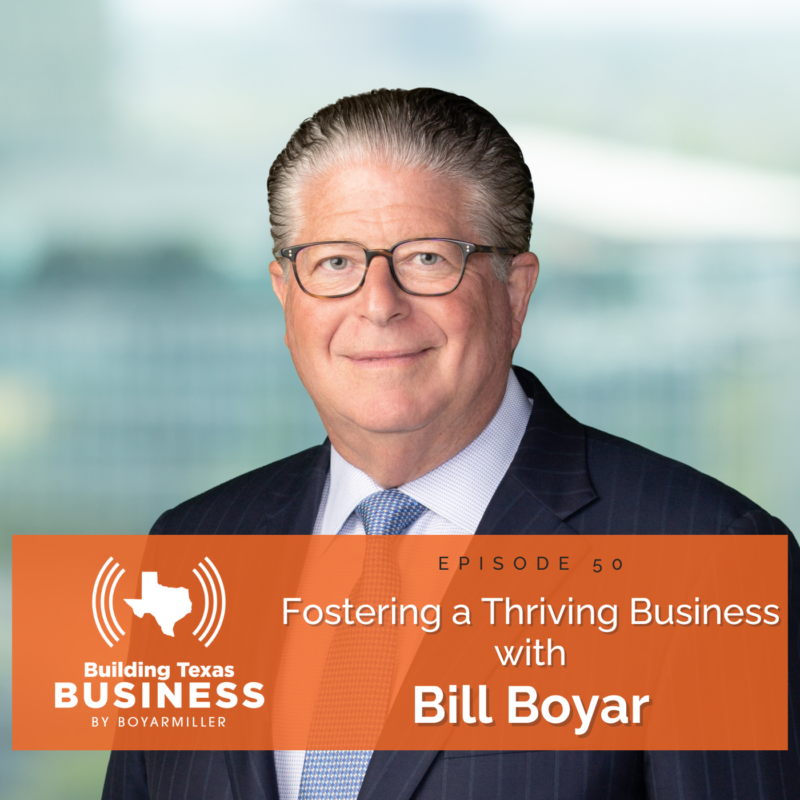
Bill Boyar, Founding Shareholder of BoyarMiller, joins the podcast. Bill shares the fascinating story of going from a summer associate at a law firm to ultimately forming BoyarMiller with the help of two of his partners.
Through his experiences, Bill shares the importance of focusing on people and building a strong foundation for a professional services practice rather than solely chasing growth and money.
Listen as Bill explores leadership transitions and entrepreneurial advice for those looking to build successful businesses.
Transcripts are generated by machine learning, so typos may be present.
Chris Hanslik: In this episode, which is the 50th episode of Building Texas Business, you will meet my partner and co-founder of our firm, Bill Boyer. Bill shares why he believes it is never too early for entrepreneurs to define the purpose of why their business exists other than making money. It’s never too early to set standards, and it’s never too early to think big. All right, so I’m excited to start what is our 50th episode of Building Texas Business and a very special guest, a founder of our firm, BoyarMiller, and happy to call in my law partner. So Bill, welcome to the show.
Bill Boyar: Thanks, Chris. I’m really excited to actually finally be here.
Chris Hanslik: Yes. So I think the story of our firm is a pretty special one. Obviously, it’s near and dear to my heart. You’re the co-founder of the firm. Let’s maybe start by telling the listeners a little bit about what led you to the firm that became Boyer, Simon and Miller at the time in 1990 and kind of that journey that brought you in to the firm and how that influenced where you went from there.
Bill Boyar: Sure. So I, my story begins in this journey begins to the campus at Tulane Law School in New Orleans, when Bob Waters from Chamberlain Herlic and Whiten Waters came to interview for a summer associate from when I was in my second year. We had an amazing interview experience. It was supposed to be the last interview of the day when they were 20 minutes and we spent two hours together. And that ended up resulting in me coming to Houston for my summer associate experience. And back in those days, it was 12 weeks, one firm. You basically put all your chips on one number and hope it worked out. It worked out great for me. So after I graduated, I came to Houston. I didn’t know anybody. I had dated a girl in college who was from Houston. She was the only person. So it was really quite an adventure. I started at Chamberlain and I was there for four years. After three years, Bob, who was my boss, my mentor, my friend, my running buddy, left to become a principal with a group to develop the Houstonian. He wanted to start a little law firm when he left and took one other guy with him. And a year later, I joined him. So we had a little three-person law firm. About six months into that experience, he came to me and he said, I’ve got too much to do. And on the principal side of this relationship, so I’m not going to practice law anymore. So I was 29 years old and the guy who had all the business was not going to be practicing law anymore. And my partner was a tax lawyer who read the wall street general and tax periodicals. And so I woke up one day and had a law firm to figure out how to run and manage a little bit of a cold shower. It was crazy. So I had some. guys that I practiced law with at Chamberlain and over time they joined me and we went from three lawyers to 10 lawyers. We moved to a facility at 5 Post Oak Park. We had 20 lawyers and we had 30 lawyers and we were on opening up an office in Austin. And this was over a 10 year period. And the last three or four years of that experience, I was unhappy and had a hard time sort of rolling out of bed in the morning. I didn’t know why other than I didn’t like the way that we were so focused on growth and making money and not really taking care of our people.
Chris Hanslik: Yeah.
Bill Boyar: So I had two little kids and in 1990 I told my wife that I was going to do something different. I didn’t know what I was going to do. So I resigned from that firm and I had learned a lot. I learned a lot. about running law firms and marketing. And we were way ahead of the game in terms of creating a brand and doing marketing before it was sort of popular. But I didn’t like the way we were treating people.
Chris Hanslik: Yeah. It sounded like the lesson there was you said it, you were Focus on making money, not your people, kind of on the wrong things that led ultimately, while it may look successful, to unhappiness.
Bill Boyar: Yeah, I think the fundamental lesson I learned that, and you and I have talked about this a lot, is that growing a professional services practice and making money is the result of doing a lot of things right. And if you can figure out what that is, what are those things that you have to do right, and the outcome is growth and making money. It’s just a much more fulfilling way to be in this business. So I decided to leave. I didn’t know what I was going to do. Fast forward, I had a client that went to high school in Waco, Texas with Gary Miller. Gary was trying to poach my client. My client said, you should talk to Bill Boyer. resigned from his firm and Gary was like, no way. So Gary and Len Simon had a small firm, seven lawyers. I did a bunch of interviewing. I interviewed and what I thought I was going to do was tuck into one of the big firms. I had a good size practice. I still in my thirties. I could bring two or three lawyers and some assistance and paralegal so I could pick up a practice and take it. And I did all that interviewing with all those big regional firms. And I was, when I got introduced to Gary and Leonard and they were like, they opened their arms and ultimately was my wife, Pam, who helped me figure out what I want to do with my life. Because every time I came home from any interviewing with one of the large firms, I sort of was unhappy and couldn’t see myself doing that. And when I came home from Gary and Leonard, I was energized and excited. And so she’s the one who pointed out to me, you need to go do that. I’d say I’ve had two great mulligans in my life. One was, Pam was my second marriage. We’ve been married for 40 years. But two, the opportunity to start another firm essentially and take the lessons from that first experience. I don’t think I could spell business when Waters came in and told me that I It was my firm to run and lead and do whatever I wanted with. By the time I got a chance to partner with Gary and Leonard and start what is now BoyarMiller, I had a better sense of what it took to be successful in this industry, but not in a traditional way. So if you think about it, There was no internet. We weren’t operating on computers. Barely had cell phones. We had the big ones just stacked in your car and plugged into your lighter. But we didn’t have all the technology to be connected. So we had to work harder for people to know who we were and are. They just gave me the opportunity. They plugged my name first on the door, so it felt like continuity in my practice. And we started and we had 10 lawyers in 1990. I think that the. What brings us to today, Chris, is we never really have cared how big we were or are. We’ve never measured our value to this industry or to our clients or to our people or to each other by profits per partner or how many lawyers we have. We’ve always really focused on what’s the value we contribute. And I think that makes us different.
Chris Hanslik: I agree, there’ll be a lot of agreement in this episode for obvious reasons, but you know, I think one of the things that I’ve always liked about that story and can relate to it as well is not only are you not from Houston, you weren’t from Texas, you know, and in a lot of ways, I think it’s a testament to the welcoming nature of the Houston business community. You don’t have to be from here to be successful if you’re willing to work hard and do what you say you’re going to do.
Bill Boyar: Yeah. I tell people all the time that we couldn’t have done what we’ve done with this law firm with particularly me as the sort of the first name on the door and one of the founders anywhere in the world, but Houston, Texas. I’m from Philadelphia. I went to school in New Orleans. I came here. I didn’t know anybody. And, you know, here we are 45 years later, 47 years later now. enjoying the organization that we’ve built together.
Chris Hanslik: So 1990, you get settled in this new firm. Based on what you had learned over that prior 10 years, what vision did you have or at what point did you
Bill Boyar: So I think starting out, I knew that you learn a lot from mistakes you make. I always tell people you don’t learn by doing things right, you learn by doing things wrong. So the learning for me about the previous firm was you take care of your people and you focus on the right things. But I had no sort of connection with the concepts of mission or purpose or vision or value. I had the things that we sort of have built the foundation of this law firm on. When I started with Gary Leonard, I was just trying to sort of rebuild my practice. I was very fortunate. I brought 100% of my business with me and some really good young lawyers and support team. But I didn’t really know how to actually build it.
Chris Hanslik: Right. How did that evolve? Where did the learning come from? What were you doing?
Bill Boyar: So we started out, and because of the similarity in the names of the two firms, the one I left and the one that we started together, there was a lot of confusion in the marketplace. And we had some young lawyers that we hired. And really our journey to build a culture started with sort of sourced out of the confusion we created in the market and our young lawyers not being able to describe who we were as a firm. So a couple of really young lawyers came in. One in particular said I was at a party, a cocktail party, and people asked me about where I worked. And they said, tell me about the firm. And I couldn’t answer the question. So one of my dearest friends in the world was starting a consulting practice about the same time we started the firm. And he was really focused on communication, culture building, things that were not popular. There was no internet, people weren’t doing this to, so they could stick something on the internet and has a, as sort of a marketing, you know, tool is more genuine, right?
Chris Hanslik: He’s like, does it matter?
Bill Boyar: Yeah. So I called the names. Mickey kindly has a group out of Boulder called conversant fan, you know, really a terrific firm. But back then he was sort of just starting to develop his own body of knowledge and the way of thinking about organizational. hygiene organizational development. So I asked him to come down. We got all our lawyers in the room and we were just wrestling with who do we want to be and how do we want to behave? What’s going to define us in terms of the sort of the cultural foundation of this firm? And we sat around and I intentionally sat in the back of the room and let, I think we had a dozen lawyers at the time. and I let it evolve and we came up with at the time five, what we call core values. To this day, four of them have survived. This is probably 1992 or three of those five core values. Four are still core to our being. And we said, okay, this is who we’re gonna be. And they were, And organizations evolve, as you and I have talked about a lot. You start with nothing, and something’s non-existent. And then you start to evolve. You start thinking and developing your way of leading through what you want as your foundation. Then something becomes reliable, where you have a leader who is like the cop. I was the cop of the core values from the day that we generated them, and then ultimately something becomes institutionalized. The first thing that became institutionalized in this firm was our core values. defines something becoming institutionalized is when that one leader is no longer the cop and everybody is given the space and everybody agrees to hold each other accountable for the behavior. Probably the thing I’m most proud of is the way that we actually worked through it, developed our core values, had them evolve, had them become reliable, and now it’s part of our DNA.
Chris Hanslik: What I love about our values here is that they have become institutional. I was here at the time where I feel like that really solidified itself. It’s when we started hiring and firing from culture and it sent a message to people that this is really real. It’s not, no one’s above the culture or the values. And it’s a game changing moment for an organization. There was not just marketing stuff for their website, but it’s really, as you just said, in the DNA.
Bill Boyar: Well, I think the defining moment for us was we do off sites twice a year. And we do them in June and November. And we were in an off site in, I think San Antonio. And we sat around the room and we were having some challenges with some people, including one or two that were in the room who were our fellow shareholders. And we posed the question, Are we willing to declare that if you cannot live consistent with our values, you cannot work here, regardless of your position in the firm. And unanimously around the room, everybody said yes. And soon thereafter, one of the people in the room was no longer in the room for that very reason. And that sent to our organization. was a game changer.
Chris Hanslik: I think that’s a good lesson for the listeners is that culture building, setting some values and starting to hold people to account for those behaviors to define and build a culture isn’t easy. It’s messy work. It’s bumpy. But if you stay diligent and consistent with it and committed to it, it will play out.
Bill Boyar: Absolutely. I mean, we evolved. In terms of the behavior, some people call them core values. Some people call them pillars. Some people call them standards. I don’t care what you call them. What it ultimately is, how we can treat each other, our colleagues, our friends, people on the other side of deals. And I think that defines us. The other piece of that puzzle is purpose. And we struggled with how to articulate purpose. And I traveled a lot, as you know. I was on airplanes a lot. I was in hotels a lot. I was in airplane lounges a lot. My travel was long distance. And I was a voracious reader of business books. And I wanted to use this firm as a sort of a lab experiment of, can you take principles from great companies? And I never read anything about law firms, anything about the industry. My study was, what can I find lessons from great companies and great leaders that I can see whether or not it works in a flat, horizontal organization with a bunch of type A people? And so I would experiment. And because we struggled so much to sort of articulate a mission statement, we pulled everybody together, as you know, in a room. And the question was, when you get up in the morning, what are you excited about? related to coming to work. You might be excited about a lot of stuff, but I was really more focused on, what are you excited about this firm? And that’s how we evolved our mission statement. I don’t know how many years ago that’s been now.
Chris Hanslik: I think it was 2007. That’s such a great story, and I tell it as you do all the time. There was no outside consultant. There was no prompts. It was the owners of the organization answering that question for about 45 minutes and a bunch of words on the board and three themes fell out that we then kind of wordsmith and that mission everyone here I think can quote it. We check in on it as you said at our off sites twice a year and it still resonates in everyone’s heart we got here.
Bill Boyar: Yeah and it’s the you know it’s the you asked me early what was the vision and you know how we think and talk around here about you know, purpose, method, and outcome. And I mean, my philosophy of leadership or organizational development, organizational hygiene, whatever you want to call it, is you start with purpose, which is mission. You set a direction, a vision for what you want to be when you grow up. And then you connect that with method, which is really, you know, who you are, how, what you do and how you do it. And that’s where sort of values reside in strategy, values and strategy and action. And if you don’t, you can have all the strategy in the world, but if you’re not in action, it’s meaningless. But, and I think we’ve done a pretty good job here of trying to look forward and listen to our people, you know, you know, and engage everybody who’s in this firm, every lawyer who’s in this firm in the process. sit around and think, and somebody who’s a first year associate today, 10 years from now, if they last through the experience, they’re going to be a partner here. So we let them have influence over their own destiny, their own experience, and what this firm is going to look like for them 10 years from now.
Chris Hanslik: Like I said, there’s pivotal moments in organizations, right, if they’re going to survive. And this firm’s now, I guess, it’s about to finish year 33. Let’s talk about some of the things, when you look back, that you think, in the moment, we’re innovative, we’re pivotal to keeping the firm going in its independent state, and it has helped get us where we sit today.
Bill Boyar: So several. I think the first one is our acceptance of technology. So early on when we started, I had a very large client who let me do very large deals, international deals, that I was probably less prepared for than he You know, he was, but was prepared for me to, but I did it anyway. And I had one deal where I lived in the Regency Hotel in New York for two and a half months. While I was up there, and this is in 1991, While I was up there, I connected with a lawyer who was part of our group, and he was running his practice on a little Dell laptop computer. And I was handwriting things on a yellow pad and faxing them to my assistant in Houston who was typing and then faxing back to me. And he’s there on this computer. So, and I’m like, this is, I’ve got to be able to do this. So I got the specs for his laptop, faxed them, faxed them to you.
Chris Hanslik: And I bet if we looked at it today, it wouldn’t be that small, right? Chunky.
Bill Boyar: It was chunky. Yeah, it was chunky. But I had it drop shipped to me in New York and. I’d work all day and teach myself how to operate that computer all night. And when I came back, we finished the deal, very successful. I gathered all of the lawyers in the firm in a room, and I said, see this? One year from now, every one of you is going to be operating your practice on one of these, or you won’t be working here anymore. And I had a moment and one of my partners said, I got a D in typing. It’s not going to happen. And I laughed and I said, well, you’re going to have to learn how to pack because that’s the way we’re going to do it. And we made the investment and it started a path for us that we were not leading edge. but we’re right behind. We can’t afford to be leading edge, but we’ve made tremendous investments in technology and we’ve continued to do that ever since. I guess the other thing I would say is in 2006, which I think was another watershed moment in our firm’s history, We had 20 lawyers at the time, if you remember. We had 10 shareholders, 10 associates. The firm divided in perfect quadrants, senior shareholders, junior shareholders, senior associates, junior associates. And we set a 10-year vision for the firm. Broke up in groups, and it was amazing how consistent everybody’s view was. 2006 and some of the critical things that came out of that work was in 10 years we had to be in a new facility. And the lesson I got out of it was we had to look at leadership succession. So we did a SWOT analysis if you remember and I was a strength, a weakness, an opportunity and a threat. So I listened to that and we did a lot of work that culminated in this beautiful facility that we’ve now been in for seven years. And, you know, you succeeding me as chairman of the firm.
Chris Hanslik: Yeah, I think I remember that meeting well and some of the other meetings we had about everyone wanted to remain independent at the shareholder level, and then doing the work at every level of the organization, and the input was consistent about being independent, investing in the future. One of the first things that needed to happen was leadership succession, and you, I think, took a huge moment, no reason to step aside, but put in place a plan to step aside by the time you were 60, and then we embarked on a couple years of trying to figure out who that person would be.
Bill Boyar: Well, we didn’t spend a couple years figuring out who the person was. We spent a couple years executing. Yeah. Well, look, I laugh to myself when I have friends of mine who are in their 70s who are trying to run law firms, and they’re recruiting and hiring professionals who are 45 years their junior, younger than their children. The real sort of wake up for me is when we started having my kids’ friends come across as candidates. And I’ve always been open door, first name. We’re all colleagues. There is some hierarchy because it’s natural with experience. But I always try to break that hierarchy down. We’re all a team. And I just knew that if you didn’t study generational differences and then respond to those differences intelligently, that we were never going to be a multi-generational firm. I could not do that. I could get this firm. I was chair for 20 years. And I got it to a place where I thought, I had exceeded my ability to drive it to the next level. And that’s where you came along. And you’ve done a phenomenal job with this firm since, which is now a dozen years, I guess. But people get entrenched in positions and it’s about power. I’ve never felt like being chairman was the source of power for me. I always felt like trying to be a great lawyer was a source of power for me, and it still is to this day. So I never, this was not about I had to retain a title. It’s why I don’t have a title. I always felt like the ability to sort of sit in the middle generationally, be able to connect with the more senior, generations and be able to connect with the more junior generations is the sort of the perfect place to be in the leadership of any organization. And when you lose sight of that, you get myopic and you rely on sort of history versus being connected to the present. And I mean, God knows the changes we’ve experienced in the last five years both generationally and socially have been tremendous.
Chris Hanslik: No questions. There’s got to be a lot of organizations out there facing that challenge, leaders out there in organizations, the challenge of succession. Do I do it? How do I do it? Maybe let’s just talk a little bit about what that process looked like for you and us because, yeah, I was right there with you. It was very thoughtful and disciplined about how we went about that. And I think the results would suggest it was executed, thought out, a great plan and executed beautifully because it was a very seamless thing for our organization.
Bill Boyar: So that in 2006, I was 55. So that when we had that meeting, I was 55. And it took me a little while to completely digest the message from that meeting. But the message was clearly that in 10 years from that moment, there needed to be another leader. And as I thought about it, I determined that 60, 860 was the sort of the tip, that was the break point, that the leader of this organization and all of the leaders of this organization in each of the practice groups needed to be younger than 60. So, counseled with some of my, particularly with my friend at conversant and talked about how best to think about this. And so at the next meeting of our shareholders, I asked the group who wants my job? And there were three of you. So we did about a one-year program where I would ask each of you to read a particular book that I thought was reflective of my philosophy of business and leadership and we’d go out to dinner and drink really nice wine and sit around and talk about what was the learning and how would you apply it to the firm and the future of the firm. Over a short period of time, I realized that you were the logical person to take that on. I went to the shareholders and said, Chris, it’s my choice. And you were unanimously endorsed. And so we created a role as vice chairman for a year where the promise was, and this was when I was closing in on 60, the promise was that by the end of that year, my responsibilities in running this firm would be transition to you, so that by the time I was no longer chairman and you were chairman, that you would have been doing the job. And as it worked out, the person who was our executive director made a decision to retire, had health issues, so you were able to then recruit your own partner in the operations, which turned out to be fantastic. So by the time it was time to make the move. Now, the biggest challenge is I didn’t go anywhere. I was still there. It was very unique. Yeah, I wasn’t going anywhere. And we had to convince our team that Bill’s not retiring. We had to also convince client base, the marketplace, our friends that Bill wasn’t retiring. But here’s what I did do. I made you a promise that I would stay away. for about six months, as much as I could, and let you sort of find your way. Because it’s different when you say you’re going to be the leader, and the day you wake up and you are the leader. And I think the first year was a little bumpy for me, because I’d been running law firms for 30 years. And even though I was sort of in denial that was part of my identity, it obviously was. But I look back now, it was one of the smartest business moves I’ve ever made. It freed me up to do other things, do a lot of work in the community, continue to grow my practice, be a better father, you know, because I had more time. And so, you know, worked out, it worked out really great. And I think that I’ve counseled a lot of people on succession and it’s hard to let go. But the key to it is to build the foundation. And one of the things I love about the way you took it on is We talked about the name and agree it wouldn’t change. And you embrace the culture of this place. You took on the mission as your own, the values as your own, and you’ve done nothing but build on what was there. I think the risk that people see in succession in organizations like this is that the next guy is going to come in and tear up all the work and bring their own. I’ve got my own ideas about what the culture should be and what the vision should be, and you didn’t do that. You had a strong foundation and built on it. And that’s why we are where we are today.
Chris Hanslik: You know, I get asked a lot of questions about that and did at the time, you know. So, one, Bill retiring, two, so your name’s going on the door, and I would say no. And, you know, as I experienced the culture and grew here, what I tell people, told them then, tell them today is, in our business, any lawyer can have their name on the door. So there’s nothing unique or special about that. I’ve always been a team player on teams my whole life. So being a part of a really well known, high functioning team is really cool and unique in my view. And to be able to have the opportunity and the privilege to be the leader of that team. So I was like, I want to make that brand at Bordermiller something special. And if I’m known as the leader of that, that’s more important than having my name on the door. There’s 80-something thousand licensed lawyers in Texas that make it each go out and hang a shingle, so there’s nothing unique about that. The other thing I think we’ve proven, even though I think it’s a little unique, because you’re right, most succession plans, there’s a retirement involved. We’ve proven you can do it without the retirement if everyone involved in those leadership roles stays focused on what’s important, and that’s the health and well-being of the organization.
Bill Boyar: So I think the If I had to point to one thing that made it work is the promise I made to you and to myself is that I would never contradict you in public. That I would bring to you my ideas, my concerns, whatever thoughts I had and you could take them and do with them what you wanted. I don’t think I’ve ever mandated anything, but I’ve never wanted to contradict you or take you on in a shareholders meeting, in a lawyers meeting, how I talk about our relationship in the public, so that there’s no question who’s the boss, who’s the chairman, who’s the leader of the firm. And yeah, I mean, I think people respect what I’ve contributed over the last 33 years to this place. For sure. contribution I made to the foundation, but I think there’s no question about who’s on first.
Chris Hanslik: Yeah, well, it’s been great. The other thing I would add to that is, you know, in our transition, you’re right, that first year is almost a reverse transition. We were both, I was still learning and always am, and there was guy in that seat. But again, there may have been a little bumpy, but it wasn’t anything that felt natural, and it’s proven itself, I think, so far to be successful.
Bill Boyar: Well, I will tell you, I made a liar out of a lot of people who doubted I could do it.
Chris Hanslik: I should have placed them better. I always like guests that have had the success like you’ve had and through failures and learning. I’ll say this, anybody that knows you, one of the things that drives you is the opportunity to work with entrepreneurs every day and making their dreams happen. What are two or three things that you know, the listener out there that has just started a business or thinking about it, what are some of the nuggets of wisdom you’d say, keep this in mind as you start that journey, or if you’re in that journey and you’re questioning why?
Bill Boyar: I’d say, so I tell people all the time, never, it’s never too early to start thinking about the purpose for which you’re doing this business. And it’s not making money. So what’s the real purpose? It’s never too early to set standards of how you want your people to be, to treat each other. And it’s never too early to dream big. Think big and work backwards. I’m sort of a classic reach out, look back thinker. Set the bar, the peg in the sand, whatever you want to call it. Look back to today and really think about, what do I have to do? Too many young entrepreneurs just get up, put their clothes on, and take one step forward, and another step forward, and another step forward, and it can be directionless, and that can create a lot of dysfunction and failure. So it’s never too early to try to actually have organizational hygiene. It’s also never too early to figure out who you can get around the table, who has experience, who’s been through what you’re trying to go through. to coach you, counsel you. That’s why organizations like YPO and EO and Vistage are so valuable, because you could find a place to get counsel or coaching from people who have already accomplished what you’re trying to do, or all who are similarly situated, experiencing the same challenges you’re challenging.
Chris Hanslik: Well, Bill, this has been great. Love the story. Knew most of it, but just loved giving you the opportunity to be able to tell it so everyone else can hear it. So let’s wrap up on some personal things. What was your first job?
Bill Boyar: So my first real job, other than catting when I was a kid, my first real job was working in summers in residential construction. I did sheathing and roofing for houses. a non-union crew. I did it, you know, for four summers. Made my way from the guy on the ground hoisting up the four by eight to the guy up on the first story pulling them up to the guy on the roof laying them to the guy on the roof being the supervisor and a hammer until it rained one day. And I’d slid off the second story of a roof. And the next summer I was on a landscaping crew.
Chris Hanslik: Literally boots on the ground. Yeah.
Bill Boyar: Yeah. And I’ve stayed on the ground since.
Chris Hanslik: Wisely. All right. Famous question. Tex-Max or barbecue?
Bill Boyar: Oh, Tex-Max.
Chris Hanslik: Yeah. I mean, you raised the kids in Nefas, right?
Bill Boyar: Well, you know, I got engaged in Nefas. I celebrated every birthday there. You know, between Nefas and El Tiempo, Yeah.
Chris Hanslik: I love it. If you could take a 30-day sabbatical, where would you go? What would you do?
Bill Boyar: You know, I knew you were going to ask me this question because I listened to all your podcasts, and I think I would probably go hang out in Italy.
Chris Hanslik: That’s a pretty popular question or answer, excuse me. I mean, and some like to split it. They say maybe two there, two somewhere else.
Bill Boyar: You know, so much of my travel is three days here or four days there or a week there, but it’s never really immersed. I went to school in Wales my junior year in college, and I really immersed. I didn’t do the U-Rail pass and go to every country that I could go to. I actually spent a year. in the UK and in Wales and something that you know a mini version of immersion is really it sounds great sounds great to me. But I got a boss who won’t let me leave for 30 days.
Chris Hanslik: I’ll see if I can talk to him about that. Bill this has been wonderful thanks for telling your story thanks for being the Kind of a milestone marker for us at the 50th episode. I think we’ve hopefully proven and validated this concept and that the listeners enjoy the content.
Bill Boyar: Well, it’s a pleasure to be on this and I’m proud of what you’ve done with this. Thank you.
Chris Hanslik: Thanks for tuning in to Building Texas Business. For more information, episodes, and summaries, head over to boyarmiller.com forward slash podcast. If you enjoyed this episode and found it informative, please take a moment to rate, review, and share it with friends and colleagues. It really helps others find our podcast. As always, we appreciate the support and feedback of our podcast community. More episodes are coming soon, so be sure to check back.
With a deep understanding of your business alongside clear and honest communication, we help clients face challenges fearlessly.
Learn more about our services and how we help clients.