


With a deep understanding of your business alongside clear and honest communication, we help clients face challenges fearlessly.
Learn more about our services and how we help clients.



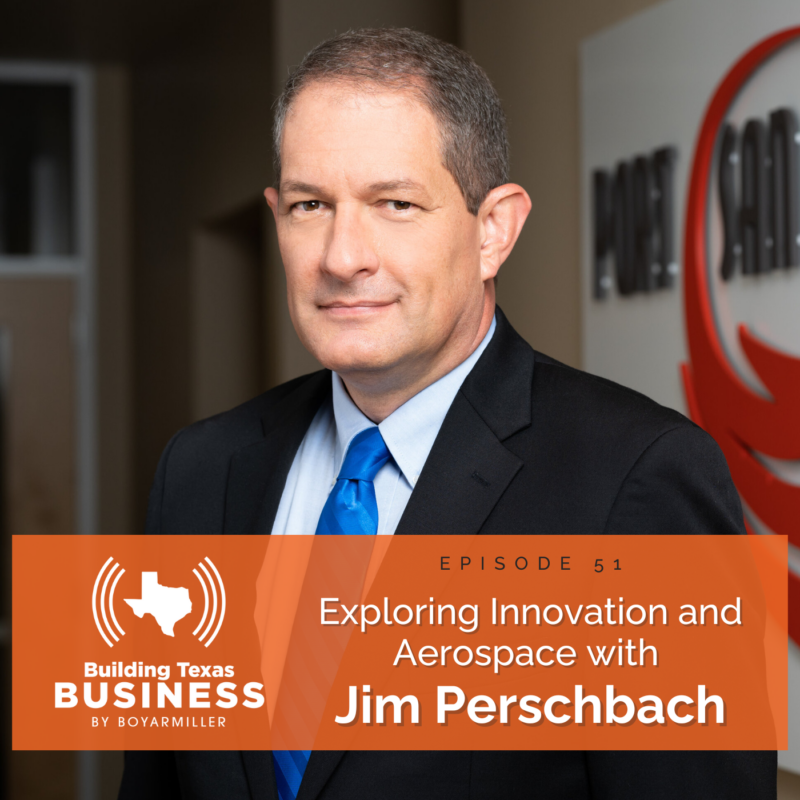
Jim Perschbach, President and CEO of Port San Antonio, joins the podcast to share his insights on leading an organization that has transformed an old Air Force Base into an innovative aerospace and national defense park.
Jim discusses the challenges of working remotely and the importance of providing flexibility to maintain a collaborative and productive work environment.
Dive into the fascinating world of Port San Antonio and discover the innovative solutions transforming the aerospace and national defense industries.
Transcripts are generated by machine learning, so typos may be present.
Chris Hanslik: In this episode, you will meet Jim Perschbach, President and CEO of Port San Antonio. Jim shares his views on why he believes the key to making great hires is to find people who are focused on value and long-term relationships. Okay, Jim, I want to thank you for being a guest on Building Texas Business. I want to welcome you to the show. Let’s start by just telling the listeners what it is you do and where you do it.
Jim Perschbach: Sure, well, thank you so much for having me. It’s an absolute thrill to be here. We operate what’s called Port San Antonio, and people always say, what on earth are you doing with the port in San Antonio? You’re hundreds of miles away from the sea. What it is, an old Air Force base, one of the most important Air Force bases in our country. That was bracked in the nineteen nineties and what we do is we operate it today as a research park as an aerospace national defense park it’s got eighteen thousand people working on this campus we’re adding this year we’re adding over two thousand jobs of an average about twelve hundred jobs a year for the past couple of years. And we focus on everything from traditional aviation. We’ve got Boeing’s largest global technical operations on the planet here. Standard Arrow builds and overhauls jet engines here. We’ve got military cybersecurity operations. We’ve got private sector cybersecurity operations and then an awful lot of startup activity focused on automation, robotics, artificial intelligence and all kinds of cool stuff that’s being incorporated in.
Chris Hanslik: Wow. That’s amazing. You’re right. I’d never heard of the port of San Antonio and thought the same thing. I’m pretty sure they didn’t dredge something all the way up a waterway. Although you do have the river walk.
Jim Perschbach: You do have the river walk. And in theory, you can get to it from Leon Creek over here. Just be a long walk up a rattlesnake alley.
Chris Hanslik: Well, it sounds, you know, expansive in scope of what’s going on there. Let’s just maybe let’s start by telling the listeners How did you come about becoming the CEO of the port?
Jim Perschbach: Well, that’s, my story is quite uninteresting. I’m a lowly airplane guy. I’m a lawyer. I spent about 18 years doing aviation and defense work. I guess the firm called it white collar because it touched on federal fraud cases and had a lot of clients. I was moved here to San Antonio because of our client base that we had some of the operations. And I looked at this and two things really struck us jumped out at me. The first one was we were doing some of the most amazing work and I say we it’s this collective aerospace and industrial world, but nobody knew about it and that’s the fault of the aerospace and defense world as we try and keep everything a secret. The second part was that we have an installation that is sitting in a wonderful part of the San Antonio community, but it’s also one of the more challenged parts of the San Antonio community. It’s a part of the city that has traditionally been somewhat forgotten about. And I, the law had been so good to me. Aviation had been so good to me. I wanted to jump out and do something different, not so much because I’m a savior for this, but because it was an exciting opportunity to come in and literally and figuratively knock down some of the walls between our installation and the community that surrounds us.
Chris Hanslik: Right. We clearly have a passion for it. I don’t know if I can ask this, how long has the port been around and how did it come into existence?
Jim Perschbach: Well, it depends on when you say the port. Kelly Air Force Base was opened in 1917 as Camp Kelly. It’s one of the oldest aviation installations on the planet. It was bracked in 1995. It was transitioned over to our predecessor in 2001. They came up with the idea of calling it Port San Antonio, I think, somewhere between 2006 and 2010, let’s say 2007, 2008. because inland ports were all the rage. And then the focus that we have now, we kind of call it tech port informally. This focus on connecting industries and connecting people started in late 2017, early 2018 as a strategy. So we stand on the shoulders of everybody that came before us, but we’re building on a heritage that goes back over 100 years.
Chris Hanslik: Wow, that’s really new. So What, what type of, I guess, team do you supervise and manage in your role as a CEO?
Jim Perschbach: We’ve got about a hundred, I think it’s a hundred three now people that work directly. in our organization. And then we’ve got another hundred and some odd folks that work with some contractors for us, particularly with the Boeing Center at Techport, which is this massive entertainment arena that we have built here on the campus. So there’s about 200 some odd people direct and contract that work with us on any given day. And then there are 18,000 people that work on this campus with massive employers like Boeing and Northrop Grumman, down to some really exciting startups, some of which they’re growing like weeds, some of which are still one or two people.
Chris Hanslik: That’s a lot to keep your hands around. That sounds like.
Jim Perschbach: Well, it is, but I’m just a pretty face for a lot of good people. And I can say pretty face because nobody can see me and I’m trusting you’re not going to put my picture up.
Chris Hanslik: That I promise. So I guess you’ve been there now almost 10 years.
Jim Perschbach: Yep.
Chris Hanslik: Tell us, let’s talk a little bit about how you gone about building your team, specifically the 100 now three plus, you know, almost 100 contractors. What are some of the things that you have found to be successful in hiring the right people?
Jim Perschbach: It’s looking at people who look at what they do on a day-to-day basis as a long-term relationship building, not as short-term. At our core, we’re just a real estate development company. We’re a real estate development company that functions as a political subdivision of the state of Texas because it’s a publicly owned asset. But we don’t get any tax revenue. We don’t get any direct support from the government. What we have is a public asset that we have to manage and maintain. So we have to go out and we have to generate revenue. And what we have found is that if your focus is solely on revenue, which is what so many real estate companies are, you are really at the mercy of just location and big picture demand. If you find people who recognize, much like in the legal business, that it’s about relationships and it’s long-term relationships, it’s about providing a value, then you start to build that culture amongst your customers. We don’t call them tenants, we call them customers. You start to build that with the community that surrounds you. And that is what I think has been the secret of our success. It is tough to find people who really do have that relationship minded core to them. But when you find them, we hold on to them. Go ahead.
Chris Hanslik: Yeah, I couldn’t agree more. You know, that mindset of a relationship and relationship building is such a more positive mindset to have than just trying to punch a clock and do a task. Yeah. So what are you going to talk about how it can be difficult to find those relationship oriented people Let’s talk about the last few years, I mean, with all the challenges employers have faced, what are some of the challenges that you faced there at Port San Antonio as you tried to fill positions or grow the team?
Jim Perschbach: Yeah. So we had two teams that we were trying to grow at the same time. The first was our internal operation. And right during the pandemic, we had our customers seeing massive growth. We’ve got companies that are doing some really groundbreaking work with not healthcare in terms of the actual biomedical delivery. but the systems that go around health care. Everything from the information technology of that, to building these medical modules that can be put in the back of cargo airplanes. And so one challenge was not only bringing people back into an office, because it is really hard to collaborate across systems and across teams when everybody is remote. I hear a lot of people saying, well, my team functions really well remotely. And that’s easy to do. You can build very functional teams with trust where they’re all working remotely. But when you have to work hand in hand with a different team in the organization, or in our case, different teams from different organizations, there has to be that level of collaboration. And so What we did is two things. One, focus on giving people flexibility and treating them like adults. Those who can work remotely from time to time, we let work remotely. For those folks who can’t, if you’re working on mechanical systems for our landscapers and that type of stuff, we can’t say work from home, but we want to provide them the same level of flexibility and the same level of treating them like adults, treating them like colleagues that we do. And that worked. With respect to building those relationships with the customers, that never ended. During the height of the pandemic, I am very proud to say that we had people, both on our team and on our customer teams, that were not shy about finding ways to get together, to work together, while still making sure that they were being safe.
Chris Hanslik: That’s great. To me, this issue of work remote and now people are kind of migrating back to a hybrid, at the core, there’s kind of two fundamental things. If you’re having an issue with someone, it’s probably more performance issue you would have had even if they were in the office all the time. And the second is, it goes back to what you said a minute ago in my view, and that is, if you’re really hiring those people with a relationship mindset, you’re not gonna have to tell them that they should be in person because they’re gonna naturally want to be more than not, but enjoy the flexibility to work remote from time to time.
Jim Perschbach: I think that’s right. And, you know, one thing I’ve found because you’re in the law business in law firms, we’re a unique set of creatures. We’ve got people who, whether it’s a personality defect or whether it gets trained to you, but there’s a certain lifestyle that we have and teams become very fluid within law firms, the role of a lawyer. You may be the lead on one project. You may be support on another project. You may be doing sales and customer capture. You may be doing back office stuff, but it flows. And hierarchies are less important than just getting the job done. And what I have found, the most interesting thing for me, jumping from that law firm world into this world, most human beings don’t operate like that and trying to bring somewhat of the law firm culture is difficult. You’ve got to find people and start to treat them as colleagues, which we do in law firms. The other thing I’ve noticed is, and I think it’s just who goes into law firms, we tend to be thicker skinned. You know, so many people dislike us every day. The business is so nasty. You get your feelings hurt, but you get over it quick. People in the real world are, they’re more sensitive and it takes a different level of dealing with them. But what that has led me to believe is the importance of people being physically together. It is really hard to miscommunicate and to misread cues when you’re doing it over text messages or even Zooms. that people being social creatures, when you bring them together and they can read those cues, they can intersect with people, it is so much easier. My mind always goes back to that Key and Peele skit of them sending text messages and Key thinking he’s just being a nice guy and Peele getting that, oh, excuse me, Peele being a nice guy and Key just getting angrier and angrier at how he’s reading those texts. Right. It’s so true.
Chris Hanslik: So what, I guess, how would you describe the culture that you feel you’ve built there at Port San Antonio?
Jim Perschbach: I think it is constantly in flux what we try and do is let everybody know regardless of their position in the organization. that we really do value them as colleagues. The challenge, I think, is the challenge that every organization has is you at some point have to find who has the stick to make the decision. And then once the decision is being made, make sure that gets communicated and spoken in one voice. And that’s something that we candidly, even with 200 some odd people, Working in our couple buildings here. We’re starting to struggle with it makes me feel a little better because I know it’s the same issue that our Defense Department’s having that major corporations are having, but I think this is the next level of what’s going to happen with the challenge and organizations. is as the automation comes in, as people spend less time doing physical work, as they move away from being just functionaries, and the human intelligence becomes more and more important, it becomes more difficult to work that collaborative systems engineering when you build an organization. And that’s going to be really interesting to watch, especially with things like artificial intelligence and automation coming into a lot of tasks that traditionally were done by people.
Chris Hanslik: Yeah. I mean, certainly that’s the hot topic now and it’s rapidly developing, which means it’s rapidly changing things. What are, you mentioned the kind of experiences and challenges in communicating across your 200 folks and a few buildings. Can you be a little more specific? What are some of the challenges you’ve seen recently? And what are you doing to try to overcome those?
Jim Perschbach: Yeah, so it’s a challenge. And I put this situation solely on me. For the past couple of years, I’ve been trying to squash down and flatten out the organization as much as possible and empower people to get things done. We have many people whose jobs keep them really out in the field. They’re working either directly with our customers across this campus, which is 1900 acres, or in some cases, they’re around the country and they’re around the world scouting for new talent, scouting for new technology, scouting for new customers. And in doing that, communication and what we call a national defense the command and control infrastructure starts to get tricky if there is a line that I think is really difficult to manage between wanting to empower people and get people doing things proactively but not finding yourself committed to something or having to walk back an effort or having efforts that are being duplicated as a candid example and I’m going to be very open on this stuff. We had two different groups in our organization launching engineering studies for parking lots for a customer expansion. And what that means is even our customer had two different people launching their project. So it makes me feel better that it’s a challenge that everybody faces, but it is something that I don’t think organizations are putting enough time into as you get bigger, as you get faster, as you get more complex, you’ve got to make sure that these systems coordinate back with each other, share information in real time, and then build a culture of people collaborating. Again, I think it’s something lawyers and law firms have been handling for centuries. It’s just more difficult to do in larger organizations with people who are used to different styles of project management.
Chris Hanslik: I think, you know, the learning there is lots of things change over time, but some of the fundamentals don’t, right? And communication is key. You may, the way you communicate may be a little different, but the fact that you need to communicate clearly and the importance of that is a fundamental that should not change. Right. Let’s talk a little bit about your leadership style. How would you describe kind of your style and how you try to show up as a leader in the organization?
Jim Perschbach: Oh, that’s a good question. That requires me to be more reflective. And you should probably ask other people. In my mind, I am a charming, sophisticated, easygoing, empowering person that everybody loves. And I’m sure that- And really good looking. And really good looking. And then I, you know, I’ve seen pictures, I’m looking at myself on this zoom and I own a mirror. So I know none of that is true. Like everybody else, I’d say that I’m trying to figure this out as you go through it. It is difficult for every human being. Everybody says we want to have collaboration. We want people coming in. Everybody says listen to other people. Everybody says don’t be arrogant. But I will tell you, whether it’s speaking to my board of directors, or it’s talking to stakeholders, or it’s even internal conversations, if somebody says something to you that kind of prickles you, because it’s a different way of looking at it, that your initial reaction is to be dismissive. This person doesn’t know what they’re talking about. How dare they? And so what I am trying to do more and more is be more self-aware and more understanding of when other folks have those same challenges. You can’t ask somebody to collaborate, to communicate, to be open to new suggestions and new ideas if you aren’t yourself. And I am hoping that comes across. I can tell you that organizationally we have almost no turnover here, which is a nice thing to see. So either people just really like being around me or we pay really well, or I don’t know, but at least that comforts me when I walk around. I think all these people can’t stand me and my arrogant walk and my obnoxious voice.
Chris Hanslik: Yeah. Well, no, it sounds like you’re doing something right. Cause turnover is a good indicator of that. Any, any lessons you’ve learned as a leader and I’m going to go a little deeper. We tend to learn the lessons the hard way, right? Where we make a mistake or, or, you know, a decision that we looked at and was, oh, that wasn’t the right way, but we learned from it and improved. Anything that comes to mind for you or you felt like, man, that was a learning a lesson, a hard way, but I’m better for it.
Jim Perschbach: Yeah, I think there, there are several of those. The hardest one I think was learning how to really let go. What I have a real passion for this campus. I knew what Kelly Air Force Base was before I could find San Antonio on a map. I’m not from San Antonio, but I knew the work that was being done here. I remember being in DC and talking about Kelly Air Force Base years before anybody thought about closing it and talking about what the workloads would be here and what the future would be for this installation. But in doing that, what I’ve realized is I can become very closed off to other good ideas. And so these are situations of lessons learned, not where anything has gone wrong, but there have been times that folks in this organization have brought forward some ideas. And my initial reaction was to say, that is the dumbest thing I’ve ever heard of. You’re not listening to me. You’re not listening to what we’re trying to do. And there’s one, it’s a guy on our team named Ray Flores. And Ray is a fantastic, fantastic mind. And he’s got a real passion for historic properties. We’ve got a whole neighborhood here of houses that were built in the 1920s out of the shipping crates that the airplanes were sent down in. And they’ve been rotting in place because nobody took care of them for decades. It was the old commander’s headquarters. And Ray came up with a plan to not only get those reactivated, but to partner with the city and the city’s historic preservation district to do it in a way that is allowing it to be a research laboratory and a training laboratory for people who want to work on historic preservation. to bring people in who are working on fixing up these homes because they’re training and apprenticing in that type of work. And it’s going to create a little community where you can put in things. Ray’s got some ideas for bee gardens and flower gardens and everything else. My initial reaction when he came up with that was, what are you talking about? I don’t want housing. I don’t want those architecture people. I want airplanes. I want cool stuff. I want all of this. But watching how he managed that, how he took the initial rejection. He took the frankly nonsensical, I don’t want to change mindset. put it together, put it in context, and explained how it was going to add value to everything else that we’re doing. And when I go over there and I see what’s being built up, and it’s really just started, it’s an absolutely amazing process. And it’s something, it’s not just the idea, but it’s the recognition that it’s an idea worth having. And the coming forward with it to explain how it adds value to the system I think was tremendously impressive the way that he did it. And for me, the lesson was, you know, don’t be arrogant. And I’m the most arrogant human being on Earth, but hypocrisy is a human tradition. So I get so frustrated when people don’t listen to my brilliant ideas. And the lesson I took from how Ray did it was he did it in a charming way without getting angry and pounding on tables and saying, no, nobody’s as smart as me. Watch, you know, hold my beer.
Chris Hanslik: Right. Well, I mean, you may not think this, but definitely a demonstration by you of some ability to allow that project to go forward, recognize that Ray had a great idea. And I would think that meant a lot to him and others see that in the organization that, you know, to kind of maybe push where they think you need to listen again. Yep.
Jim Perschbach: Making me listen is a good thing because man, I’m unpleasant to be around some days.
Chris Hanslik: So you’ve kind of talked around this and I’d like to hear more. This may not be. directed maybe at the port, but I think so because it feels like what San Antonio is doing there is innovative. So I’m going to talk a little bit about innovation, not just in your organization specifically, but in the customers that you talked about. What kind of innovation are you trying to implement and that you see being implemented that maybe you’re maybe borrowing from?
Jim Perschbach: Yeah, so that’s a great question. The innovation that we are focused on is finding stuff that makes our core industries better. Aviation, national defense, critical infrastructure. And it is really tough to do because you need to find people who look at a problem from a different perspective, which means they come from a completely different mindset, a completely different culture, a completely different viewpoint. But you can’t have just tinfoil-hatted crazy people coming in and running the asylum because things will go nuts. Right. What we have built is a system. It’s really a machine that is designed to attract as many different people and as many different ideas as we possibly can with no front-end gatekeeper. We don’t question whether anything makes sense or not at the front end. There are ways that you can do that as you test it up. And then we bring together different entities, different people, different organizations to sanity check and prototype things. And there’s a couple of examples that I’m real proud of that show this in work. One is we have a 72 foot tall robot sitting at the end of the runway. It has a 20 kilowatt laser attached to its arm. It’s a directed energy weapon. We could cut a building with it, but we’re not going to do that. It takes the paint off of an airplane in 60% less time than human beings do it, eliminates all the danger and the toxicity of doing that, and takes what would normally be chemicals that would kill you and turns it into two and a half pounds of dust that you could toss in your kitchen garbage without a problem. And it takes the cost of building the stripping hanger from astronomical to very doable. And in doing that, it addresses two challenges that we’ve had in aviation. On the military side and on the commercial side, that sustainment cost and the peaks and valleys of it meant we have commoditized the work, we have offshored the work, we’ve had a lot of platforms just sitting fallow. And this allows them all to go back to work and allows us to upskill the human beings. The guy who came up with that idea was a computer software salesman. And the point is, now he didn’t develop any of it, but he had the idea and he ran it and he put it together. He just needed to be connected with the people who have the different skills, the robotics, the lasers, the optics, the HEPAVAC, which is the scariest thing on earth. I feel like a puppy dog next to that thing, because a 72 foot tall vacuum is loud. the airplane people who can work on it and the facilities in which to work it. There’s another one I’m real proud of, met this guy in the back of somebody else’s laboratory. And he was developing a LIDAR system, putting it on the back of a robot, because he had a friend in real estate. And that friend said, it’s really hard to go out and measure these buildings. It’s expensive. You have to bring a lot of people in. You have to upload to CAD. It takes a lot of time. This system measures and uploads a space within a centimeter or two of accuracy and does it almost instantaneously. We took him to Atlanta to an aviation show, and we put him in our little museum down here. And the next thing you know, he’s being named by Aviation Week as one of eight startups in the world changing aerospace. And the reason is, unbeknownst to him, when other people looked at that solution, they saw it as having potential to do everything from optimizing the way that you utilize a hangar space to being able to scout out a lunar cave that we can use for a lunar manufacturing facility. And the examples abound. There’s a gentleman on our campus named Sam Jimenez. We just put him into the San Antonio Aerospace Hall of Fame. But Sam is one of the few space architects in the world right now. And he is developing systems with NASA and a couple of private sector companies to melt lunar regolith. to build a landing surface for usable rockets and then to grind lunar regolith and turn it into a filament that can be used to 3D print a habitation cap on top of a lunar cave. It’s just amazing work. That’s crazy. But Sam also runs a foundation called the Wex Foundation, and he brings in eighth to 12th grade students who work with him and work with the NASA scientists the research scientists Southwest Research Institute on the same work. So if you walk into our museum space. you’re going to see a one seventh scale version of this hang printer. It’s still about 15 feet tall and it works, but it was put together by a bunch of students working with those scientists. So at the same time, what we’re doing is showing these people, these kids and not kids, that you can really do anything you put your mind to as long as you do it. Last thing I’ll say, all of this sits in our Boeing Center at Techport, which if you go look at it, looks like any other arena and entertainment facility on the planet. But to show you how bad a businessman I am, we’re never going to make a profit off of that building. That building, which has hosted Smashing Pumpkins and Judas Priest and Parkway Drive and Paw Patrol is going to come in there and do some shows. All of the profits out of that building go toward our Kelly Heritage Foundation. And that supports these educational opportunities. So we had a couple of weeks ago, 100 kids from the school districts around us come in. They did the largest computer build of all time and they all walked out of there with their own three thousand dollar gaming machine. But more important. They did that hand-in-hand with both folks from Air Force Cyber, with the companies, the gaming folks flew in. These kids knew that people were there to help them. And we hope that those kids come back and they start to continue, whether it’s coding, cybersecurity, robotics. That’s what we’re trying to do here. I can’t even remember what you asked me, but when you talk about innovation.
Chris Hanslik: We started with innovation. What I love hearing is that from somewhat of a novel concept of bringing these defense and security companies together in one place to create and collaborate. And you’re doing two other things by extension, bringing in the kids to encourage them that there are careers and things to do in the science, math, et cetera, which we know is an issue in our country, to help promote that and get them excited about it. And at the same time, preserve the heritage, which is, as you said, over 100 years old. I think all of that’s really neat. And necessary it is, you know, that’s that’s really interesting stuff that I think most people they’re gonna listen to this had no idea was going on in San Antonio and hopefully we can spread what you’re doing to other places. So let’s turn to a little personal. I’d like to know, you know, what was your first job?
Jim Perschbach: Oh, that is a good question. I think my first job that I actually got paid for was working for one of my mom’s friends. She had a big old house and she ran a kennel on it. So I’d wander around that place cleaning out dog stalls. And I worked at Red Lobster and a grocery store. I worked injection molding machines on a factory line, all kinds of glamour stuff.
Chris Hanslik: Right. All the kinds of things that made you determine that you wanted an office job.
Jim Perschbach: Yeah. Working 12 hours a day on injection molding machine. You ever seen these things? One of the things we made were plastic forks and knives and everything else for fast food restaurants around the world. And it’s a, I don’t know, six and a half, seven and a half foot plate that slams together and fills up with molten plastic. And then. all these things are supposed to fall out and your job is to build boxes and fill them with plastic bags and just catch all this stuff. But every now and then something would get stuck in there. So you’d have to crawl in and knock it out with the broom handle. This was a long time ago. They would get really mad at you if you’d stop the machine for doing that. So it was terrifying thinking that thing is going to Slam back on you. You learn to move quick. You learn to move quick. Some folks were smart enough to actually hit the emergency stop button, but you get yourself in trouble doing that.
Chris Hanslik: So native Texan.
Jim Perschbach: No, my father was army for the first couple of years of my life. And then he went into doing, I still don’t know what he did. Born in North Carolina, Southern California, Utah, Tel Aviv, London, suburban Philadelphia. All around.
Chris Hanslik: You’ve been in a good while.
Jim Perschbach: I’ve been in Texas since 1993. They sent me down here and then they, they bounced me around to the glamour places that had a military commercial derivative programs. That’s how I got to San Antonio. Gotcha.
Chris Hanslik: Well, the question I like to ask all my guests is what do you prefer? Tex-Mex or barbecue?
Jim Perschbach: I don’t know. I eat like a toddler. So I’ll go get fried chicken strips and macaroni and cheese.
Chris Hanslik: Okay. Well, that’s it first. So let’s ask this, if you could take a 30 day sabbatical, where would you go and what would you do?
Jim Perschbach: I would spend those entire 30 days at Walt Disney World and not just because I think it’s the coolest place on earth, but what they have put together in terms of how they use the real estate, how they use the operations, how they incorporate technology and how they do it all by putting on a show, I think is unmatched anywhere on the planet. Yeah, that Guardians of the Galaxy cosmic rewind. If you haven’t written it, it’s like roller skating through the universe. It’s the most amazing thing I’ve ever written.
Chris Hanslik: All right. Well, Jim, I want to thank you for taking the time and sharing the story of the Fort San Antonio, as well as your own as a leader. It’s been fascinating to hear what’s going on there and keep up the great work.
Jim Perschbach: Well, thank you so much. Thanks for having me and y’all take care. Come see us sometime. We’ll do it.
Chris Hanslik: Thanks for tuning in to Building Texas Business. For more information, episodes, and summaries, head over to boyarmiller.com forward slash podcast. If you enjoyed this episode and found it informative, please take a moment to rate, review, and share it with friends and colleagues. It really helps others find our podcast. As always, we appreciate the support and feedback of our podcast community. More episodes are coming soon, so be sure to check back.
With a deep understanding of your business alongside clear and honest communication, we help clients face challenges fearlessly.
Learn more about our services and how we help clients.