


With a deep understanding of your business alongside clear and honest communication, we help clients face challenges fearlessly.
Learn more about our services and how we help clients.



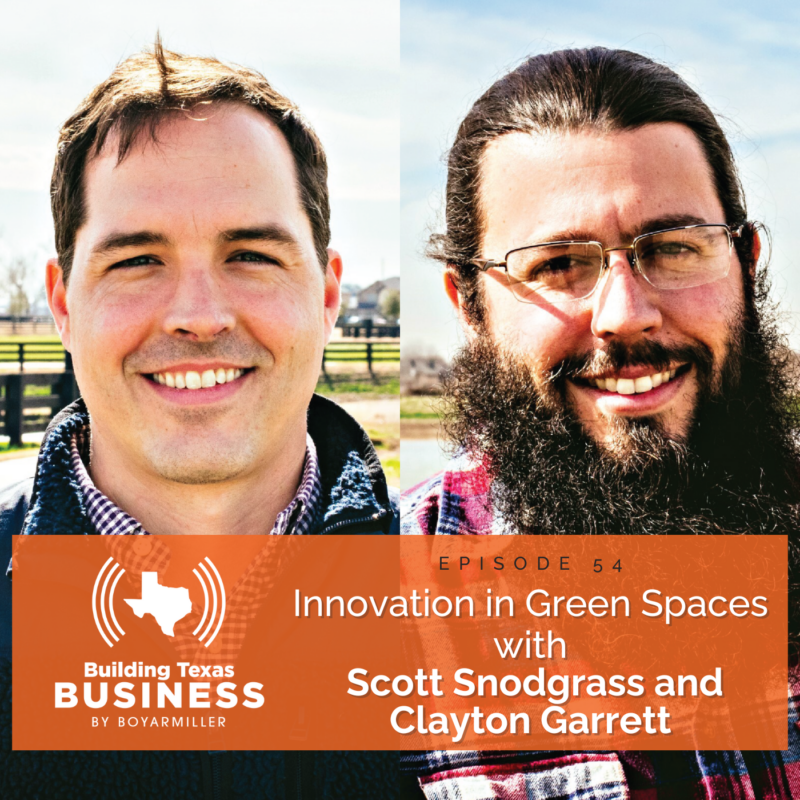
In this episode you’ll meet Clayton Garrett and Scott Snodgrass, founding partners of Agmenity and Meristem Communities. You will hear how they have built an innovative company that brings urban farms to master plan communities, and how they have done so by focusing on caring about people, being passionate for farming, and delivering healthy food.
Transcripts are generated by machine learning, so typos may be present.
Chris Hanslik: In this episode, you will meet Clayton Garrett and Scott Snodgrass, founding partners of Agmenity and Maristem communities. You will learn how they have built an innovative company that brings urban farms to master-planned communities by focusing on caring about people, being passionate about farming, and delivering healthy food. All right, Clayton and Scott, I want to welcome you to Building Texas Business. Thanks for being here. Thanks for having us. Yeah, absolutely. So let’s get started. You’ve got some great stories to tell, but let’s just talk about, I guess, what your company or companies do so they give the listeners a background on the type of business you’re in. I know you have Maristem Communities. You also have Agmenity. So tell us about those companies and what you do inside them.
Scott Snodgrass: What happened? You know, we originally had Agminity was our first company together that we’d been running for a number of years now. And Agminity provides agricultural amenity services to developers. That’s a big chunk of big words. So we usually break that down by saying that we put urban farms into master plan communities, into neighborhoods. And we do that in partnership with the developers that we work with there. So we had been around the real estate development world for a while providing those services, but really from a farmer’s point of view. And very much Clayton and I had both been on the ground doing farming work there with Agmenity. And then that transitioned into Maristem communities.
Clayton Garrett: And Maristem is a community developer. In our context in Houston, we call those master-plan developers. And so we’re doing, in this instance, a master plan called Indigo in Richmond, Texas, southwest of Houston. Maristem’s goal is to connect people to amazing places. In fact, our tagline is “Places for People.” We’re focused on the design and the framework and how to connect interesting spaces. So as you can imagine, we also put an organic farm in Indigo. It would be very strange otherwise. It’s something we’re incredibly passionate about and easy for us to do, whereas it’s a big challenge for other developers. So we’ve oriented a community around that, and we’re super proud to bring it to market in January ’24.
Chris Hanslik: Great. So it sounds like a kind of an evolution with this amenity being a, I guess, a service provider to developers and then transitioning now into a developer yourself of the full community.
Clayton Garrett: Yeah, we had a property and we went to the development community and said, “If this was your property, what would you do?” We just asked questions, right? We had known some things about what we were interested in prior to that by just being associated with it. So, we are a consultant to a lot of other master-plan developers. And so we get to sit in the room when they’re talking about, you know, where they’re going to put a community center or how they’re going to connect spaces. And so we were able to really engage on that front. And then when we had our own property, we didn’t set out with a specific goal in mind other than like, “Hey, we’ve seen some things that don’t work in other places. Why did they make these decisions?” And so we kind of framed our plans around what that was going to be.
Scott Snodgrass: People look at us and they’re like, “You’re not developers, but you’re doing development. How did that happen?” And then when they find out agriculture was in our history, they’re like, “From farmer to developer? That’s a big shift.” So we have to explain that. You know, we’ve been sitting in those development meetings for years with a number of different developers, so we’ve seen behind the scenes and we started to ask questions about why certain decisions were made. I think we were also shocked that it may just be two or three people making the decisions for what’s going to be a more than billion-dollar community. When it’s done, that was kind of shocking to us, how small the actual employment side can be for those teams. We said, “Okay, well, we have this property now and we heard some other people’s opinions, but nothing resonated with us.” We didn’t find anyone we really wanted to partner with. And so we said, “Okay, let’s look at what we’re going to do here.” We started going down the route of looking at maybe some light industrial—just ways that we could use some of the property to return some income from that but also keep a farm there. We had a farm at that property as well. And then, I don’t know if you heard of it, but COVID hit.
Chris Hanslik: You know, I did read something about that recently.
Scott Snodgrass: Yeah. So what happened with COVID was that in the real estate development world, basically everything—there were only two parts of the market that were still active. The logistics side of industrial started to explode because everybody was ordering everything at home. All of a sudden, Amazon needed a bunch more distribution centers and fulfillment centers. And then also single-family homes went through the roof as everybody was stuck at home and realized how unhappy with their home they were. Then the people who could afford to were looking to add a home with another office or “Zoom rooms” became a thing at homes that people were starting to move into. So the single-family market went kind of crazy in Houston and still is right now even. And so we said, “Okay.” We’ve been walking alongside all these master-plan communities. We really understand the human side of it and the connections between people and how important it is. It was something that we were interested in fostering. And so we said, “Okay, I guess we’re…” We looked at each other and we’re like, “I guess we’re going to be master-plan community developers.”
Chris Hanslik: I love how that just organically happened and no pun intended with agriculture and organic, but let’s go back to the beginning. What was the inspiration behind. of your background in farming. If there was one, tell us a little bit about how that just all came together and you two partnered up.
Clayton Garrett: Well, we’re sitting in a lawyer’s office. So my story: I’m a licensed attorney, which is “in recovery,” I like to say. So, you know, that wasn’t a great ultimate fit for me. I was interested in building something. I’ve always been sort of more connected to the small business side. Scott and I joined forces in 2008. At that time, Scott had an edible landscaping company, and I had seen a couple of models of large-scale organic farms that were in the ecosystem and was really interested. I came from a food production background, managing Artisan Green Town, which had about 70 employees at that time. We had just finished purchasing Whole Foods’ bakery when they were moving out of it. And so I wanted to be in the food space, and I also wanted to be connected to agriculture, which my family has a history of. That was the genesis for me, and Scott was doing something really interesting in town. And so then after that, from my perspective, it’s just been a series of opportunities coming our way and us looking at them in a unique light. I think we try to be in a niche, qualitative business, not trying to have a discount model, which is just not something that our personalities can wrap our heads around. And so, Agmenity was an opportunity presented to us. A landscape architect in town brought us in and was like, “Hey, we’re trying to do this interesting thing with one of the great developers here in Houston, Johnson Development. Can you guys help?” And so, a series of conversations later, we’re creating a farm with them, advising them on the plants that are going to be throughout their community. And then that was the same sort of conversation around purchasing a farm here in town and going after that vision.
Chris Hanslik: How about for you, Scott, what kind of got you started in this? What was that inspiration?
Scott Snodgrass: Yeah, so I was actually I was managing a coffee shop and then shifted into actually buying coffee from Central American countries, primarily Nicaragua. And so I had been traveling to Nicaragua and really working on both sides of the relationship in the U.S. trying to teach people about quality coffee. In 2006 and 2007, and even almost into 2008 when I was doing this work, the coffee scene in Houston was pretty lacking. There were, I think, three coffee shops. There were three of us trying to actually do good coffee in Houston. That has now bloomed, and now there’s great coffee shops all over town.
Chris Hanslik: It’s exploded, right? I mean, they just opened a new one down the street I saw this week in Cuccos. Yeah, yeah, yeah. So there’s a lot of folks in the building. There you go. Yeah, guys there.
Scott Snodgrass: Yep. And so we knew that was changing. We were trying to teach people here in the US that they should pay for quality coffee—what quality coffee is, how to enjoy it, learn to enjoy it, and then pay a little bit more for it. Then, cutting out the distributors who acted as the middlemen in the process and working directly with farmers or cooperatives of farmers in Nicaragua. I was traveling down a couple of times a year talking to farmers, testing coffees, negotiating with them on pricing and everything, and then importing it back into the US. As a part of that, I started getting asked all these agricultural questions, and I was like, “No, I’m the sales and marketing guy. I’m your buyer, and then I’m helping you with your marketing in the US.” I didn’t know the ag stuff, but I realized their only access to information—most of the small towns didn’t even have an internet cafe at that time—was limited. They had no access to the internet, and the only access to information they had on the ag side was the chemical salesman in their town who was in charge of selling all the chemicals. So, of course, every problem they went to him with, he had a solution they could buy that fixed the problem, but it might also create another four or five problems for them. In seeing that, I was like, “Okay, well, I’m trying to help these farmers out anyway on the sales side. I have access to information. Let me go start doing some research on my own.” And so I started just watching YouTube videos and reading things on the internet and checked out a few books at a library to learn about coffee production. I think the bug kind of bit me and I really got into agriculture then. And so I had started an urban farm and ran it for three years here in Houston. Then Clayton and I joined up soon after that. Interestingly enough, our lives had unknowingly been intertwined. In the past, we were both at UT at the same time, graduated a couple of years apart, but were there at the same time and never knew each other. Then both of our families are from Lubbock, both involved in cotton farming in Lubbock. My mom and my uncle both graduated just a class away from Clayton’s dad in Lubbock. So, small world, leading these intertwining paths to bring us back together.
Chris Hanslik: Well, that’s great. So then you hook up and you start working with these developers. Give us an idea, I guess, how did amenity start to grow and what were some of the growing pains you experienced through that process?
Clayton Garrett: Yeah, starting Agmenity was really about fulfilling one particular client’s needs, right? They were amazing in understanding that we were headed from a concept that had been sort of around in the U.S. I mean, there were probably at that time maybe 10 to 12 Agrihoods that were sort of known, and they were trying to do it in a different way—a more mass way, let’s say, instead of a very curated, passionate project by a developer. So it was kind of walking alongside them and growing over time, really understanding what that individual project was and then how we could start to apply it to other people and places and what the market is, right? At one point, we felt like we were doing something very specific. Then over time, you realize, “Oh, there’s some ways in which we can use some of these lessons to apply them to different places.” And so, you know, I think that the market for produce that’s sort of connected to community and the community that a farm can create within the broader context—I think that appetite is huge. From a development perspective, when we talk to developers, their questions are pretty rudimentary, like, “How does this work?” or “What is the structure involved?” or “What is the compensation?” When you start to go down the line, it’s a no-brainer for a lot of folks who are engaged and interested in it. So, it was just a matter of time. These development projects take a long time, as many of you know. Part of that process is just having a timeline, being available, having consistent communication around the people who are the early adopters, and then broadening the appeal, saying that this is available for lots of different people in different ways.
Scott Snodgrass: Each project is a big undertaking for us and we have full-time embedded staff at every farm. So Harvest Green, our first project, we have four full-time staff members on the ground. They’re farming and teaching classes every day.
Chris Hanslik: So Ag Minity, that kind of goes to a question I was going to ask. Ag Minity actually runs the farm inside the community. So you employ people to do that, just get paid by the developer? Right.
Scott Snodgrass: By the homeowners association. In other states, we may get paid through quasi-public financial bodies. In Florida, CDDs tend to be the groups that are paying. So we employ and then get paid for doing that. It’s an amenity service that we’re offering, and then residents get to enjoy it. You asked about some of the struggles there. Hiring has been, I’d say, the number one struggle at Agmenity. When we first started, we were just looking around in Houston because we were a new company. We were learning what we were doing. We didn’t expect to bring in top talent from around the country to do this. We already knew this, but struggled through it even more: there’s not an urban farming scene in Houston. It’s very small. We’re already friends with all the people who are in that scene and knew that none of them were interested in leaving what they were doing. They’re entrepreneurs themselves; none of them were going to leave what they were doing to come join us at Agmenity. So it really was a struggle, and we went through a few rounds of employees trying to figure out who is the best fit. What sort of person is the best fit for that? We have a CEO at Agmenity now, Justin Myers, who does a great job. He handles all the hiring now.
Chris Hanslik: Thankfully, y’all didn’t see, but he smiled. He just got a big smile when he said that.
Scott Snodgrass: Thankfully, both to take it off of our plate and also because he does it better than we ever could have. I think we’ve really, as a team, narrowed in on who is the right kind of person to come into one of these positions because the reality is most farmers in big-scale agriculture have that job because they like to be in their tractors alone. Most of them don’t necessarily like being around people a lot; they tend to be more introverted. At our farms, it’s an amenity service, so our teams get interrupted constantly by residents wanting to ask questions and see the farm and meet the goats and all those sorts of things. Our team has to handle both sides: they have to be able to put their head down and do hard work in 100-degree weather outside in the afternoon, and they also have to be friendly and smile and talk to residents when they come out at the same time.
Clayton Garrett: And they have to be passionate about both of those things. I mean, for the people who we hire, this is all they want to do. This is a mission for them. And so our company, Agmenity, reflects the mission drive that they have.
Chris Hanslik: So let’s just to drill down a little deeper, because Hiring is the key to the kingdom, right? I think I don’t care what business you’re in, especially the service side, hiring the right people that have the passion for what your company’s mission is critical. So what were some of the things that you learned along the way, mistakes in the hiring process and what was the learning and the correction you made to kind of hone the process So that you could find the right fit because I think a lot of learning for people in that.
Scott Snodgrass: Yeah. So Clayton mentioned passion. Passion is really important, but passion without grounding in experience is not great. And we went through a number of hires where there’s these romantic ideals around agriculture and people like, oh, I’ve been working this desk job for the man. And it would be so great to get out in nature, dance with the butterflies. And that’s just not the reality of it. It’s sweat and dirt and blood sometimes. And so like it is very difficult work. And so you need that like deep internal passion that’s realistic that says, this is going to suck a bunch of the time. But also the impact that I’m having on people having access to fresh produce, learning about where their food comes is so impactful to me that it’ll keep me going because it’s difficult work. And at the same time, we have to make the job better and continually find ways to, you know, we can’t change the weather in Houston.
Clayton Garrett: Just the two of us, right? And we’re in other places, so just for a sense of scale, Agmenity is in various stages of development. We have seven agricultural farms within developments. It sounds like across different states. Yeah, across different states. So here, there’s four in Texas, and then we’ve got three in Florida, and our eighth one will be in Alabama. So it’s across the Southeast and with different developers doing different scales of development, which is really interesting—from mixed-use projects to larger master plans and traditional neighborhood design plans that are more walkable. But I think the scale is relevant for what we’re interested in. And so the competencies that people need to have… our hiring process used to be that we needed somebody and we hired very quickly. Now, there’s a written component of our application process; there are over six hour-long interviews. There’s a team component on the ground during working days; there’s sort of a filtering process where somebody gets brought into our framework and they have to meet other people on the team and get to hear from them. The goal is to ground people in reality. “Talk to Nathan on the farm, and he’ll tell you what his life is like on a very real basis.” One of the other things I think we’ve learned is that I want people to be as calm and as grounded as possible in interviews. I really want to get down to a non-stressed environment for them so I can see what they are in a non-stressed environment, because there will be plenty of stress when they’re on the farms or in any sort of engagement. Those stress times are different than a normative time for most people. That is a transition I think a lot of people of our generation are looking at, instead of the old ways of hiring where you’re trying to put people on the spot or whatever it is.
Chris Hanslik: So what, if anything, do you do to kind of keep your team and amenity connected? Throughout the state of Texas and across the state, do you do anything to kind of build the culture for those employees?
Scott Snodgrass: We were just talking about that today, actually. Right now, we have Texas, which is kind of a hub, and then Florida is going to be a hub. So those two hubs are going to have their own connected subcultures within the community. Alabama may get lumped in with Florida in that regard, too, as it’s about halfway. But how we do it corporate-wide is a question we haven’t answered yet. We’ve talked about whether that’s a corporate retreat for all employees where we go somewhere. Maybe it is going to one of these farm resorts—there are four farms in Cabo. “Four Farms” is a good one, or maybe it’s Blackberry Farm in Tennessee. Are we taking team members somewhere and letting someone else do the work, but still letting them enjoy the same kind of experience that they get to give other people? And then doing a series of workshops and team building and that sort of stuff. We’ve got to find some way to get everyone together. Right now, our leadership on the ground in Florida was one of our leaders here in Texas. So we’ve been able to transfer the culture over there that way. But we recognize that the faster you grow and the more people you bring on, the quicker you dilute the culture that you have and the more influence aggregated all those employees have. We don’t want to grow so fast that we just lose that dynamic culture because right now it’s really healthy. So we’re trying to find out how to do that. Hiring people who fit into your culture relatively well and who add to it and change it is one step. But also, I think just making sure that those two groups stay connected so that they don’t end up diverging too far will be really important.
Clayton Garrett: I mean, we have a very strong leader at Agmenity, too. So, common language, common framework, really caring about people, and having other people care about fellow employees. I think everybody recognizes that there are easier ways to make money than to do this work. And so the people who are invested and engaged want to be recognized for the challenges that are there, but also the opportunities. Most of the people are interested in food and plants, so we speak to them in that vernacular often and it’s been incredibly rewarding. We don’t really have a retention issue. People leave for great opportunities, which is something we’re really proud of.
Chris Hanslik: Very good. So, you started in Agnidity and the farming, and we talked about this a minute ago, let’s go deeper. You transitioned into a development company What really was the calling there? Like you said, long lead time projects and stuff. So what was the bug or the catch for you to make that transition?
Clayton Garrett: Really just two stubborn people who were incredibly obstinate about accomplishing a vision. I think having a company like Agmenity that has such a high mission and is filled with truly lovely people as a team encourages a certain type of behavior from all of our other businesses, like Maristem. From my perspective, it was about looking at our property and our project and what could happen in the ecosystem. We did a bunch of pressure testing with the market; we asked other developers and consultants for feedback. We went to the market and got feedback, and we liked some of it and didn’t like other parts. And so we just decided, like Scott mentioned earlier, that we needed to own and control this. Once we made that decision, there was a cascading effect. There’s a sense of scale where Maristem is developing Indigo in Richmond. Indigo will have 650 residences and 120 multifamily units with a commons around a 42-acre farm. When you think about master plans in Texas, it’s relatively small at about 235 acres. But when you think about our California friends and our East Coast friends, that’s a pretty big project, right? About $400 million of assessed value from a taxable value standpoint. So that’s a very different scale than Agmenity as a consulting business.
Chris Hanslik: Right.
Clayton Garrett: And so we had to have great partners. Through our years of working around real estate, we understood we needed to get some great consultants. We had seen some amazing people doing large-scale projects. For instance, one of our consultants is Terry Slavik-Tsuyuki, who was the CMO of Newland Communities, one of the largest master-plan companies in the US. We needed to bring that level of talent onto our team because we were first-time developers. To be able to attract folks like that and have them help us plan and conceptualize our project was really impactful, both in raising capital and bringing on other team members as well.
Chris Hanslik: So it sounds like, you know, with Maristim, you’re managing consultants where at Unity you were managing employees. What’s that? What are the similarities? What have been the differences in the challenges in the stem construct of managing contractors?
Scott Snodgrass: There have been so many similarities that have been surprising. First, when you’re trying to select consultants for a project—say we’re doing Indigo—we need to have a land planner who helps us develop the land plan for the community. We don’t have expertise in land planning on our own, so we need someone who’s going to help us do that. It’s not unlike hiring someone, right? You start talking to people about how you’re doing this, asking if they know anyone who does this work that they’d recommend, just in the same way that you would look for an employee through good relationships. They come to you and present their work, what they’ve done before, and why they think they’re a good fit for you. So the interview process is relatively the same in that regard. And then we’ve really found that, as we said, you see these billion-dollar projects with only two, three, or four employees working at that firm, but there’s a group of 10 to 15 consultants doing a significant portion of the work. I think the difference is that it’s very easy—because those people work for another company with its own values and its own vision—for your vision as a developer to again be watered down through all of those steps. Since we don’t have the expertise in land planning or civil engineering, I don’t know all the nuances of getting sewage from someone’s house to the wastewater treatment plant and getting it treated.
Clayton Garrett: And I’m not interested in learning.
Scott Snodgrass: Yeah, but our civil engineers don’t want it to work.
Clayton Garrett: It needs to work. It really isn’t very important.
Scott Snodgrass: And so our civil engineers have to know how that works. Their value set isn’t necessarily our value set at Maristem Communities. How do we make sure those things align? We’re learning more and more that being in the developer chair is really about crafting a vision and then, as much as you can through all the steps in the process, trying to hold onto that vision in every way you can. Inevitably, you come up with some great utopian idea and it gets punched around by your consultants first. Then it gets severely dragged through the mud by the municipalities, your county, and your city. Once you actually go to the public, you’re going to get public commentary and it’s going to get beat up a little bit again. So it’s really about how we craft a vision that is strong enough to make its way through all that. Through the whole process, you have to be willing to take the hits, get back up, and still keep that vision. Not only do we have to hold that vision ourselves, but we have to convince each of our consultants in that process to hold the vision, which is very similar to company culture in many ways.
Chris Hanslik: What you’re thinking about on the financial side, what are some of the lessons that you learned, maybe wish you had known, but you learned the hard way that helped you maybe manage growth and that you might tell a listener that’s an aspiring entrepreneur, You know, try to avoid this, you know, pothole if you can.
Scott Snodgrass: Well, we’re serial entrepreneurs. We had another business we haven’t talked about yet, which was a farm on the property we’re now developing. At that farm, we took a really big swing. I think that was the big financial lesson: we made sure to have the capital we needed to go out and do everything. On the financial side, we had everything set up. But if you don’t have the backend handled really well, too, then you’re just going to bleed all that money that you’ve arranged for. We really struggled on the staffing side of having the right staff to really grow that business and get it to the size it needed to be to support the financial infrastructure it demanded. I think most entrepreneurs go the opposite way, and we have done that before, where you don’t capitalize yourself well enough. You’re just bootstrapping constantly, right? That’s a big struggle and it doesn’t put anyone in the right mental place to do their best. But if you go the opposite way, you can have the same problems if you over-capitalize but don’t have the operations side handled right.
Clayton Garrett: You know, so many lessons around financing. When we were financing this project, we did everything that every bank institution and private lender asked us to do. Still, they were having trouble wrapping their heads around us as a development entity—a new entity—and our vision. What’s really fascinating to me is that the things people would comment on as a fiscal challenge—which means risk, right?—are the things that are getting the compliments and creating the most value for us. For instance, Indigo is a walkable neighborhood with traditional neighborhood design, which means alley-loading. Houston, if you’re familiar with it, does not have a lot of alley-loaded home types. But when we did some market research, we saw that the market is massive for that; there’s a huge appetite for it. You can see lots of reasons why if people have ever lived in that sort of framework. That is the thing creating a tremendous amount of value for us, and the financing world considered that to be risk, right? So really trying to understand what that is, I think, is a critical lesson, and how to overcome it. People told us no all over the place, told us we were crazy… those lessons are very familiar for us at this point. But also, we’ve been able to be stubborn, like I said earlier, and kind of craft our vision and hold it. We’re set up for this project to be very successful and have an identity in the future as well.
Chris Hanslik: That’s great. Let’s talk a little bit about leadership and ask both of you kind of how do you describe your leadership style? How has it evolved over time? How do you try to show up for your people?
Scott Snodgrass: This has been a big learning process for me since the first time I was an employer. The first business I had, it was just me and a business partner; we didn’t have any employees. It was really just about learning that partnership relationship, and Clayton and I continue to evolve that. I see all the benefits in being founding partners together and not just alone. There’s tremendous value there. But on the leadership side with employees, very early on… it’s easy for me to perform highly in the work that the company does. I would place that same standard on every employee, expecting every employee to be able to accomplish the same amount of work per hour that I was, or at the same level of detail that I could. I have a high capacity for stepping into a new space quickly, figuring out the ecosystem, understanding how things work, and crafting a plan. I’m very ideological. I’ve had to learn to put a little more effort into the soft-skills side of things and to recognize that my role in the company needs to be different than anyone else’s. Therefore, I can’t have the same expectations of anyone else, or even… Clayton and I can’t have the same expectations of each other even though we’re in the same role, because we’re different people. Just recognizing the differences in people and using more soft skills—being able to slow down a little bit and say, “Okay, in this moment, we need to make sure this person feels cared for. The work doesn’t matter right now. Let’s just care for this person.” Shifting more and more to a focus on humans, which is what Maristem does as a development company. We have to do it from an employment standard as well.
Clayton Garrett: I think the job of a leader is to be a servant to the company. People think, “Oh, you own the company, you can do whatever you want,” right? And you’re like, “No, that’s not how it works.” We are servants to the overall framework of the community. One of the things I think is a job is to prioritize a number of different things, but from a leadership standpoint, you really do have to prioritize various things—top of the list is payroll every two weeks for us, right? That’s a high priority. I was talking to a leader of a company with a couple hundred employees and I asked her—she’s the president—”Do you still think about payroll?” And she’s like, “Yes, in fact, we’re talking to our owners and principals in our company about that every day because they need to be on board about what needs to happen when we think about cash and all these other things.” I was just relieved to think that it never goes away—this is a priority that a leader needs to understand. They need to understand their cash position at all times and their fiscal responsibility. Then there are all the soft skills. Are you being true and authentic? Are you showing up? I think that’s relatively easy for us to do because we’re passionate about what we do. At times, I think we have the absence of what people complain about—work that doesn’t matter. We feel like what we do matters. It’s less about promoting a positive ideal than just not having the negative experience that people often have. People in our organization are typically excited about what they do and how they’re doing it, and they can show up in authentic ways. I think there are some other good lessons, like being playful as an organization and being curious. I believe that’s a big part of a lesson for leaders—allowing that space to happen.
Chris Hanslik: That’s great. So let’s talk about this, Scott. You kind of mentioned it, but what has been the learning and the value for the two of you and being co-founders and partners? Because that’s not always an easy thing. And in fact, can be the downfall of an organization if they’re more than one at the top and they get sideways. So talk to us about that a little bit.
Scott Snodgrass: You know, it’s no surprise—we talk about it in marriage terms quite a bit. Both of our wives, I’m sure, hear plenty and are like, “Yeah, you do the same thing when you come to work here.” And they’re not wrong. I think it’s actually really helpful because there are things that your employees, no matter what level they’re at, are going to struggle to share with you—to tell you about who you are. It’s a little bit easier when you have someone who’s at the exact same level as you and has the exact same authority that you do. So we’re 50-50 in everything we do. We anticipate doing all of our businesses together. If we open new businesses in the future, we anticipate doing that together. It just keeps things simple. We’re a good pair; I think we’re very complementary. If you had two people with the same personality, that might not be great because you’re bringing the same things and lacking the same things. We come to the relationship and… I don’t know that when we became business partners we knew that. I think we just lucked into it, and that’s why it’s lasted so far. But I do think there’s a lot of value in that. Having two partners is also great for your employees in the regard that if someone’s having an issue with one partner, they have another partner they can go to and say, “Hey, help me deal with this situation.” We have different employees who over the years have been naturally drawn to one of us versus the other just because of personality fit. I think there are a lot of great benefits to it. No doubt it is a struggle at times, but I think that struggle is a kind of refining fire. When Clayton and I can’t agree on something, we’re 50-50, so no decision can be made unless we can both agree on it.
Chris Hanslik: Right.
Scott Snodgrass: And so we’re kicking the idea back and forth. We’re both beating up each other’s arguments. And then, you know, figuring out in the end, like which one is coming out of this fire and even stronger than it went into it.
Chris Hanslik: Right. That’s great. That’s really good.
Clayton Garrett: Yeah.
Chris Hanslik: Healthy process.
Clayton Garrett: I was joking the other day with Scott that we’re designing buildings and frameworks around buildings now, right? And large, relatively large scale master plan. I was like, we were arguing about something and I was like, how about we just each design our own buildings?
Chris Hanslik: Like, let’s just do that.
Clayton Garrett: Let’s just divide the line. But you know, sometimes you do want to put a piece of duct tape down the middle of the room and be like, “You stay over there and I stay over here.” Structurally, I think one of the most important lessons that we’ve been very true to is what Scott mentioned—we’ve never changed incentives. There have been lots of different ways and times and good reasons to change incentives around what we do, but from my perspective, what we’re trying to accomplish is this macro vision. All of the minor day-to-day stuff, even capital calls and various things like that, is secondary to what we’re trying to accomplish. For me, that’s been a critical structural component that’s been really helpful. It feels like I have a partner in this; if I want to go on vacation or if life happens—which it does, right? We’ve been in this eight years now and we’ve both had numerous babies and deaths in the family—you need somebody to help. In fact, I feel tremendously lucky to have a partner and I look at some of our business friends who own businesses and don’t have a partner and I’m like, “Man, that is a challenge to not have somebody to rely on in lots of different ways.” So you take the good with the bad, not that there’s a lot of bad, but we also have fun. We celebrate wins; that’s a big part of what we try to accomplish. Our spouses and families are on this journey, but really the two of us are on this very specific journey. We have someone to share and reflect with. We started with an edible landscaping company, knew there was something there, and we’ve come to the place where we’re doing a $400 million community. That journey is shared, and we get to talk about that, which is amazing.
Chris Hanslik: All right. Very dynamic story. So I appreciate you sharing it. I mean, it is very, to me, innovative, and I can see why there’s been so much success, but I can see where the interest is around that. Let’s turn a little bit to the personal side. So both of you, I’m asking you both, Tex-Mex or barbecue? Yeah, same. This is why we’re good partners.
Clayton Garrett: We’re going to be very similar.
Chris Hanslik: We would agree on all the best barbecue restaurants in town, though. Oh, you would? Very good. All right. And then, so I’ll go with you first, Scott. If you could take a 30-day sabbatical, where would you go? What would you do? Oh, goodness.
Scott Snodgrass: Probably Central America and take the kids and kick around in the cloud forest a little bit. Very cool. Yeah.
Clayton Garrett: Very cool. Clayton? I’d love to go to Japan and really experience like a very different culture than what I’m used to. So that would be something interesting.
Chris Hanslik: Very good. Well guys, thanks so much for taking the time to come on the podcast. I love your story and best of luck to you with Indigo. I know it will be a success. Thanks, Chris. Yeah, I appreciate it. And there we have it, another great episode. Don’t forget to check out the show notes at Boyarmiller.com/podcast. You can find out more about all the ways our firm can help you at Boyarmiller.com. That’s it for this episode. Have a great week and we’ll talk to you next time.
With a deep understanding of your business alongside clear and honest communication, we help clients face challenges fearlessly.
Learn more about our services and how we help clients.