


With a deep understanding of your business alongside clear and honest communication, we help clients face challenges fearlessly.
Learn more about our services and how we help clients.


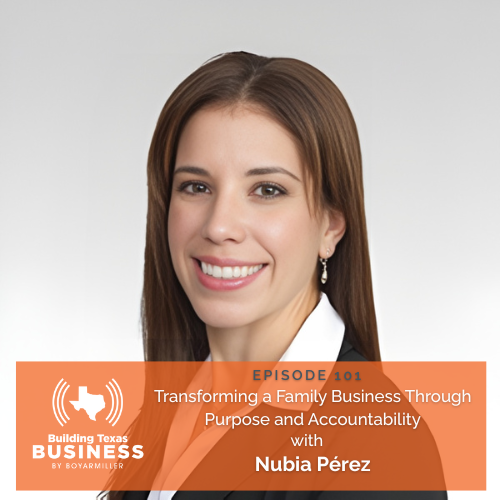
In this episode of Building Texas Business, Chris Hanslik talks with Nubia Pérez, CEO and part-owner of Gretna Machine Shop, a Houston-based precision manufacturer serving the energy, aerospace, and defense industries.
Nubia shares the remarkable story of how her family built Gretna from a single-garage operation in 1980 into a certified lean manufacturing company, and how she later transformed it through leadership, culture, and purpose.
After her father’s passing in 2012, Nubia faced a decade of uncertainty before realizing that the company’s future depended on her stepping forward. She reveals how she rebuilt Gretna from within by creating accountability, redefining its culture, and leading with empathy and transparency.
From embracing EOS to driving diversification from oil and gas to aerospace, Nubia explains what it takes to modernize a second-generation family business while honoring its legacy. She also shares her perspective on automation, AI, and making manufacturing “mindful” again.
If you are interested in leadership, culture change, and the evolution of Texas manufacturing, this episode offers a powerful look at resilience, renewal, and what it means to lead with heart and purpose.
Transcripts are generated by machine learning, so typos may be present.
Chris Hanslik: Alright. Nubia, thank you for joining me on Building Texas Business. So great to have you here.
Nubia Perez: Thank you for having me. I’m super, super excited. Okay,
Chris Hanslik: well good. Let’s get started. I want you to just start by introducing yourself and your company. Tell the listeners, what are y’all known for?
Nubia Perez: Sore A machine shop. We are a machine shop here in Houston. We’ve been around for 45 years and we make precision metal components.
Chris Hanslik: Some of which you brought.
Nubia Perez: Yes. Yeah, I have some examples here. So these are all, basically we make widgets. So for the aerospace defense and oil and gas industries. So we buy the raw material. And with our CNC machines or computer numerical control machines we make them ultra precision parts depending on what our customer require.
Chris Hanslik: Very neat. Now, 45 years in business. Obviously you are second generation.
Nubia Perez: Yes.
Chris Hanslik: So tell U.S. a little bit, how did it get started? What’s the story behind the starting Gretna machines?
Nubia Perez: It’s a great story. Gretna started in 1980 by my parents Benjamin and Ninfa Perez, and my dad was a machinist in Columbia. My parents were originally from [00:01:00] Columbia, from Medellin, and it was the late 1960s and the US was giving visas to, laborers and welders. And my dad being a machinist, he came over age 23, 24, and the one friend he had was in New Orleans, so he ended up flying to New Orleans. Story has it, he couldn’t find his friend’s apartment and he only had $50 in his pocket. So the first night he literally stayed. Probably somewhere along the neighborhood outside.
Chris Hanslik: Okay.
Nubia Perez: Because he couldn’t find his friend’s apartment, nor did he speak English at this time. And he eventually got a job there, got himself established, worked at the Avondale Shipyard, and really started gaining roots there in New Orleans. He and my mom were already dating, so he went back, married my mom. And then together, they lived in New Orleans for about 13 or 14 years. They lived eventually in Gretna. So if you’ve been to New Orleans, on the other side of the Mississippi River is Gretna, Louisiana.
Chris Hanslik: Okay.
Nubia Perez: So it’s, that’s actually why it’s called Gretna Machine Shop. ’cause my sister and I were born there, so eventually my dad worked [00:02:00] for Baker Oil Tools as a machinist and as an inspector. And he did such a great job for them that. Baker Oil Tools here in Houston said, Bennelize, call him Benny. Benny, why don’t you come to Houston and come work for Baker Oil Tools here in Houston? And he said, how about I go to Houston if I open up my own shop? And you just send me the work and I can machine the parts for you.
Chris Hanslik: Wow. Okay.
Nubia Perez: And that’s how Greta started off 34th Street, Northwest Houston in a small garage. And the first couple months he my mom was still in New Orleans with U.S., with the girls. And he would just sleep in the garage and machine parts. And then eventually my mom came to Houston with all of U.S., and he asked my mom, can you just come in and answer the phone? Just from me. And you can imagine my mom broken English, but she was able to answer the phones. So she would answer the phones. My dad would be in the back machining parts. And I was in a pack employee a year and a half, two years old. Wow. So I grew up with the company. He literally grew up. Yeah. In the company. I have very vivid me memories of my dad. [00:03:00] This was before all of the OSHA rules, smoking a cigarette, machining parts. But I would. It was all paper checks and my mom would give me a check and she’s Hey, go give the check. Paycheck that machinist go runner five wheel, again, a five wheels running in a machine shop. But before osha, before any of that, right before and I would go and come back and it was some great memories. So together from 1980 to 2012 they ran the company until my father passed away in 2012.
Chris Hanslik: Wow. What a cool story. Yeah.
Nubia Perez: It truly is the quintessential. American Dream.
Chris Hanslik: Yeah, just you can see the pride that you have in it.
Nubia Perez: Yes, it is. It is. It’s very, it’s humbling and I’m very proud to be part of it.
Chris Hanslik: So how did it come to pass that you took over or, Tell U.S. what you were doing and how that came about.
Nubia Perez: Divine intervention. ’cause it was not my plan. Okay. At all. So at this time, I have a master’s in sustainable international development from Brandeis University up in Massachusetts. So my plan was I was gonna go work for the American Red Cross or the UN and travel the world and [00:04:00] marry a Brazilian live in London. And just other, a
Chris Hanslik: Brazilian, you had a very, you were very specific.
Nubia Perez: Never met the Brazilian, but I was gonna so that was my plan. And I was able to land my dream job. So I was working for Gazprom Marketing, the world’s largest producer of natural gas and I was originating carbon credits. So I was in the environmental commodities market. Okay. So I was traveling Latin America originating carbon credits from renewable energy projects in Latin America to trade them in the cabin trade program in Europe. Super fancy, super awesome and I got to travel quite a bit. But then at the end of 2011, early 2012, the carbon market was starting to soften and my dad was starting to get sick. I honestly, I prayed about it a lot and I remember just thinking there has to be something else for me to do. Aside from working at Gret, I really don’t wanna, so I looked at pharmaceutical sales. I looked at being a teacher at anything and everything, but it was pretty clear that, gretta was where I [00:05:00] needed to be.
Chris Hanslik: Yeah.
Nubia Perez: Finally made the decision. I’ll never forget, I went to Houston’s restaurant with my mom and my dad, and I told them, all right, I’m quitting my job. I’m gonna come work for the family business for two years if Gretna. So I knew that I didn’t wanna be like this entitled, just owner’s daughter that comes in and takes over the company without knowing anything, right? So I said I either become a machinist or learn about business. Machinist seems really hard. So I decided to learn about business. Gretna was able to have me go to get my MBA from Rice and okay. So that’s where I learned some of the, just some of the mechanics, just getting my MBA and started my MBAI officially started Gretna May 1st, 2012. Started my MBA September of that year. My father passed away in October, 2012.
Chris Hanslik: Wow. That’s a lot.
Nubia Perez: Yeah, and I wasn’t. Looking back, a lot of second generation companies have their parents were the founder. Unfortunately, I have my mom from a financial accounting side.
Chris Hanslik: Right.
Nubia Perez: But the operation [00:06:00] side, my dad wasn’t there, you have a runway
Chris Hanslik: where they’re still around advising and looking over your shoulder. Maybe that’s, some of that’s good, some bad, but. You didn’t have that option?
Nubia Perez: I would say it would probably be net good. Yes, I didn’t have some of the conflicts and stuff that you maybe you have with the first generation, but he was already in hospice that summer. So I really didn’t get to really absorb a lot of the knowhow of running the shop.
Chris Hanslik: Yeah. A lot, there are a lot of family owned companies, a lot multi-generational. But that transition can’t be easy. So I think it’s impressive that. You knew enough to say, I don’t want to come in as like the entitled owner’s daughter. Tell me about, how did you manage being welcomed and earning the respect of the employees as you came in to start taking things over?
Nubia Perez: 2012 to 2022 I call it those, the dark years. Okay. Those 10 years and. What had happened looking back in retrospect, so my mom and my sister and I all after my father passed away, became owners. So the company’s still 100% [00:07:00] women owned.
Chris Hanslik: Okay.
Nubia Perez: Between my mom, my sister and I and really in those looking back. Because Gretna was an RI successful. I went to good schools, everything was good. We just assumed everything’s gonna be fine. It’s been fine, right? It’s been 35 years, like company will continue running as it did. So looking back, what I call those dark years, there wasn’t clear leadership. My mom’s title was president, my sister and I are vice president. But there wasn’t a clear vision, a clear path. There was no accountability. There was none of that. So in those 10 years, and mind you, COVID happened between that.
Chris Hanslik: Right
Nubia Perez: the company ran fine, but it was a hundred percent, pretty much oil and gas and primarily still Baker Hughes. So there was some. Issues, underlying issues that really didn’t come to surface until after COVID. And the funny story is, so I have kids, I have a 5-year-old and 7-year-old, so my team knows I, I reference a lot Disney movies ’cause that’s the world that I [00:08:00] live in. So it’s December, 2022 and I’m sitting. It’s two in the morning. I’m sitting in our living room and I’m trying to figure out, I love doing org charts, so I’m trying to figure out like, who’s gonna run this company? Is it gonna be this person? Is it gonna be this person? And maybe if I move, in PowerPoint, maybe if I put this person here. And if you’ve seen Frozen two Else, which it goes out in the cave, you probably haven’t, I don’t know if you’ve seen it, but she’s trying to figure out,
Chris Hanslik: I have not
Nubia Perez: who, she’s trying to figure out who the Fifth Spirit is. So she’s, is it this person, is this person, and finally she realizes. I’m the Fifth Spirit, and that’s literally what happened to me. I was sitting on my couch and I’m trying to figure out who’s gonna run this company who’s the most qualified? And I was like fuck. Like it’s me, like I’m the Fifth Spirit. Like it’s me. It’s time for me
Chris Hanslik: right.
Nubia Perez: To start taking on the reins. And I am one of the owners one of the daughters. I have my MBA, I have the desire, I have the get it, the one that has the capacity. It’s me. I’m the one who has to take the reins of this company. So January 6th, [00:09:00] 2023, I gave a big speech to the company and I said, it’s time. I am going to start running this company. I don’t really know what that means. Don’t really know what that entails. To answer your question, I spent the next six months doing an internship on the shop floor. So I, I don’t usually dress like this typically. I wore my Gretna shirt and my steel toes, and I just watched and asked lots of questions and didn’t make any drastic changes. I was just there to absorb and look and it’s I need to understand. Our business. Not so much from what I was doing previously the last 10 years prior, but really more on the day-to-day operations side.
Chris Hanslik: Yeah. It’s, I’m amazed that y’all, now I can understand why you call it 10 years of darkness, that you went that long without maybe clear leadership was so who, I guess no one was running the company, right? Y’all were just doing it by somewhat committee in those 10 years.
Nubia Perez: It was. It’s like a faux running. We would have meetings as with our accountant or with my mom, but [00:10:00] we were as a leadership team or as owners. My mom, I said we were focused on, we became ASI 100, which is a certification to do aerospace parts. So that’s all great. We we knew that we needed to diversify. We moved to a new building. So we did a lot of behind the scenes work. But truly understanding more importantly, like what is, where do we wanna be in 10 years? Yeah. And then working. Back and I, we had a lot of family members in the company at the time and we just assumed that things were just, just gonna get continue.
Chris Hanslik: Yeah, I guess so if you look back, what were some of that, I think there’s a lot of lessons here. What were some of the things when you look back at that and say, boy, we ignored some things that. Maybe there, but maybe you didn’t want to confront. Or, just lessons learned that you wish you had implemented something sooner.
Nubia Perez: There’s a lot. Probably the biggest thing is accountability. But in order to have the accountability, you have to have the right people. In order to have the right people. You have to have the right [00:11:00] culture. And at this time I would say it was a very toxic culture. Looking back
Chris Hanslik: in what way?
Nubia Perez: It was a, what I would call an I gotcha. Okay. You give people work, but only with the expectations of saying let me just reprimand you and make you feel like shit in that moment.
Chris Hanslik: Yeah.
Nubia Perez: Instead of, let me give you the tools, let me be very clear, my expectations are of you. And and that wasn’t done.
Chris Hanslik: Yeah.
Nubia Perez: And then I’m gonna hold you accountable because of that.
Chris Hanslik: I say, yeah, you can’t have accountability without clearly defined roles and expectations. Exactly. Exactly. That the culture you’re describing sounds like it was almost one where people were scared to act ’cause they were gonna get rep reprimanded or somehow in trouble.
Nubia Perez: Exactly.
Chris Hanslik: Exactly. What that’s was a company
Nubia Perez: exactly what it was. Yeah. And so we run on EOS so we’ve been running on EOS now for two and a half years and to really working under that framework of. Culture. Our vision, the daily, the scorecards, the, it’s all interconnected. And I think in the past, or while a lot of companies may do is [00:12:00] they just take it on one piece. I know we should have a scorecard, or No, let’s do metrics now. Yeah. Let’s do metrics, but not how that’s all interlinked with the overall picture.
Chris Hanslik: Right. That’s great. Seems to be going well, right?
Nubia Perez: It’s upward trajectory.
Chris Hanslik: Good. Yeah. And how has the diversification helped in that regard?
Nubia Perez: Tremendously. Yeah, tremendously. So we were, two years ago an even time, 80, 90% oil and gas. And now we’ve really flipped to 60 to 70% aerospace. So to make that transition. Has it hasn’t been easy.
Chris Hanslik: Sure.
Nubia Perez: It’s definitely has not been easy, but it is, it definitely gives U.S. that ability to just look into different markets. But we also don’t wanna spread ourselves out, obviously. Too thin.
Chris Hanslik: Too thin. Sure.
Nubia Perez: So really going deeper with the customers we have, truly understanding the industry needs and building up that network of other suppliers. That can really support supplying, the you have to be
Chris Hanslik: careful with growth, [00:13:00] because you can spread yourself too thin and run yourself out of business. I wanna go back though to something you said. You mentioned obviously family owned business. Second generation family leadership. But you also mentioned there was a bunch of family members in the business. And I can only imagine. That created a lot of problems when you were talking about accountability. Maybe given the familiar relationship. And you female, that maybe some others in the business were men and didn’t wanna take direction from you, or was there, did you face that?
Nubia Perez: I mean, I think with family it’s really family or non-family you said are clear roles. Responsibilities for every single person in your company, including that cousin who wants to work there part-time in the summer, right? Every single person has to have very clear roles. And then when you have, because we run on EOS, those weekly metrics based on those clear roles and responsibilities, that’s also where discipline comes in. I’m a big fan of the book Discipline is Destiny. If you don’t have that discipline of it’s, this isn’t just a once in a while, okay. I feel like it. [00:14:00] But it is that, ugh, we really have to do this today. Yes, we have to have these meetings. We have to have review these metrics. We have to. See what’s working, what’s not working. That consistency, it’s just like working out. You just work out for two weeks and expect results. You have to have that consistency. But you mentioned about being a woman. I get asked this often, being a woman in a machine shop, I personally find it to be a benefit and not you would think benefit. Being a minority, being the only woman I just. I sit in a lot of, I read a lot of leadership books and listen to all these podcasts as well about leadership
Chris Hanslik: and now you’re finally on one.
Nubia Perez: And now I’m finally on one. But so much you, you talk about empathy, you talk about communication, you talk about the importance of listening. You talk about all these just core characteristics. And I have a boy and a girl, and. I see that communication just happened naturally. I know I’m stereotyping and generalizing, but typically women we’re better communicators.
Chris Hanslik: Better. [00:15:00] No question. You’re better at communicating.
Nubia Perez: So now it’s, now there’s this awareness of, it’s really important to, to listen and have empathy. I’m like, yeah. Like I learned that and I was like four.
Chris Hanslik: Look I’ve said for years there are things we learn as just in our daily life, right? Our personal life. That somehow when we step inside the office environment we think we have to leave them at the door. Empathy’s a big one, right? Because I think corporate you have to go back years, but it maybe, I think it’s softening some, but this core, the idea of corporate culture means you leave all that and you’re inside a box and there’s clear lines and you’re not asked to maybe think or be human and you can’t stop being human. And I think that’s what we’ve learned is no, you bring all that to work with you and at work we need to. We have goals and responsibilities and things we’re trying to accomplish in an organization, but we also have to realize those are humans that are helping U.S. do it. And we have to have a human element.
Nubia Perez: Absolutely.
Chris Hanslik: And empathy and social intelligence and all those things that[00:16:00] bring U.S. together and connect U.S. as a community should happen inside a company. I believe if the company’s gonna be successful, it must happen.
Nubia Perez: Absolutely. Absolutely. I think a lot about being younger and it, I’m not knocking my dad, this is, like you were saying, this is just generationally how it was.
Chris Hanslik: Yeah.
Nubia Perez: And I remember vividly my parents saying, when you work, you leave your problems at home.
Chris Hanslik: Yep.
Nubia Perez: It’s impossible.
Chris Hanslik: Yep.
Nubia Perez: It’s impossible to do that.
Chris Hanslik: A hundred percent.
Nubia Perez: So I tell my guys we may work with robots, wanna have robots, but we’re not robots.
Chris Hanslik: Yeah.
Nubia Perez: And if. If you don’t have change perspectives and really put yourself in that person’s shoes you’re just, it just makes for a really nasty work environment.
Chris Hanslik: It’s called Grace, right? We give grace in our personal life. Something we started doing that has been very transfor transformative for U.S. is just an, at a beginning of some of our partner meetings is an open share and it’s about what’s going on personal and. It allows you to be vulnerable. And what you, what we realize, it’s [00:17:00] something we know, but we either forget or gloss over. Everybody has stuff going on. And you still have a job to get done. But we can support each other if we know something’s going on the personal side, we can be more supportive Absolutely. Rather than resentful or whatever. ’cause it feels like you’re not pulling your weight right now. And I think as a leader, you have to create an environment where people feel comfortable. Doing that and supported and doing that,
Nubia Perez: and that it’s safe.
Chris Hanslik: Yep.
Nubia Perez: And it starts with oneself.
Chris Hanslik: Yep.
Nubia Perez: So this means I have to be vulnerable, I have to be able to admit my mistakes.
Chris Hanslik: Yep.
Nubia Perez: And say, you know what? I screwed up. I screwed up. And then that gives people permission to do the same, but I can’t say, Hey, you should give this person grace when I’m not doing the same thing.
Chris Hanslik: For sure. So let’s shift a little bit. I can talk about culture and all that all day. I love it. And it sounds like you’re doing a lot to change. And mold the culture at Gretna. But let’s talk a little bit about innovation. What, you come into this business 13 years or so ago. What have you seen kind of change from an innovative technology standpoint or [00:18:00] where do you see some trends going that you are trying to position the company to be ready for so that it can, not get left behind?
Nubia Perez: Automation, automation’s a key thing when it comes to manufacturing. We still have. Operators and machinists to run our machines. But we would, if we don’t take into consideration eventually having that ability to truly run lights out and to really run unattended machining, then automation has to be a part of that conversation. I would say we’re not one of the leaders in that. Partly because of this dark ages and because we had all these other issues going on as a company. But that is now that. I have a strong leadership team and we have a strong culture, and we have a 10 year vision of where we wanna go. Now we have that space to think, all right, now let’s think about how, and we’re not gonna do it overnight, obviously.
Chris Hanslik: You don’t necessarily have to be a leader, but you have to be an early adopter. And you can’t do that if you don’t have a vision and and a plan.
Nubia Perez: Right. [00:19:00] Automation and. Whatever aspect that means when it comes to CNC Machining in particular. I see ai, right? We have, we just had my leadership meeting this morning and again, we have to have an AI strategy, a technology strategy going forward for 2026 and beyond. And not just ChatGPT, you know?
Chris Hanslik: It’s so funny because beyond that the big subtitles get always trap U.S., right? Because we, everyone just thinks chat, GPT, when you say AI and it is. So much more than that. So much more than that.
Nubia Perez: And it’s a tool, it’s a tool that we have to see how can it be incorporated in marketing and sales and operations and legal documentation, review, whatever that is. And again, it’s not a blanket, but what are some low hanging fruit that we can start getting comfortable with it? But. But first and foremost, manufacturing, definitely automation is a key component that we’re starting to have very more conversations about that. And we’re also in in an industry that it’s all about speed. So we have to figure out if we’re gonna compete [00:20:00] internationally or compete with countries we have to be able to. At least on this, in this part of the United States, deliver as quickly as possible.
Chris Hanslik: You, that, you mentioned something that made me think internationally, but then the raw materials and seed and products here. What has this year been like this past 12 months or so in dealing with the tariffs? How’s that impacted your business? What have you done to try to, navigate around that?
Nubia Perez: So raw material, obviously, clearly is one that is a pass through to our customers. So what we may see as a softening from the customer to purchase. So that, especially on the oil and gas side, has been a little
Chris Hanslik: Yeah.
Nubia Perez: Flat. And also in our quotations, so we used to. Send an RFQ and leave it open for, I dunno, two or three weeks. There was times when I said, look, this quote’s good for 24 hours. ’cause we don’t know where the pricing, what the material is going to be. Yeah. In some cases a customer supplies material for U.S.. So then that’s kinda it’s a non-starter, but probably more from a, an investment standpoint and from [00:21:00] customers actually making those purchases. That’s where we’ve seen some of the, they’re afraid to make investments, which means that they’re not
Chris Hanslik: right. They’re not to U.S.. They’re slowing down on what they need from someone like you. So it just slows your business.
Nubia Perez: Right.
Chris Hanslik: How do you see maybe the first six months of 2026 going in that regard? Do you see some headwinds, you see some things changing that might. Be, positive for the business.
Nubia Perez: So I see aerospace definitely continue to grow here in Houston and in Texas. It’s a great industry to be a part of. If you think about it, we’re known as a city to be an oil and gas city, but we’re the space city.
Chris Hanslik: That’s right. We’re both, that’s what I love.
Nubia Perez: But there’s some.
Chris Hanslik: We’re a port city.
Nubia Perez: There’s just, when it comes to, and the talk about onshoring, there’s a great excitement when it comes to manufacturing in general. In the US and here in Texas and Houston. I’m part of the Greater Houston Manufacturing Association. I’m a board member of that association, part of the National Tooling and Machining Association. And conversations [00:22:00] are definitely like, how do we make manufacturing sexy again?
Chris Hanslik: Yeah.
Nubia Perez: Like how do we make it where the young generation is excited about? Things that are being made.
Chris Hanslik: Yeah.
Nubia Perez: And there’s such a disconnect unfortunately, that someone how to make this right. It’s, I, things have to be made.
Chris Hanslik: It’s pretty interesting because you think of machine shop. This is like Really cool stuff. And clean and, yeah. It’s not what you think.
Nubia Perez: It’s not what you think.
Chris Hanslik: So on the oil and gas side though, just recently, right? For the first time we had the sale of leases in the Gulf for the first time in several years, do you think that may not be a near term? Because I know there’s a lot of investment in time, but you see that. As an opportunity in the near to midterm?
Nubia Perez: It is. And what I’ve learned just about markets in general, perception is, sometimes more than reality. So when, right when people get excited, when people hear about further investments or whether it’s this space a rocket that launches or further leases and just there’s more momentum and more excitement that, so I do think all of that helps. [00:23:00] Absolutely. Absolutely. Okay. So I’m excited about 2026 as an industry, obviously as a company, and I’m an optimist, but just in manufacturing the conversations that I’ve had outside of our company, just with the different associations and the different government Governor Abbott pushing for more, for their trade schools and more vocational schools. That’s all great. Yeah. That’s all great for U.S. as a state.
Chris Hanslik: So we come back to culture. You is. I don’t. I dunno if you got to finish the thought, but you described the old culture at Gretna as toxic. How would you describe today’s culture?
Nubia Perez: I would say that it’s open. It’s, we’ve ta we’re, our tagline is to be leaders in mindful manufacturing, which means we’re very intentional in the people we hire and our customers. Extremely relationship driven. I have all of our customers names on my phone, our sales. People do. So in a world of so much disconnect, we’d like to position ourselves as a company’s. Like we’re gonna pick up the phone, we’re not gonna hide. Yeah. [00:24:00] Your shit happens. Your part’s gonna be late. Sometimes we’re gonna scrap parts. But something that infuriates customers, ’cause they’ve told U.S., is when no one answers and picks with a phone and tells ’em what’s going on. So we are proactively having those, building those relationships. That’s how I would describe very open, very intentional. Every Friday at 6:00 AM we do these company meetings and we start out with some exercises
Chris Hanslik: Okay.
Nubia Perez: That our quality director leads, he’s a big health guy. So yeah. Then everyone in our com, the leaders of the company say whatever’s going on for that week. And then I call it my sermon, like I just talk about whatever is on my mind. And it’s usually topics that you wouldn’t normally hear in a machine shop. Empathy, authenticity the importance of of communication. To your point earlier, we’re not robots isolated. And I feel that the better home life they’ll have, the better they’ll be at work. ’cause
Chris Hanslik: I love that. I could do that here, but no one would be there at 6:00 AM on Friday.
Nubia Perez: We start early for some reason. And I don’t know I [00:25:00] should have asked my dad at some point, I don’t know why. Machine shops, we start at six. I’ve asked people, we’re like, I don’t know. We’ve just always start at 6.
Chris Hanslik: Yeah. That’s just what they do
Nubia Perez: in the machine shop industry. We start at 6:00 AM No idea why. And maybe because the most ’em, our air conditioning are, I don’t know.
Chris Hanslik: What’s the cutoff time?
Nubia Perez: Two, so eight hours, two 30. Okay. And then with overtime, maybe to leave time for overtime
Chris Hanslik: to maybe and interesting then second shift.
Nubia Perez: And
Chris Hanslik: so you, you clearly have stepped into a role that you, sounds like you didn’t want or wasn’t sure you wanted, you never met the Brazilian?
Nubia Perez: No. I am happily married though.
Chris Hanslik: Okay good.
Nubia Perez: We’re good. I.
Chris Hanslik: But, and then I’m impressed by how you took on yourself to learn leadership. So just a little bit on, how would you describe your leadership style and how do you think it’s evolved since you’ve stepped into Gretna?
Nubia Perez: So about a year and a half ago, I had the CEO of a client of ours asked me, what has shocked you most about being a CEO? And I said, I didn’t appreciate how much time I was gonna spend internally. [00:26:00] Really thinking and I didn’t think that was gonna happen. So I would say right now I would like to consider myself a transformational leader. One who I truly love finding the spark in people.
Chris Hanslik: Wow.
Nubia Perez: And what is their higher calling? What is it that gets them excited? I’m a big being EOS, right person, right seat. Get it when it has the capacity. If you. Position people in a place where they’re that you’re not setting them up for failure, where they truly are following their God-given gifts. I think they can do great things and that for me is more exciting. So I would like to see the success of a comp of our company being almost the result or the consequence of just having people just be successful. It’s oh, and by the way, because they’re successful, I have an amazing company, but if I have
Chris Hanslik: Yeah. Each individual, right? Yeah. Makes the whole,
Nubia Perez: but if you invest in people and we say we don’t just invest in machines, but truly invest in people. And at the end of the day, people just wanna be seen, wanna be heard, wanna [00:27:00] feel valued. And if you give people that space to grow then you really don’t have to motivate them. They find it internally.
Chris Hanslik: Yeah. That’s great. Yeah, that’s, well look, I love how you tell a story of the dark 10 years. It’s, it seems obvious to me you’re in the beginning of a very bright 10 year future. So I want to thank you for sharing that story with U.S.. I do want to ask a little bit before we close what do you like to do to recharge or unwind?
Nubia Perez: Couple of things. I’m getting my yoga certification just because that sounds something fun.
Chris Hanslik: My youngest daughter just got certified in Pilates.
Nubia Perez: Yeah, just fun. I’ve been practicing yoga for 25 years. I’m just. Kind of something I do. But being with my family, so again my kids, they’re such a because we had our children later in life, I have a lot of friends whose kids are now in high school and college, so they’re consistently relish these, this age. They’re great. So I’m constantly reminded. I’m still enjoying the snuggles and sitting on the couch watching Elf. Getting lots of kisses at night. And frozen. [00:28:00] And frozen and yes, that is the world that I live in. Okay. So spending time with my family.
Chris Hanslik: Awesome. All right. So do you prefer Tex-Mex or Barbecue
Nubia Perez: Tex-Mex? Yeah. Yeah. No. Yeah, though I do like Good Company’s brisket.
Chris Hanslik: There you go. Another plug for Good Company. So well, look, I’ve known you for a while. I’m so proud of what you’re doing at Gretna, and like I said, no, no question that you’re got everything going in the right direction and couldn’t be happier for you.
Nubia Perez: I hope so.
Chris Hanslik: Thanks for being here.
Nubia Perez: I stand on the shoulders of giants.
Chris Hanslik: You’re doing a good job,
Nubia Perez: so thank you, Chris.
Chris Hanslik: Take care.
Nubia Perez: Thanks.
With a deep understanding of your business alongside clear and honest communication, we help clients face challenges fearlessly.
Learn more about our services and how we help clients.