


With a deep understanding of your business alongside clear and honest communication, we help clients face challenges fearlessly.
Learn more about our services and how we help clients.


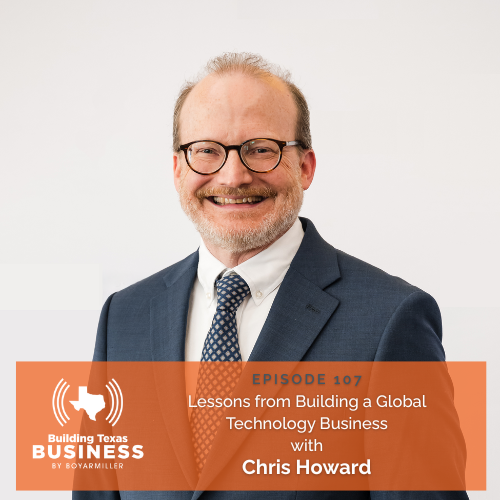
In this episode of Building Texas Business, Chris Hanslik sits down with Chris Howard, founder and CEO of Softeq Development, for a conversation about entrepreneurship, innovation, and building a technology company over nearly three decades.
Chris shares how he started his business after leaving IBM, the early risks he took, and the lessons he learned while growing Softeq into a full-stack engineering firm working across hardware, software, and emerging technologies. He explains how a mindset of constant learning has been critical to staying relevant in an industry that continues to evolve at a rapid pace.
Chris and Chris discuss what innovation looks like in practice, how business owners can think about adopting new technologies, and why curiosity and adaptability are essential traits for long-term success. The conversation also explores how artificial intelligence is changing the way companies operate and what leaders should be doing today to prepare for what comes next.
The discussion also highlights lessons in hiring, culture, and leadership, including how to build teams that can grow with the business and deliver consistent results over time.
If you are interested in entrepreneurship, technology, and leading a business through constant change, this episode offers practical insight from a founder who has done it for nearly 30 years.
Transcripts are generated by machine learning, so typos may be present.
Chris Hanslik: Chris, it’s great to meet you. I want to welcome you to Building Texas Business. Thanks for taking the time to come on the show.1
Chris Howard: Absolutely. Thanks for having me.1
Chris Hanslik: So I think the best way to start is just for you to kind of just introduce yourself and your company. What do you do and what’s the company known for?1
Chris Howard: Sure. Yeah, so I started Soft Tech 29 years ago, actually. So we’ve been at it for about three decades. We’re based here in Houston. It was around my interest of what I called technical software development, which to me meant innovation. I used to say back in the day, don’t hire us to do your website. I wanted to do something new or innovative. I started my consulting career by doing things like for MedTech. Like, you know, threading a catheter through your leg and surrounding your heart with sensors and converting that data from analog to digital and displaying in a high res display and then writing it in real time to a right once read mostly optical drive. And that was back.1
Chris Hanslik: It sounds like easy stuff. Yeah. That’s right. Wow.1
Chris Howard: That would be interesting project even now, but.1
Chris Hanslik: Yeah.1
Chris Howard: But yeah, when I founded Soft Tech, it was actually my second company, but the first client was Compact Computer back in 1997. And again, it was creating the first PC-TV hybrid. It was the first computer with a television built-in, first DVD drive, and it had a 36 inch monitor, which back then it weighed 200 pounds, right? We actually had something that we called the Texas remote. It was a remote control. It was about this long, had a ball handle, had a trigger underneath and a track ball on top. And you literally felt like you’re pointing a 45 at the screen as you navigated it around.1
Chris Hanslik: That’s hilarious. Yeah.1
Chris Howard: So I describe the company as a full stack hardware and software engineering company. So we do everything from hardware, firmware, mobile, web back end, AI, ML and data analytics onto one roof. So something like smart devices and IoT and wearables checks all the boxes. Not every project does, but that’s really more in our sweet spot.1
Chris Hanslik: Okay. It’s fascinating. Well, it’ll be basically 30 years old. So congratulations on that first. Thank you. You know, you hit immediately on a subject that I like to talk about usually later in that episode, but I’m going to kind of go there now. You talked about innovation and always love to talk about what business owners and entrepreneurs do to be innovative. And it sounds like that was really the impetus for you even starting the business. But what really intrigues me is software changes so often and so rapidly, and maybe less than 30 years ago, or maybe from your view, it still was, but certainly today, everyone agrees it just changes so quick. What do you think has been the key for you in Soft Tech to maintain that kind of innovation edge and not render yourself obsolete or stay ahead of the game so that you’re still providing value to your customers. Yeah.1
Chris Howard: Well, I think that I’ve always had an attitude of constant learning, which is what excites me about that space. And I would always talk about software and the software industry was like drinking from a fire hose. Although I think now they’ve really turned it up now. It’s more like a fire truck. The thing for me, I mean, I started my career storing code on paper punch tape, literally holes in paper. And then my first and only programming class was at the University of Houston was Fortran. And we were, again, storing code and paper holes on Hollerith cards, right? So that’s where we’ve started from. And of course, since then, I taught myself over a dozen different programming languages and just really tried to learn everything I could about the space and always learning the next new big thing, right? And so it’s definitely only accelerated over the years. We’ve gone from, you know, something like, oh, we’re going to go from a semi-language to basic Pascal, C C sharp, ARB oriented programming. And now we’re into AI and AI development and using AI to develop software and programming. So you constantly have to be willing to learn and grow in this environment in this space. Otherwise, yeah, you’re not gonna last very long.1
Chris Hanslik: Yeah, so true. Yeah, I think it’s it’s obviously very true in software. I think that’s probably true in any industry, right? If you’re not continuing to learn and involve. You know, there’s always gonna be advances in whatever space you’re in to try to stay on top of. What have you done to kind of instill that into your team?1
Chris Howard: Yeah, well, I mean, that’s one of our core values is innovation. We have five main values. It’s trust, empathy, collaboration, commitment, and innovation. And so we’re constantly trying to reinforce that both in your career and for our clients. I’ve seen, you know, not everybody wants to do that. You want to hire toward your culture. Some people just want to do one thing and do that one thing forever. I’ve read into developers in the past. I remember one guy actually quit because he said, I only want to do ASP.net development. Well, that’s a pretty narrow category, right? I mean, you know, my DOS skills aren’t doing anything for me right now, right? You know, so if you’re not learning new stuff, if you’re not having your finger on the pulse of, you know, what’s new and interesting, you know, you’ve got the LLMs right now, you’ve got cloud code, you’ve got open AI, you’ve got open cloud, you’ve got all this stuff that’s all coming on. And I’m just talking about this year, right? You know, so if you’re not constantly looking at that. I do that through our Slack channels, by posting what’s new, by encouraging people to incorporate that into their job. And it’s not just development, right? I mean, this is affecting everybody across marketing, sales, administration, finance. If you’re not out there experimenting right now with what AI can do for you and your role and your responsibility, not necessarily vibe coding a mobile app. But if you’re an accountant and you’re not clicking the Gemini button in the top right corner and starting to experiment on what you can do with AI, you’re just going to get further and further behind.1
Chris Hanslik: Right. So true. The saying is, if you’re not moving forward, or if you’re staying stagnant, you’re getting behind. Keeping on that, I guess what then from where you sit, do you see some of the trends around AI going over the next six, nine months because it’s so fast unless you can look out a little further and share that?1
Chris Howard: Well, I mean, AI is definitely a wild card. It is a brave new world. I’ve been hearing about AI for 40 years. We’re always trying to wait for the coming of AI. But what I’ve seen in the last year is that it is suddenly become useful. You’ve seen with Gen AI, whether it’s for images or video, now for software development, it’s a real thing. And it’s a real tool. And it’s really useful. The challenge is like how does it affect you and your business? How do you leverage it in your business? I think for any startup founder or any current business owner needs to understand that they need to be looking at what’s available in AI and how do they leverage it in their own business because otherwise somebody else is going to do it.1
Chris Hanslik: And is going to eat your lunch, right? The challenge is, yo, there’s so much overwhelming information. It’s like, where do you start? I mean, we have people calling us up on the phone like, hey, I want to add a height to my business. What should I do? And it’s like, well, that’s a very broad question. We really have to dig into what it is your business does and what we could do in order to leverage AI and make your business more productive.1
Chris Howard: I’ve heard similar people in your field talking about the same thing. You have to start with breaking down the tasks that you do to run the business or a certain aspect and then figure out within those tasks where automation can be implemented or applied to help you be more efficient. So we kind of jumped ahead because I told you I’d like to talk about innovation in the business. Let’s go back to the very beginning. What was it that prompted you to start SoftTech 29 years ago. Yeah.1
Chris Howard: Well, I mean, I think I always had maybe the entrepreneur mindset. I started my first business back when I was in college, right? I was working at IBM and just saw some of the other engineers doing side projects. And I remember this was IBM down at NASA during the shuttle days. So they had an IBM PC in the hallway. And I remember one of the engineers said, well, why don’t you become an expert on that thing? And I thought, well, that’s a great idea because they didn’t know what to do with it. Right. So within a couple of weeks, I had convinced my manager to move the department’s only PC and put it on my desk. And then from that point on, I just learned, you know, tried to learn everything I could about it. And then as the other engineers started to get computers, I was the expert because I had actually read the manual, right? So they were coming to me for advice. But I saw these guys doing side projects, doing consulting projects, starting to do programming outside of the company. I thought, well, why don’t I just print up some business cards, Chris Howard consultant and try to see what I could get. And actually did get a project for a doctor in the med tech space, that one that I talked about earlier. Yeah. And, you know, I was commuting all the way from this is here in Houston. So I was from Sharps Down to Clear Lake, which was like an hour drive. And then from clear all the way downtown to go to U of H at night and then home again. That was my route. And so, this guy said, Hey, I’m all in on this project and, you know, I want you to, you know, quit your job at IBM and, and, and write this program for me. And I thought, well, I’ll do that if you pay me like a month in advance and give me a one month notice. Right. And I thought, I had a computer that I bought at home using my IBM credit card. I thought, well, and I had kids. And so I thought, well, I could work from home and do this job, make more money than I was making as an intern at IBM and go to school, right? Maybe even go to school full-time. And so it was really kind of like the first time, like, said the work from home thing. Of course, back then there was a lot of stigma of working from home. And so for me, it was an opportunity to make more money and be closer to my family and get my education rather than having to spend two hours every day in the car. And so that’s that that was really impetuous. Now, my family thought I was probably crazy. Like back then IBM was the gold standard of companies, right? I mean, you’re at IBM, you know, you had it made, right? And so, you know, like, you’re, wait, you’ve got two kids and one on the way and you’re quitting IBM and you don’t have your degree yet, you know. This is a little crazy, but my mindset was always a little different. I always viewed it not like I was giving something up. I viewed IBM as a safety net. Basically, I could always go back and get a job at an IBM or at IBM rather than like, this is an opportunity I’ll never get again. That’s not how I saw it. And so I felt safer. A lot of people, like, I can’t start a company. I have a family. I kind of felt the opposite. I need to start a company in order to support my family. And maybe I just was a lot more comfortable with risk than some people. Some people want that paycheck every Friday. But if you’re an entrepreneur, you have to figure out how am I gonna pay everybody? How am I gonna pay my staff of 10 or 20 or 200 people? I gotta make payroll on Friday. And if you’re the type of person who enjoys that kind of challenge and can manage that level of stress, then the startup life is for you.1
Chris Hanslik: Well, certainly you hit on something there. I think the common thread among many entrepreneurs is the tolerance for risk, and maybe the excitement around that risk because of the eventual and hopeful reward. And so it’s just a mindset. I mean, there’s no other way to say that some people have it, some people don’t. It doesn’t make anybody bad or good. It’s just that risk tolerance and what it does to kind of energize you to figure it out and make sure it gets done.1
Chris Howard: Yeah, I think the risk tolerance plus the curiosity of like, how do I run a business? How do I get an 800 number? How do I put a website together? How do I do sales? How do I do marketing? How do I develop a product? How do I support clients and customers and the challenge of growing a business? So when I started my company, it was pre-internet. And I remember the only real business place that I knew of was to go to something called SCORE, which is the Society of Retired Engineers, something like that. And I remember them giving me a mimeographed or copied pamphlet about the different types of businesses and sole proprietorships and what the difference between a C Corp and a S Corp was. And that was about it. So I really did have to figure out a lot of things on my own. Now things have changed quite a bit. And for the positive, there’s just so much more information out there if you wanted to start a business. And a lot of education in the colleges as well. I mean, here in Houston, we’ve got the number one graduate program for entrepreneurship at Rice University, which has been number one for, I don’t know, five, six years or more now. Same thing at U of H and number one undergrad program for entrepreneurship, which I wish was there when I was going to college. Although admittedly, I did eventually drop out. I had one semester left of my electrical engineering degree. And I was going to night school, but by then I had a family and I had a business. And so I, I, I say, I checked the entrepreneur box and dropped out of college. Right.1
Chris Hanslik: So anyway, you aren’t alone in those that have done that. And it didn’t seem to hold them back. So, well, so let’s talk about the kind of, so you get, you get started. In those early days, I mean, what were some of the things that you look back, some of the learnings that may be, maybe decisions you made that didn’t go like you thought they would, but you learned from them, got better because of them, and it’s helped you continue and grow the company to where it is today.1
Chris Howard: I think, again, it’s that constant learning mindset, also just experimenting. And of course, like you said, learning from your mistakes. I remember taking out the first ads in programming magazines. The first company I had was a graphics toolkit company. So I was advertising in like Byte Magazine and Dr. Dobbs Journaland stuff like that. I’m like, I’m going to run these ads and I was kind of got a nabbered with, well, I’m going to sell this for $99 a tool kit and I only need to make, you know, I only need to sell, you know, 20 of them a month in order to make more money than I was making that minimum wage and things like that. But, you know, the first thing that happened was I started getting these calls on my 800 number and it was other magazines trying to sell me ads because I saw I was an advertiser in this magazine. I’m like, wow, now I’m paying for the 800 number just for people to sell me things. That was the idea. The turning point in that company was I did finally get like we worked on it for a while. We finally got reviewed in one of those magazines. And the weird thing was we got reviewed in the magazine and then we got reviewed a second time like a week or two later. I think even by the same magazine it was PC week back then was one of those weekly magazines. And that’s when things really turned around. Once we got that exposure. The other thing I was doing was writing articles and magazines and having a byline. The thing about people seeing things in print and you’re suddenly like an expert, right? Although it was a little bit daunting because I was writing articles for programmers in a programming magazine. He always had something like a little bit of fear of like, well, what if I’m stupid? Right. Someone calls you out. Yeah, that’s right. I’m going to show like whether I really know anything. I ran my business out of the house for quite a long time back then and then did eventually run and back then if you didn’t have brick and mortar, you want a real business, right? And so, but I did eventually get a business. The challenge on that one one learning mistake I think was I did eventually get an SBA loan to grow my company and moved into a nice bigger office and had furniture and all that stuff and felt more legitimate but at the time the SBA really wouldn’t let me spend the money on things like hiring more developers or programmers. I had to hire it. I had to spend it on things like office space and furniture and fixed assets and things like that. Well, that wasn’t stuff that was really going to help me in my business. It wasn’t helping me build a new product. No one was coming by my office in order to buy product at that point. If I had to do it over again, I wouldn’t have gotten that SBA loan at that point in time because it wasn’t really helping me and then it just ended up to be debt that I had to service and I didn’t need it. I’ve always grown my businesses through cash flow. Soft Tech, of course, is a services business. I’d say the challenge with, I mean, it’s probably a good or bad thing. I mean, the thing about Soft Tech and services and international businesses is that banks don’t really want to loan you money, right? Investors also don’t want to invest in services businesses because you can’t show that hockey stick growth. But a lot of businesses aren’t VC-backable or investable. So over time, I’ve been able to grow the business. And it’s a very good business now, but it’s, you know, it wasn’t something like you’re going to get credit lines at the bank and that’s always been a little bit of a challenge. I’m trying to think of some other lessons learned, but yeah, that’s a great one.1
Chris Hanslik: I think I think this idea that you have to understand. Really, your business and where it sits in the marketplace, right? And you’re right. Is it going to be right for outside investors or not? And if the answer is not like you determined, then you really got to figure out how to be smart and to grow the business and scale it and get the resources you need to make it successful.1
Chris Howard: So I think because of that, then when I started Soft Tech, I actually did the opposite. I had an office with that business, but I ended up like, well, no one ever comes by and I’ve got all this overhead. You know, what if I actually moved the business back to my house and I had like two rooms of my house, and, and, and ran it from there. And instead of paying rent, I actually got a T one line to my house and spent like $2,500 a month. And I’m like, this is going to be my rent on the information super highway. And I had 10 computers and a network and a server and I was running it out of my house. And so of course, fast forward many years later, like just a few years back, you know, people were like, how did, how did the business change for you over COVID? And I said, well, I think the world just caught up to me because I was running my business out of the house for 10 years. And then we homeschooled our five kids back when probably only 100,000 people in the US were homeschooling. And now everybody suddenly found out that you could do those things. So what I’m happy about from an entrepreneur is the stigma has been removed from running out of your house. And people understand that you can work from home and be a legitimate business. Because back then, I had opportunities with companies like Compaq and HP and Disney that were multimillion-dollar opportunities. And I had some trepidation. Like, well, what if they suddenly find out I’m a guy that’s just running a business out of my house? What would happen? But, you know, the topic either never came up and they didn’t really care or in the case of Compact, they actually did come by and do a site audit after I moved from my office to my house. But they’re like, Hey, this is great. I love this. I wish I could work here. Yeah.1
Chris Hanslik: You were just ahead of your time by decade or so.1
Chris Howard: I think the world caught up to me at that point. Of course, now we have offices all over the world. We have an office in Munich, an office in Vilnius, Lithuania. We have an office in Guadalajara, Mexico. We’re headquartered here in Houston. But I do spend quite a bit of my time still at my house, even though it’s like my office is two miles down the road. Because if I’ve got 10 meetings that day, I’m not just going to go and sit in my office and do the meetings. I might as well be at home taking those calls.1
Chris Hanslik: So you mentioned the growth. What are some of the things that you think you’ve done well in a process, if you will, or just learning to build the team the right way.1
Chris Howard: Yeah. Well, I think from the beginning, I tried to set up Soft Tech as a business. When I started Soft Tech, I could have been Chris Howard consultant and been hired by Compact to do that project. But I understood that businesses are like an API. Other businesses know how to work with other businesses. I started Soft Tech. I’ve got my SoftTech.com domain. I started email addresses like sales at SoftTech.com and support at SoftTech.com. I had an 800 number. I had a headquarter address. All of that was an API for Compact to interact with. A couple months into the project when I was delivering the product for them, and by the way, even on my business cards, I didn’t say founder or CEO. I said, Chris Howard, senior software developer, because I thought, well, it’d be kind of weird to be at Compact and be the CEO sitting there coding, right? So once I was delivering the product for them, they’re like, you know what? Soft Tech is one of our few vendors that’s actually delivering quality code on time. Let’s give them more work. Let’s give Soft Tech more work. And if I was just Chris Howard, they wouldn’t have given me more. They’re like, well, Chris is fully loaded. So when they said, hey, can you do more? I’m like, well, absolutely. And so then I just started bringing on more people behind the scenes. And so you look at like 30 years later, I still have soft.com. I still have sales at soft.com. I still have all these APIs. The only difference is now we have hundreds of people behind that. And I just always operated as a business or the business that I wanted to be so that these Fortune 500 companies would interact and knew how to interact with me and knew how to issue a PO and things like that. So that’s always, I think we’ve been good at doing business with the Fortune 500. One, establishing the trust that we can deliver that product to operating as a business that has an API and that they understood how to work with.1
Chris Hanslik: I think you hit on something that’s so important. There’s so many things to go into running a business, but at its core, you’ve got to deliver good products, quality, whether it’s an actual service or a product. The best way to gain a reputation in the market is deliver quality products on time, that’s going to generate repeat customers. That’s going to lead to those customers maybe making referrals or plugs for additional business to you. So as you were interviewing and growing the company, are there things that you do to kind of look for certain qualities to make sure someone’s fitting the culture that you have there at Soft Tech?1
Chris Howard: Yeah, absolutely. And like to your point, like you said, my pitch on that is if you do what you said, when you said for how much you said, turns out the client keeps coming back to you. That’s how you’re going to get SOW number 38 with the client, right? A lot of companies can get that first contract with an HP or Verizon or somebody, but if you don’t deliver, you’re not going to get that next one. As far as hiring, I think that’s been one thing that I’ve been fairly good at is identifying talent and quality. I have a different approach to that, maybe partly because I’m not hiring because of the degree you have because I don’t have a degree myself, right? And so I’m hiring more for skill level and so I’m evaluating you know someone’s you know ability to be a problem solver. Like if you’re a developer for example, I actually have people code in my in my interview, right? In my something simple like, hey, write me a quick function that reverses a character in a string and I look at see how they approach that problem, how they’re asking me questions, did they ask me about requirements, did they ask me how that string is terminated, did they ask me about memory, and then, you know, once they do that, you know, I might see a bug in there, I’ll ask him to find the bug. Or then I’ll turn the parameters around like, well, let’s say you don’t have much memory. How would you write this program? Or how would you make this function faster? And so I’m getting a better feel for how they actually operate and work in their job. And I’ve done a pretty good job at identifying good developer talent. I’ve had engineers say, well, I’ve never been in a company where I’ve had so many great engineers in one room. How did you do that? These are guys that are used to being the smartest guy in the room and now they’re suddenly feeling like maybe they’re not. And those same people, like even when we went to places like Belarus for example, I had to convince people to come work for me when I didn’t even have a business there yet. I had to convince them to quit their paying job and come work for me and I don’t have a logo on the building, right? I mean, that’s a particular challenge. And now many of those guys are now working at companies like Google. I just saw another guy, he just had his 15th year anniversary. He worked for me for five years and then he went on to work for Google for 15, right? So I’m happy when people come to me, grow in their career and then take that next step, right? So yeah, definitely, trying to evaluate people for skill level, and that can apply even in a sales job or a marketing job or whatever. You know, try to get to the point where you’re not just looking at a CV, but get them to do something in, you know, that’s related to their job, have them pitch you, you know, in that meeting. Like, sell me that’s this pencil. Yes. Right, you know. Yeah.1
Chris Hanslik: Well, I love that because we started doing that and trying to implement that here at the law firm, that skills aspect of the interview process. And it’s certainly one, I think it makes sense in any job, as you mentioned. Hiring programmers, I mean, it seems to be a natural deal where you can say write a little code and test them. We’ve tried to come up with some things here that we could do once a candidate gets to a certain point in the interview process. I can tell you, attorneys don’t like it. We’ve had some people really bristle. But also my view of that is then we found something now you know during the process to figure out is this really gonna be a good fit or not and that’s that’s what the process is meant to do is trying to find people that are gonna fit the culture in the environment of your organization and I know it can be a little bit easier to do it’s like with software, but I mean I think the other thing like1
Chris Howard: That I would do for the developers is find out, you know, have you ever written a program for fun, right? What have you done at home? You might be going to college, but if you haven’t done any program and you haven’t maybe done any open source work, you haven’t just written something for yourself, you know, it’s kind of indicating like your passion in that space. Are you trying to learn on your own versus, you know, just taking courses at a university? It was a passion and curiosity, right?1
Chris Hanslik: How curious are you? I think there’s a we use that term around here quite a bit, but it’s good to be curious. And to me, at least in the work space, there’s an indication of someone’s interest in learning if they’re curious about things, right? So let me ask you this. So as you sit here in 2026, what are some of the headwinds and challenges that you feel Soft Tech is facing and that you’re either addressing or trying to prepare for?1
Chris Howard: Yeah. Well, again, definitely AI is one of those game changers. I mean, there’s talk about, you know, AI replacing developers, right? And you don’t need developers anymore.1
Chris Hanslik: I’ve heard that. Yeah. Open call is going to, you know, substantially reduce the number of developers you need.1
Chris Howard: Well, right. And then same thing I’m sure with legal, right? It’s like, well, there’s a lot of things in legal that might be automated through AI, NDA reviews, et cetera. But as I look at it, I see it more of an opportunity than an issue. And I think that’s also something that I’ve had in as an entrepreneurial mindset is like, how do you turn a problem into an advantage? What I see with AI is that, you know, definitely it has the potential to make developers faster and more productive and better programmers. I just see it as a natural progression of, you know, in the beginning you had to flip switches to program a computer and then you could write a semi-language and then you could write basic and then you could write Fortran and then you could write cobalt and you’ve got C, C-sharp, object-oriented programming. And then syntax highlighting, all this other kind of stuff. And then on top of that now is AI. But in all cases, you still have to understand the development process. And it’s just that maybe you’re not necessarily typing the characters yourself, just like you’re not having to flip switches anymore. But you can leverage a tool like Claude or Sonnet or some of these others that to describe the problem you’re trying to solve. But you still need that human element to do that business analysis and the architecture and how you want to approach the solution and the innovation part of it. I mean, that’s one thing that the AI isn’t going to do for you. It’s not going to necessarily innovate. It might not necessarily have an opinion on whether you should implement it in Python or .NET or what microprocessor you should use for your solution what version of Linux you should run or something like that. So you’re gonna have to still understand how it works. Another analogy that I’ve used is that you’ve been able to translate English to German, right? And for a long time, but how do you know what the quality of that German is if you don’t know German? And it might say exact opposite of what you were trying to say, right? So if you don’t have some oversight of the process, and I think now, the complexity has also gone up with AI tools, right? If you actually do a deep dive, I just did a webinar yesterday with NVIDIA about vibe coding, right? And there’s a lot that goes into, you know, he was talking about how he spent a whole month basically preparing for the code generation where you’re writing markdown files and you’re describing security and you’re describing requirements and you’re describing coding standards and you’re doing, how you’re going to do your automation and your testing and things like that. And so that stuff is all things you still have to know in order to write a quality enterprise solution. You can do some prototyping and things like that, maybe see if there’s something to be of interest. But when you take that next step of like, now this thing’s got to get out there and be secure and serve thousands or millions of clients, is it architected in the best way? Right? I see that maybe the billing model changes and it’s not so much by the hour. It’s more by the outcome, which is something that we’ve always tried to do from the beginning anyway. And probably legal is very similar. I mean, I know there’s a lot of hourly based stuff, but maybe it’s moving more toward our senior level people understand legal or software development really well, and using AI as a co-pilot makes them even better and more efficient. That doesn’t mean it all gets cheaper.1
Chris Hanslik: That’s what we’re facing, the more and more the project billing or task-based billing as opposed to hourly. For all those reasons, everyone is trying to implement and then from our client perspective summer, you know, expecting the use of AI to be more efficient. And then, like you said, you have to have a base understanding to know is what it’s giving you accurate and. Did you do it in a secure way? And there’s rules of ethics involved. There’s all kinds of complexities to it. But it shouldn’t be viewed just because of complexities as a deterrent. It should be used as an opportunity because if we can do more and if we can change how we price what we do, we actually can become more profitable.1
Chris Howard: Well, more profitable and the outcomes can also scale and you can do more faster. So that’s great for clients.1
Chris Hanslik: It doesn’t have to be cheaper. That’s right. So let’s just turn quickly. I mean, I guess, so you started this company almost 30 years ago. You actually grown it to a very impressive scale. How would you describe yourself as a leader?1
Chris Howard: Yeah, good question. Well, I mean, I’ve always aspired to create a business that people want to come to work for. I think that the, our values that I gave earlier, really my personal values of how I run a business. I like to establish trust. I like to have empathy. I like to do the innovation and the collaboration and that’s the culture I try to build for people coming to work. I think over time it seems people do like to work for me, which I’m proud of. And I’ve also been able to do that cross-culturally. I saw the challenge of like, how do I start a company in a country like Belarus, right? And we’re English is a second language. And you’ve got this American there, this trying to convince you to join a business, right? And so I’ve enjoyed those challenges. But I think that having that, I think empathy is a big factor of that and trying to give people the ability to grow in their careers. Our mission is actually creating a better future for you and by that what we mean is for our clients by implementing their solutions. for our employees, for giving them the ability to work on meaningful projects no matter where they’re located in the world. And as for our communities, how do we give back to our communities and create a better future locally? And a lot of what we’re doing here in Houston is around how do we give back to startups and and do mentoring and participate in those types of activities. And then also in other parts of the world, it might take the form of, like in Belarus, it was more about donating time for orphanages that had kids that were early impacted by things like Chernobyl and those types of things. So that’s how we approach it.1
Chris Hanslik: That’s great. Everything you read said it’s important for the people that work in an organization to have and feel a connection to the organization and what it stands for if you’re going to have a chance of retaining them, right? So it sounds like putting those values into action in that way can create that engagement and that retention.1
Chris Howard: Yeah. So when I started 30 years ago, I didn’t really, I always thought culture was something that just kind of happened, right? You know, it’s been the last 10 years I’ve been, uh, had more intention around culture and there was more awareness of companies creating culture and things like that. So, I don’t think it was a, it was really a thing 30 years ago, I guess, you know. And so I think that that having that intention and making sure you’re hiring people to do fit your culture, people that do want to learn, you know, do have that empathy who can build the trust, who do want to collaborate, you know, it kind of just reinforces all that. So, you know, if there are, you know, would be entrepreneurs listening, you know, I would say trying to be, you know, purposeful about what kind of culture you want to build in your company is something definitely to pay attention to.1
Chris Hanslik: That’s great. That’s kind of a great way to kind of just end the serious side of this conversation. I mean, I just really appreciate all you’ve shared with us a couple of things just before we wrap up. What do you like to do to just kind of relax and unwind or recharge?1
Chris Howard: Well, I’d say family is very important to me. So we did have five kids. They’re all in their 30s and 40s now. We have three grandkids. We have our eight-year-old daughter we’ve been raising since she was one. And so I like to do a lot of things with family. And really focus on that. Another reason why we homeschooled, spending a lot of time with them. I do read a lot. So I have a goal this year of reading 50 books. And I’m on track. I’m actually three books ahead on that right now, so far in the year. So I have a pretty good shot at making it this time. I’d say, especially as an entrepreneur, making sure you carve out time for family because it is a long journey and it is stressful. I think that’s one thing that I’ve also done is always been there for the nighttime routine especially and then also tried to be there for you know, the big events. I mean, our eight-year-old had an event earlier today at her school, but I was able to attend. And that’s one thing that I think entrepreneurship allows you to do, is actually, if you do it right, it actually gives you the flexibility of being there for those events, being there at the baseball events, being there at the recitals. Because you can do that. I’ve tried to do that. Not just as an owner of the company. I’ve tried to do that for all of my employees. You need to do something in the middle of the afternoon. Go do it. The trust factor there is make up the time in some other way, shape, or form. Absolutely.1
Chris Hanslik: To take half a day off or a day off every time you want to do something, go pick up your car or go to your son or daughter’s recital and, you know, make up the time on Saturday or whatever, right? I mean, it’s all- Yeah, but get the job done, right? Yeah, exactly. Just do the job.1
Chris Howard: In outcome, basically, we’re talking like, just get the job done. I’m not looking for like 40 hours, either. Just get the job done. And I’m happy, you know, but giving them the flexibility to do that.1
Chris Hanslik: Very good. I love that. So, last question. Do you prefer Tex-Mex or barbecue?1
Chris Howard: Well, I like both, actually. But, you know, that’s the good thing about Texas is there’s no shortage of steak and barbecue and Tex-Mex, you know? Yes. We’re very fortunate. Yeah. I think a lot of people don’t understand that Houston is one of the most diverse cities in in the United States. And as such, we have every kind of, you know, cultural food that you can imagine, you can get authentic, you know, absolutely here in Texas. But but I’ll I’ll check the C box both. I like both of those. OK, I’ll give you that out. Yeah.1
Chris Hanslik: So Chris, man, this has been so fun. I said, I think before we got started, I think this is the first other Chris that I’ve interviewed on the podcast and we didn’t get mixed up with each other. So that was good. Kudos to us.1
Chris Howard: You can title it Taylor to Chris’s. I don’t know.1
Chris Hanslik: I like that. I like that. Maybe that’s what we’ll do. So, but thanks for the time. Congratulations to all the success you’re having there at Soft Tech and what I know will continue in the future.1
Chris Howard: All right. Well, thanks for having me and allowing me to share.
With a deep understanding of your business alongside clear and honest communication, we help clients face challenges fearlessly.
Learn more about our services and how we help clients.