


With a deep understanding of your business alongside clear and honest communication, we help clients face challenges fearlessly.
Learn more about our services and how we help clients.


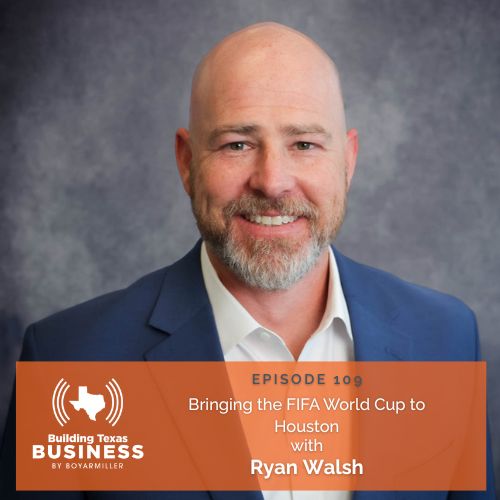
In this episode of Building Texas Business, Chris Hanslik sits down with Ryan Walsh, CEO of the Harris County-Houston Sports Authority, for a conversation about Houston’s growing role as one of the country’s premier destinations for major sporting events.
Ryan explains the mission of the Sports Authority, how the organization helps attract and support events like the Super Bowl, Final Four, World Baseball Classic, and FIFA World Cup, and why those events create meaningful economic impact across the region. He also shares how Houston’s venues, hospitality industry, public partners, and business community work together to deliver large-scale events that showcase the city on a national and global stage.
The conversation takes a deep look at the upcoming FIFA World Cup in Houston, including what residents and visitors can expect from Houston Stadium, the Fan Fest in EaDo, international fan culture, and the once-in-a-generation opportunity for Houston to welcome the world. Ryan also discusses why 2026 may become the biggest sports year in Houston’s history and how the city is preparing for a summer that will put its food, culture, diversity, and collaborative spirit on full display.
Chris and Ryan also talk about leadership, building the right team, creating a culture of accountability, transparency, and collaboration, and preparing an organization for high-pressure moments where execution matters.
If you are interested in Houston business, sports tourism, leadership, and the impact major events can have on a city’s economy and identity, this episode offers a timely and insightful look at how Houston is getting ready for the world stage.
Transcripts are generated by machine learning, so typos may be present.
Chris Hanslik: Ryan, I just want to thank you for taking the time. I know you’re super busy right now, but I really appreciate you coming on the podcast to share your story and that of the Sports Authority.
Ryan Walsh: No, I’m glad to do it. I’m excited to be here, so I really appreciate the invitation and the opportunity.
Chris Hanslik: I wanted to start because I don’t think a lot of Houstonians understand what the organization is—the Harris County-Houston Sports Authority. Give us a little background on the organization and its mission.
Ryan Walsh: Sure. There are several organizations like this throughout Texas, but ours is unique in a lot of ways. We were created by the state legislature in 1997. In fact, then-State Senator John Whitmire—obviously now the Mayor of Houston—carried the legislation that created our organization. We were originally created to carry the public debt on three of the major sports venues in Houston. At the time, that was Reliant Stadium, Enron Field (now Minute Maid Park), and the Toyota Center. Coming back to Reliant, it’s a full-circle moment. Our organization was created to handle the public debt and financing of those facilities during construction. We are currently the landlord of the Toyota Center, Minute Maid Park, and Shell Energy Stadium. Shell Energy was built in 2011 and was privately financed, so there is no public debt on that facility. We remain the landlord of those three and still carry the debt on NRG Stadium. It is operated and maintained by an entity called the Harris County Sports and Convention Corporation, which is confused for us all the time. My mother still doesn’t really know where I am! I spent eight years out there before coming to the Authority, so I’m very familiar with it. As the organization has grown, we’ve picked up the moniker of being the sports marketing entity for the City of Houston and Harris County. That’s not just fancy videos and pamphlets; sports marketing in this sense means going out to rights holders like the NCAA, the NFL, or FIFA. When sporting events tour the country, we go to them and say, “Houston is a great opportunity; come check us out.” We are selling Houston from the sports side, working with partners like Houston First, who sell Houston as a whole. Our specific area is sports marketing, and we’ve done a really good job. Since 2004, Houston has hosted more major events than any other city in the country. The total economic impact is well over $10 billion. That really showcases why Houston is a global destination for sports.
Chris Hanslik: That’s an amazing stat. I’m close to it, but I had no idea we led the country in major events, and I’m sure the average Houstonian doesn’t either. Dive a little deeper into the importance for all Houstonians—the economic impact across the region and the benefits you see for Houston in general.
Ryan Walsh: Going back to what our organization does: we collect 2% of the hotel occupancy tax (HOT) generated in Harris County, including the motor vehicle rental tax. From that, we pay the debt service on the facilities. We don’t use any of that for the sporting events themselves; it is strictly dedicated to debt service. I consider it a cycle. We bid on these events, people come to town, they stay in hotels and rent cars, which generates that tax. That goes back into our coffers to pay for the facilities and maintain them as world-class venues, which allows us to continue attracting more events. It’s a very cyclical effort.
Chris Hanslik: Yeah, it feeds the beast.
Ryan Walsh: Absolutely. It’s a self-fulfilling cycle because one begets the other. You want to sell Houston from a sports side, creating that global destination to entice rights holders, while also maintaining these fantastic, industry-leading facilities governed by our sports teams.
Chris Hanslik: You hit on something integral: if we are bringing people in, all of Houston has to look good, not just the sporting event. There must be partnerships on the hospitality side—hotels, and namely, our food and restaurant scene. Can you talk about the strategy and how you ensure all those different constituents work together?
Ryan Walsh: That’s a great question. Talking to event rights holders around the country and the world, one common thing that comes up is that Houston is fantastic because of how we collaborate. We “play in the sandbox” really well together. Because we’ve done so many major events—three Super Bowls, four Final Fours, etc.—we know what needs to happen and how to get it done. We have phenomenal partners: Houston First, Metro, the airport system, and the city and county governments. We had a meeting the other day with public safety partners for the World Cup, and it was phenomenal to see the eagerness of everyone to help. People say Houston is a “can-do” city, but it really becomes a “must-do.” We want Houston to succeed as a whole. I tell my staff that these city-wide events aren’t just a Sports Authority event or a Houston event—they belong to everyone.
Chris Hanslik: You mentioned collaboration. What are some other beneficial attributes that make Houston a great destination? Also, as you look to the future, what are some pitfalls or headwinds that could impact us?
Ryan Walsh: Beyond the partners, we have great universities and ancillary facilities we can tap into for bid packages. For example, the AAU Junior Olympics is the largest youth sporting event in the country. We typically have 60,000 kids come down, and we use facilities all over the county—from Cy-Fair to Humble ISD to the University of Houston. We have unique venues like Sabercats Stadium for rugby. However, the biggest challenge is the competition. Sports is an absolutely booming industry. The World Economic Forum recently noted that sports is a $2.3 trillion global industry. In the U.S. alone, sports generated $275 billion in economic impact recently, with $111 billion in direct spending. Other cities are realizing the benefits of hosting major events. Look at Kansas City; they are getting accolades for investing heavily in their facilities to become a World Cup host city. Competition, whether through new builds or general deals, is going to be intense. It is not just the great partners, but it is the great facilities that we have—whether it is a Sports Authority facility or another partner’s facility. That really speaks to the diversity of what we are able to accomplish. Beyond the food and the friends, the biggest challenge or opportunity, depending on your perspective, is how competitive it is. Youth sports and sports in general—spectator sports and competitive sports—is an absolutely booming industry. We have some stats that we typed up knowing that you were going to ask something like that. Everybody is interested in making some money, and there is plenty to go around. I think you are going to see a lot more niche sports and a lot more competition as these cities realize that hosting these major events is a really great benefit. Kansas City is a World Cup host city because they have dedicated a lot of resources to making sure their facilities are great. But it is going to be the competition, whether it is these new builds you are seeing around the country or just the deals in general that are being generated, that makes things interesting.
Chris Hanslik: It’s interesting you mention Kansas City. A friend of mine who is a real estate developer there told me about their lucrative state tax incentives for entertainment destinations, which includes stadiums. It’s working for them; they have great facilities and are attracting the same major events we are.
Ryan Walsh: There is definitely significant competition going forward. You see the Power & Light District and the stadiums they are running. Cities like that are competitors we may not have considered in the past. We are aware of it and planning for it. You can’t rest on your laurels.
Chris Hanslik: Well, you see that even here at home with the chatter over updating NRG Stadium and the Toyota Center.
Ryan Walsh: Absolutely.
Chris Hanslik: Let’s talk about this year. 2026 will probably go down as the biggest sports year in Houston’s history.
Ryan Walsh: I agree. Just look at March: we had the World Baseball Classic, the Sweet 16, the Elite 8, the Houston Rodeo, Astros Opening Day, a PGA tournament, the Rockets, the Dynamo, the Dash, and my wife’s 40th birthday!
Chris Hanslik: You did those in the wrong order!
Ryan Walsh: I saved the best for last, believe me! But that was just March, with an economic impact of over $800 million. Adding the World Cup this summer, I think we can easily exceed $2 billion in impact for 2026. This really is the penultimate year. We’ve got every cool sport you can imagine. If we can get through the World Cup, we can do anything.
Chris Hanslik: It brings to mind how Houston has always been at the forefront of sports innovation. Look at the Astrodome in 1966—the first domed stadium ever—and the creation of AstroTurf.
Ryan Walsh: Absolutely.
Chris Hanslik: Being a pioneer in sports is in the DNA of this city. So, let’s talk World Cup. I know things are about to get busy starting in May.
Ryan Walsh: Absolutely.
Chris Hanslik: So let’s go, you know, World Cup. I know that things are about to get really busy as it relates to World Cup, I think, starting in the beginning of May.
Ryan Walsh: Yes. On May 1st, we move into the stadium—which will be referred to as Houston Stadium for the tournament—and the NRG Park facilities, as well as EaDo for the Fan Fest. We start building everything out. People ask how planning is going, but honestly, we’re done planning; it’s all execution now. We have a phenomenal team, including Chris Canetti as President of our host committee. FIFA officially moves in May 15th. Our first match is June 14th, and it goes through July 4th. That final day is also the country’s 250th birthday, and Houston is one of only two cities globally hosting a match that day.
Chris Hanslik: The stadium won’t have any signage other than FIFA, right?
Ryan Walsh: Correct. All the NRG signage is removed. It will be Houston Stadium. We’re also setting up the Fan Fest in EaDo.
Chris Hanslik: Oh, wow.
Ryan Walsh: So it’s July 4th in Houston on top of all the other cool stuff that happens in Houston. It’s gonna be a big day.
Chris Hanslik: What is that going to look like? Will it be primarily at Shell Energy Stadium?
Ryan Walsh: We’ve taken over four city blocks in EaDo, just south of Shell Energy Stadium. FIFA wants these Fan Fests to be watch parties where fans can get engaged. We’re going to show all 104 matches. We are one of the only Fan Fests that is free to the public and open for 34 of the 39 days. We want everyone in the community to experience it. There will be food celebrating Houston’s culinary diversity, a massive watch area with a stage, and all-local Houston talent performing between matches. Saudi Aramco is a big sponsor, and they have a massive activation including a mini pitch. It’s a huge sense of pride that this is free for the community. Regarding traffic, we don’t anticipate it being much worse than normal, just more concentrated Ubers and shuttles on the southern edge of Shell Energy Stadium. They’ll have some activations at Shell Energy as well. For us, taking over those four city blocks is going to be a phenomenal experience. It really is an experience, not just a place to go. You think of a Final Four or Super Bowl fan fest where you go throw a football or get a koozie; FIFA really wants these fan fests to be watch parties. They want fans to be able to get engaged and invested in the games wherever they are. So, we’re going to show all 104 matches, regardless of what time they are. We are required by FIFA to take five rest days, but we are open every single day aside from that.
Chris Hanslik: Interesting.
Ryan Walsh: We are open every single day aside from those rest days. For us, it’s a sense of pride to have this fantastic fan fest and make it free of charge so that everyone in the community can experience it. There’s going to be food celebrating the diversity of Houston’s culinary scene. We’re going to have a massive watch area with a stage in the center and two massive screens on the sides. While other fan fests around the country are trying to get A-list talent, ours is truly community-driven. We held a talent search because we want all Houston talent on our stage in between the matches. Saudi Aramco has a massive activation out there, including a mini pitch. As part of the legacy program, we have the “Free Kick” soccer program to grow the game. We’ve got that mini pitch where the championship of a 7v7 tournament we started several months ago will be played during the World Cup. There’s going to be something for everybody. While there are hospitality packages available for corporate friends, it’s a big point of pride that this is free to the community. Of course, at the stadium itself, there might be increased security just because of the nature of the beast. People talk about traffic and sitting on 610 for three days, but we really don’t anticipate any more vehicular traffic than usual. Most of it will be Ubers, lifts, and shuttles. It’s going to be a fascinating 39 days, and whether you’re a resident or a visitor, Houston is going to show its best side.
Chris Hanslik: Will there be activations on the grounds of NRG Park, similar to the Rodeo’s wine garden, or just the game inside?
Ryan Walsh: There will be some sponsor activations, but FIFA’s goal is for people to watch the game. Unless you have a ticket, you probably won’t be on the grounds, but there will be plenty to do at Fan Fest and around the city.
Chris Hanslik: When does Fan Fest open?
Ryan Walsh: June 11th. It stays open from the first match in Mexico City to the final match in New York.
Chris Hanslik: I’ve heard that fans from countries like the Netherlands or Sweden will travel here even without tickets just to be near the atmosphere. Is that true?
Ryan Walsh: Exactly. The Dutch are famous for bringing tens of thousands of fans and doing a massive pre-match “Orange March.” Our team worked with the Port of Houston to ship their double-decker bus here. We’ve even got it licensed to drive on Texas streets! We heard 5,000 residents of Curacao are coming too. When Peru played in Russia, 40,000 people traveled there despite only having 10,000 tickets. You’ll see a lot of transient visitors following icons like Ronaldo, who has 686 million Instagram followers. The draw is just fathomless.
Chris Hanslik: I was going to say I heard that arrangements have been made so that they could do the march here.
Ryan Walsh: Oh absolutely.
Chris Hanslik: The details like what is that going down main or Fannin?
Ryan Walsh: I think it’s going down Main Street to the stadium. That match is at noon, so the march will be early in the morning, which is good for summer in Houston. We were told the other day that four or five thousand residents of Curacao are coming in; I think that’s almost the entire population of the island! Chris Canetti tells the story of the World Cup in Russia when Peru was playing. They only had 10,000 tickets, but 40,000 Peruvians traveled just to enjoy the atmosphere. I think you’re going to see a lot of people following the teams around the country. Portugal will be a cool one because their fans will stand outside the team hotel just hoping to catch a glimpse of Ronaldo. Especially since this is his last World Cup, there is so much interest. Ronaldo has 686 million followers on Instagram—I just can’t fathom that draw. You will see a lot of transient visitors who are just happy to be here.
Ryan Walsh: Yeah, man. I just can’t fathom that, but just the draw that these guys have, these teams have, I think you will see a lot of transient visitors that are just either following the teams or just here to say, hey, I’m just happy to be here.
Chris Hanslik: Wow. So, if you want to avoid the fray, stay away from downtown in June?
Ryan Walsh: It’s going to be going on in the downtown area. So if you want to stay out of the fray, you avoid downtown for a good part of June. I say come on down! Take an Uber and join in. There’s Fan Fest, Astros games, and plenty to see. The atmosphere is going to be excellent.
Chris Hanslik: Where can people find more information?
Ryan Walsh: Check out our host committee website at fwc26houston.com. It’s a central repository for everything happening at the stadium, Fan Fest, and across the community.
Chris Hanslik: Great. Let’s talk about you. You’ve been CEO for about a year and a half. How did that journey come about and what has it been like leading such a significant organization?
Ryan Walsh: It’s surreal. Ten years ago, I wouldn’t have predicted this. I was working for County Judge Emmett, and he asked me to help at the Sports and Convention Corporation (NRG Park). I became CEO there for eight years. When this position opened up, I wasn’t looking to leave, but after calls from friends, officials, and eventually the Mayor, I made the transition. It made sense because I understood how the facilities work and how the city/county politics interact. I’m a native Houstonian—Kingwood, military, then U of H. I actually have a double major in Political Science and Russian, though I haven’t spoken Russian in ten years! I got into politics after the 2009 economic crash and the rest is history. One of the coolest parts of this job is the direct impact on people. I remember the Taylor Swift concert in 2023—thousands of people were waiting in the heat, but everyone was just so happy to be there. That’s the power of sports and entertainment; it has an immediate positive effect on people’s lives.
Chris Hanslik: You had to rebuild a team. As a CEO, what did you do to facilitate that process and find the right people?
Ryan Walsh: That first year was definitely a transition. I established three core principles: accountability, transparency, and collaboration. I don’t want those to be buzzwords; I want the team to live them. I’m not a micromanager—that would drive me crazy. I find people who are great at what they do and I trust them. Be picky during the hiring process, but once they are in, give them autonomy. If you make a mistake in hiring, you have to own it and move on, but the goal is to hire smarter on the front end.
Chris Hanslik: Hire slow, fire fast.
Ryan Walsh: Exactly. If you do make a mistake, you’ve got to own it and move on. There is learning in asking how we can get better on the front end, because the best way to increase retention is to do better on the intake. You’ve got to train, develop, and provide opportunity. Most people want a healthy level of autonomy. Give them direction, tell them what’s expected, and then let them go do it.
Chris Hanslik: You have to be clear, concise, and consistent. If you don’t know where you’re going, any road will get you there. When hiring, you also have to consider how someone fits with the existing team. If you don’t have a cohesive team that trusts each other, the pressure of something like the World Cup will find those weak links. Do you have a plan for the team after the World Cup? Will everyone get a chance to catch their breath?
Ryan Walsh: Absolutely. I tell the team that self-care is family care. I always close staff meetings by telling them to take care of themselves. Post-World Cup, we’ll likely close the office for a couple of weeks so everyone can regroup. 2027 will be our “leadership year” focused on staff development. 2025 was transition, 2026 is World Cup, and 2027 is growth. We want to be a cohesive team ready for whatever comes in 2028.
Chris Hanslik: I love that strategy and vision. Ryan, this has been a great conversation. I appreciate everything you’ve done to make Houston the best it can be. Before we wrap, I have to ask one last question.
Ryan Walsh: Yeah?
Chris Hanslik: Tex-Mex or Barbecue?
Ryan Walsh: Tex-Mex, all the way. We’re close enough to Ninfa’ on Navigation!
Chris Hanslik: That’s true, they’ll be right in the heart of it. Thanks again, Ryan. I appreciate your friendship.
Ryan Walsh: Thank you, Chris. Likewise. Anytime.
Chris Hanslik: Take care. Thank you.
With a deep understanding of your business alongside clear and honest communication, we help clients face challenges fearlessly.
Learn more about our services and how we help clients.