


With a deep understanding of your business alongside clear and honest communication, we help clients face challenges fearlessly.
Learn more about our services and how we help clients.



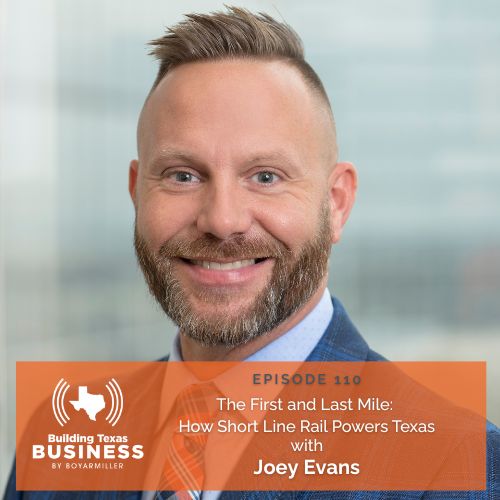
In this episode of Building Texas Business, Chris Hanslik sits down with Joey Evans, head of business development, government relations, and transportation technology at TNW Corporation, for a conversation about an industry that quietly keeps Texas – and the rest of America – running. Joey introduces listeners to the world of short-line railroading and explains how TNW’s four Texas railroads, located in Gonzales, Dumas, Brownwood, and at the Port of Victoria, serve as the critical first and last mile of freight movement across the state.
Joey breaks down how short-line railroads fit into the national transportation network, why one rail car effectively removes four trucks from the highway, and what makes TNW’s operation distinctive – including its flagship Dumas facility, which has grown into the largest privately owned rail car storage facility in North America. He also shares how the company built its proprietary technology platform, MyTNW, to give customers real-time visibility into their entire fleet, and how TNW has continued to push innovation in an industry that has historically lagged behind when it comes to technology adoption.
The conversation covers TNW’s approach to customer relationships, strategic planning, and staying nimble in the face of shifting market conditions and geopolitical uncertainty. Joey also discusses his work as president of the Texas Shortline Railroad Association and the significance of newly passed state legislation that lays the groundwork for dedicated state funding to complement federal infrastructure grants – funding that could accelerate rail upgrades across Texas by years and help the state compete with neighboring states that already have these programs in place.
Joey also speaks candidly about his own leadership journey, from starting as a railroad conductor with no college degree to growing into a strategic role, and how mentorship, faith, and a shift away from purely transactional thinking have shaped the leader he is today. He talks about the importance of building a personal brand early in a career, the value of servant leadership, and why asking for help is a sign of courage rather than weakness.
For business owners, entrepreneurs, and leaders interested in Texas infrastructure, economic growth, logistics, and what it takes to build a service-driven company with deep roots and long-term vision, this episode offers a compelling and eye-opening look at an industry that touches nearly everything – even if most people never think about it.
Transcripts are generated by machine learning, so typos may be present.
Chris Hanslik: Joey, I want to thank you for taking the time to come on Building Texas Business. It’s great to have you on the podcast.
Joey Evans: Thank you, Chris. It’s an honor to be here.
Chris Hanslik: So let’s start by introducing yourself and T&W Corporation. Tell the listeners what the company does and what it’s known for.
Joey Evans: T&W Corporation is a transportation company based out of Dallas, Texas. We’re 45 years old and we specialize in short-line railroading. When most people think about railroads, they obviously think about Union Pacific and Burlington Northern, the big railroads. But when you look at the state of Texas, there are 50 short-line railroads like us. We have the honor of having four of those railroads based in rural Texas: Gonzales, Dumas, Brownwood, and we are the operator at the Port of Victoria.
Chris Hanslik: Okay. So then just to drill down a little more, short line rail, what exactly is that and how does it fit within the overall rail system?
Joey Evans: Absolutely. Short-line railroads are often perceived as being about a short amount of mileage. However, they are actually defined as railroads that hit a certain tier of annual revenue. You can have a railroad that is 10 miles long that fits the tier of being either a Class 1, Class 2, or Class 3. Generally, you will not see small railroads that hit the Class 1 tier, but we fit into the national network because we are the first and last mile for a majority of the shipments that move across America. There are about 150,000 track miles across the United States. There are 10,000 track miles inside of Texas, and short-line railroads make up about 2,500 of those miles.
Chris Hanslik: Okay, so if I understand it right, this is getting off the main line and actually getting product to a manufacturing facility or production facility or getting that product from that facility onto the main line to be shipped to Texas? anywhere across the country.
Joey Evans: That’s correct. Using the highway system as an analogy, the bigger Class 1 railroads are like the interstate highway systems. When you get off that interstate into rural counties in Texas, you see a lot of agriculture or manufacturing. We are the people that deliver out to those county line roads or farm-to-market roads.
Chris Hanslik: How did, I guess you said the business has been around or T&W has been around for 40 plus years. How did it come about that the focus to invest and be in this industry?
Joey Evans: Yes. 45 years ago, the Murchison family had a vision that started in Dumas, Texas. They purchased a small railroad that had just a couple of tracks. Since then, we’ve been able to put infrastructure and capital investment in place to grow it. That specific railroad is now the largest privately owned rail car storage facility in North America, holding about 12,000 rail cars.
Chris Hanslik: Wow.
Joey Evans: Again, in rural America. Wow.
Chris Hanslik: That’s 12,000 cars. Yes, sir.
Joey Evans: Yes, sir.
Chris Hanslik: So then describe kind of, I guess, what is your role within the company and how does that play into the company’s overall strategies?
Joey Evans: I lead business support and development, as well as government relations. I also have a hand in the transportation technology aspect of T&W Corporation. My job focuses on trying to grow Texas business and attracting business into the state. At a government level, I advocate for funding for short-line railroads. Texas is unique based on its size; until last year, there was no economic lever for state funding for short-line railroads. Last year, we were fortunate enough to get a Senate bill passed into law that provided a foundation. It wasn’t appropriated last year, but as we move into the next legislative session, we are confident we can help T&W and other short-line railroads as well.
Chris Hanslik: Okay. So you mentioned innovation. So what are some of the things that T&W has done or is doing to bring innovation into your business?
Joey Evans: Railroads have typically been considered a bit of a black hole when it comes to technology. Our CEO, Paul Triang, had the foresight to ask how we could provide better visibility for our customers. About seven years ago, we started asking customers what success looked like for them. We took that feedback and built our own in-house platform called MyTNW, which allows customers complete visibility over their entire fleet of rail cars. They can track cars coming to them—we call that the “Amazon effect”—and interact with us. We then integrated API access to make them more successful. We brought the technology even further in-house, building modules for dashboards, safety, and finance. It has become a full suite of products for our internal business and our external customers.
Chris Hanslik: That’s fascinating. So, yeah, because you think, I mean, railroad doesn’t exude innovation, right? It seems like old school, you know, the original kind of mode of transportation and things have moved beyond it. it clearly still plays a critical role. And, you know, you see commercials now like energy transfer and whatnot about pipelines or rail versus having, you know, trucks on the road. What, when you look at Texas and just to put it in perspective, I mean, how much, whether it’s petrochemicals or products,
Joey Evans: The rail systems move essential products to keep our economy going and shelves stocked. Trucks are not our competitors; they are our complement. Whether it be raw materials for a manufacturer or outbound goods like clothes and water, items we touch daily are generally hauled by either rail or truck. To put some data points around that, for every one rail car you see, that represents four trucks off the road on average.
Chris Hanslik: Okay.
Joey Evans: Right. Putting freight on rail relieves congestion. There is a general concern regarding congestion in the Houston, Dallas, Austin, and San Antonio markets. We look at the money spent to upgrade our bridges and highway networks because so many people and businesses are moving to Texas. Most products are already moving by rail in some way. We focus on how to continue attracting business to Texas. What makes Texas different is our ability to be agile and adapt quickly. At T&W, we can move from an opportunity to a contract and having steel in the ground very quickly. That is attractive to businesses looking to relocate. We ask the customer what success looks like for them and focus on a 10 to 15-year plan rather than just looking at right now.
Chris Hanslik: Okay. So yeah, that’s one rail car, four trucks. That’s pretty amazing. And I love it because it does put it in perspective. It does. The importance of keeping the rail system, I guess, vibrant and healthy. Right. So let’s talk a little about T&W itself. I mean, as this company has grown, I mean, what are some of the things that you and the other leaders have done to kind of build the team and grow the team so that you can keep the company growing and stay on its strategic focus?
Joey Evans: Over the nine years I’ve been at T&W Corporation, we’ve built a leadership team with industry experts. Today, that team has about 200 to 250 years of combined rail experience, mostly in short-line railroads. Our team is focused on bringing in new business without operating in a silo. I leverage the different strengths of the team around me. We are constantly communicating. Regarding innovation, AI has become a prevalent factor in railroading through tools like Copilot, Claude, and ChatGPT. We use AI to help leverage our individual weaknesses.
Chris Hanslik: So does the, yeah, well, first of all, AI, you’re right. I mean, I think everyone’s trying to find it. You would think in this old, you know, technology of railroad that you can even find a way to leverage AI just highlights the point that, you know, everyone could benefit from it and find a way to use it the right way and leverage it the right way. And it doesn’t replace the human element. So what kind of internally does the team do as far as, strategic planning or really working with these customers and developing these kind of strong relationships to help kind of feed the business and keep it going?
Joey Evans: Great question. We spend a majority of our year on strategic planning. Once we formulate a plan, we never “close the book” on it. We are constantly reviewing our progress and adjusting on the fly if business conditions change. Geopolitical events can flip a plan on its head, so we remain flexible. We don’t just stick to quarterly meetings; we meet with customers whenever needed to understand what they are feeling or if their market needs have changed.
Chris Hanslik: Right. So you hit on a great point, that idea of you can’t be in front of your customer enough, right? Asking questions, what’s going on in their world and how can you be a solution? I know that’s what we do as a professional service firm is trying to be a resource and a solution and help solve problems for the client. And you can’t know that unless you’re engaging conversation and asking questions and listening to what they’re telling you.
Joey Evans: Some of the best advice I’ve received as a leader is just to listen. I’m a talker and a people person, but that advice to listen and then formulate a plan is vital. You have two ears and one mouth for a reason.
Chris Hanslik: So I’m always interested to know how being in the state of Texas, is an advantage for a business and maybe what headwinds that may be causing. I think your position is unique being part of business development and understanding, but also the government relations. So let’s just talk a little bit about the great state of Texas and the fact that that’s where your business is focused. What have been and are some of the advantages that T&W has realized because it’s based and operates in the Lone Star State?
Joey Evans: The advantage of being in Texas is that our leaders, like our governor, are very pro-business. Organizations around Texas are incredibly competitive in attracting business through incentives. At the local level, rural cities are offering more incentives than in the past. At the state level, there are significant tax advantages for moving here from states like California. We have a great group of leaders advocating for us. Growth in the “Texas Triangle” is extraordinary. TxDOT data shows that 70% of the population lives in the major metropolitan cities, and people are moving here at an astronomical rate. Many of these people have entrepreneurial minds, which is great for our growth.
Chris Hanslik: Yeah. Well, we’ve certainly seen it from our perspective as well, right? The number of, especially coming out of California, wanting to domesticate it and become a Texas corporation or Texas LLC and move from California here, I mean, really since the pandemic has been, I mean, I can’t even count how many we’ve done. I literally just got off a call this morning before starting this episode with you. And it was a company looking to do that. Had a call yesterday from a client here, but does business in California. And California, God bless them, has some crazy, wacky laws on consumer products. And they get some notice letter that they’re allegedly violating some California code. What the heck is that? I don’t know if they’ll continue doing business out there because of that. And it’s just stories and stories after that. So I think we are very grateful to have a legislative mindset that is pro-business. You hear about it all the time. And I think we all benefit, right? The high tide rises all boats. And so what about, you know, given your… your role in working specifically with the legislature, anything that you’re seeing on the horizon that you’re kind of excited about to talk about that you think may be coming to make it even easier to do business in Texas?
Joey Evans: That’s a great question. While there are advantages, there are also challenges in Texas, specifically regarding our power grid and water table. Statistics suggest that if we don’t find water solutions, we could face a real problem in the next 30 to 50 years. This is a concern for businesses looking to move here, especially with the boom in data centers.
Chris Hanslik: The AI boom, which then creates the data center boom, is all about how much water is there or is there enough to support all of that, plus the human needs for clean water.
Joey Evans: You have Virginia leads the nation in the number of data centers with just over 600. Texas is not far behind that at 411, I believe.
Chris Hanslik: And I think the pace we’re going, we ought to, we ought to get ahead of them in the next five years, I would bet.
Joey Evans: The AI boom has created a data center boom. Virginia leads the nation with over 600 data centers, but Texas is not far behind at 411. Within the DFW Metroplex alone, there are 194. The amount of water and electricity they require presents a challenge. On the advantage side, I serve as the president of the Texas Shortline Association. It’s exciting to potentially have state funding to complement federal funding for infrastructure. Much of the rail infrastructure today is 50 to 100 years old. Replacing it is expensive; it used to cost about a million dollars per mile, but now it’s closer to two and a half million. State funding will help us keep up with surrounding states like Louisiana and Kansas.
Chris Hanslik: And I assume that that funding is earmarked where it has to be used in infrastructure improvements. That’s correct.
Joey Evans: That’s correct. It has to go toward infrastructure improvements and match federal grant programs like the Consolidated Rail Infrastructure Safety Improvement Grants. Over the last five years, about a billion dollars has been earmarked annually for these competitive programs. T&W Corporation has been very fortunate, securing five out of five grants totaling about $35 million. This has accelerated our infrastructure upgrades by about 15 years.
Chris Hanslik: So let’s talk a little, I guess, the business model. I mean, so what exactly does a company like T&W sell? Is it time or space on a track? How does that work?
Joey Evans: We sell service. All railroading involves moving items from point A to point B, so we focus on being the best in service. Customers generally look for equipment safety, fleet optimization, and the ability to land a large number of cars at once. We are a metric-driven company. We focus on dwell time, “right car, right train,” and “order to spot.” Our goal for order to spot and dwell is 15 hours, but across 2025, we averaged around seven hours. Safety is our most proud metric. 2025 was the safest year on record for the industry. Most of our railroads have been injury-free for over six years, and we maintain high standards to prevent human-factor derailments that cause equipment damage.
Chris Hanslik: That’s great. Let’s talk a little bit just about yourself and kind of leadership. And you mentioned a little bit, you alluded to some things earlier, but just having… evolved into this role at TNW, you know, how would you describe your leadership style? How do you think it’s evolved or evolving? And what are some of the things that you’ve done to kind of, you know, have a coach or mentor to help you go along that journey?
Joey Evans: I’ve been in railroading for about 23 years. I actually started as a conductor.
Chris Hanslik: Like in the engine? Blowing the horn?
Joey Evans: A conductor is actually the person in charge of the train and switches the rail cars, while the engineer drives. When I started that journey 23 years ago without a college education, the railroad saved my life. I began as a transactional leader. When I mentor young people now, I emphasize building their personal brand. Earlier in my career, I was proud to be the hardest worker in the room, but our CEO and COO helped me transition into thinking strategically. I had to take a step back and realize I couldn’t just stay at the transactional level. My faith has also helped me slow down and focus on the big picture. Your word and your brand are what you have as you get older.
Chris Hanslik: Absolutely. That’s a good point. So, you know, I think there’s, to your point and your experience, that saying no substitute for hard work is very true, except that’s not enough, right? You have to evolve. I heard a speaker the other day talk about that, how a lot of people have this mindset of, I may not be the smartest, but I’ll work anybody. okay that’s that’s actually a that’s not a bad thing but you can’t keep that up it’s not sustainable over the longevity of your career you can’t be as you as we get older you’re not going to work as hard right right so you’ve got to keep that mindset and that work ethic but evolve and learn to you know work smarter not harder and develop other skills because that one will fail eventually where you can’t keep up
Joey Evans: And developing other skills and helping develop other people and knowing that it’s okay to go and ask someone for help. You know, that was one of the biggest problems that I had is that I thought I had to do it all my own. And to your point, as we do get older, we can’t go at that anymore.
Chris Hanslik: Well, the most courageous thing you can do is ask for help.
Joey Evans: That’s right.
Chris Hanslik: And people think it may be a sign of weakness. It’s actually a sign of courage. That’s right.
Joey Evans: T&W Corporation is rooted in core values: integrity, safety, servant leadership, and quality. These are conditions of employment, not just slogans. I view myself as a servant leader. While safety is always paramount, I love being a resource for others; it allows me to feel fulfilled.
Chris Hanslik: Yeah, that’s great. Well, you did mention earlier the fact the family that owns TNW, the merchants and family, I think what’s really cool about, you know, being a Texas focused podcast and your Texas focused business is that that family was the original owner of the Dallas Cowboys. And they didn’t get more Texas than that, which is pretty cool.
Joey Evans: They are a great group of owners. We are their only operating company. They allow us to make decisions for the business while guiding us in principles to ensure we live up to the family name. They are a significant part of Texas history, from oil and gas to the Dallas Cowboys.
Chris Hanslik: Yeah, that’s great. Well, Joey, this has been a great conversation. I want to wrap up just a couple things. You mentioned your faith. What do you like to do, I guess, just on your own personal time?
Joey Evans: I’m a huge barbecue lover, so I spend most of my time with my family. We live in Caddo Mills, and you can find me out on the smoker. every weekend or on the grill.
Chris Hanslik: Are you a big trailer smoker?
Joey Evans: Not a big trailer smoker, but multiple smokers to the point to where I’m starting to get the side eye from my wife on bringing home new barbecue equipment.
Chris Hanslik: What’s your favorite wood to smoke with?
Joey Evans: I’m a post oak guy. I like post oak and mesquite. Anybody that knows me knows that I’m a big, I know in Texas, I think y’all say the word pecan. I say pecan because I’m from Georgia. I love pecan wood as well. Yeah, it’s pecan. Yeah.
Chris Hanslik: That’s okay. So favorite meat that you make?
Joey Evans: Ribs. Ribs. Yeah. I’m a big rib guy. Dry rub? Dry rub ribs. You’re my man. My daughter.
Chris Hanslik: Can you ship some down to me?
Joey Evans: I can. All right. Yeah. My eight-year-old daughter asks for them every week.
Chris Hanslik: You’re training her right. Yeah, that’s right. Well, you stole the thunder of my next question because I ask every guest, do you prefer Tex-Mex or barbecue? So we know the answer to that one. It’s barbecue. Yeah, right. So very good. Well, Joey, thanks again for coming on the show. Love to hear what y’all are doing. It was great education in this kind of unique industry that I don’t think people know much about, the short-line rail, but obviously critically vital to the economy of Texas.
Joey Evans: Thank you for having me. The rail network really is the first and last mile of everything. I’m proud to be part of T&W Corporation and look forward to our next 45 years helping Texas grow.
Chris Hanslik: That’s great. Have a great day. Thanks again.
Joey Evans: Thank you.
With a deep understanding of your business alongside clear and honest communication, we help clients face challenges fearlessly.
Learn more about our services and how we help clients.