


With a deep understanding of your business alongside clear and honest communication, we help clients face challenges fearlessly.
Learn more about our services and how we help clients.



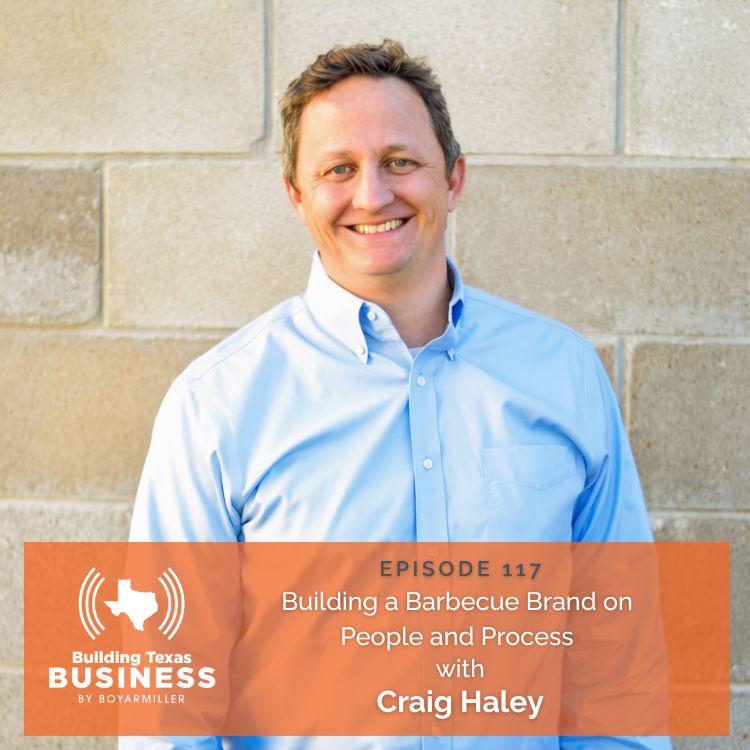
In this episode of Building Texas Business, Chris Hanslik sits down with Craig Haley, CEO of Smokey Mo’s Texas Barbecue, for a conversation about what it takes to run a growing restaurant brand while keeping the feel of a neighborhood joint.
Craig shares how a college job at a College Station sports bar turned a computer science major into a lifelong restaurant operator, and how more than 30 years in the industry led him to a Central Texas barbecue brand founded in 2001. He explains what makes Smokey Mo’s different, from its smaller footprint and community roots to hiring general managers from inside the neighborhoods it serves, and why great food paired with genuinely friendly service remains the whole strategy.
The conversation covers the operational work behind the scenes, including standardizing kitchen flow across locations, modernizing the look and feel of the restaurants, consolidating four point of sale systems into one, and building loyalty and guest feedback tools that actually move the business. Craig also offers a candid look at rising beef costs, why brisket yield testing matters so much to a barbecue operator’s margins, and the deliberate decision to hold prices down for guests even when costs climb.
Chris and Craig also talk about leadership lessons, including hiring for traits you cannot teach, having the courage to let go of people who are not a culture fit, communicating strategy so every team member knows where they fit, and getting to the root cause of a problem rather than patching the surface. Craig closes with advice for anyone considering franchising or entrepreneurship, starting with the reminder that passion and hustle matter more than the promise of easy money.
If you are a business owner, operator, or leader interested in restaurant operations, culture building, cost management, and scaling a brand without losing what made it work, this episode offers practical insight and a good deal of Texas barbecue along the way.
Transcripts are generated by machine learning, so typos may be present.
Chris Hanslik: Craig, it’s great to meet you. Welcome to Building Texas Business. Glad to have you on. Great. Thanks for having me on. I’m super excited to be here. So let’s start by just introducing yourself and your company and tell the listeners what you’re known for. Yes.
Craig Haley: My name is Craig Haley. I’ve been working in restaurants really since high school. I went to college at Texas A&M and ended up paying for my college by working in restaurants. I went for computer science, and I ended up loving the restaurant business. So I’ve been doing that now for over 30 years at this point. Wow. Yeah, currently at Smokey Mo’s Texas Barbecue. I’ve been there for a little bit more than five years, and it really fits with my passion, which is taking care of guests and serving great food, specifically serving Texas barbecue. It’s just been something that I grew up eating, grew up having family gatherings and eating it with my family, my grandpa, and learning from him. So I have a passion for it, but also I love the restaurant business. So it just ties the two together in a pretty awesome way.
Chris Hanslik: That’s great. Well, I know enough because we have several clients in the restaurant business. In fact, I just got back from lunch with one of them. But you have to love the restaurant business to be in it because it’s not easy. It’s a lot of work. And I’m sure you’ve seen that over the last 30 years. Yeah, no doubt.
Craig Haley: It’s a business that is challenging every day, which is part of what I think those of us who love being in the business love about it. You go to work, no matter if it’s a great day or a bad day, you leave. And if you gave your best, if you did everything you could do, if you gave full effort, you really feel like you accomplished something. And you took care of as many guests as well as you possibly could. You served great food. And there’s not a whole lot of jobs out there where you get that day-to-day feeling of, man, I really did something that mattered today. And I think feeding people is really something that matters. And so I fell in love with it because of that. And I think that’s kind of what you see in people that are successful in the restaurant industry. They love the grind of it. They love the challenge of it. They love the sense of accomplishment, and they just love people. And I think that’s really what it comes down to: people and food, you know.
Chris Hanslik: Yeah, got to be a people person. So tell us a little bit more about Smokey Mo’s Barbecue. How did you get involved, and a little bit about what you think distinguishes Smokey Mo’s from the other barbecue restaurants here in Texas? Yeah, that’s a great question.
Craig Haley: Smokey Mo’s has been around for 26 years. It was started by a founder, Morris Melcher, in 2001, and he was just barbecue through and through. I actually worked with him at a restaurant—it was Rudy’s Barbecue in Austin, Texas. I worked with him in 1999, so I was familiar with him. He went down the street and built an 1,100-square-foot restaurant and grew kind of a little Central Texas barbecue empire out of it, really just rooted in the idea that he was going to serve great food and be incredibly friendly. So for us, it’s those two things: the food’s got to be great, and we’re going to be super friendly. I think that’s where we start. And what really is different about Smokey Mo’s, in my view, is the fact that we’re still neighborhood barbecue. Like, we’re involved in the community. We’re at the booster clubs. We’re feeding people for their weddings, graduations, and all the holidays. We’re a part of the community in a way that other restaurants that have 20 locations just can’t do. It’s just part of our DNA, and we love that about the business. We’re hiring our GMs from within the community, they know the people in the community, and we’re a small box, so we’re a smaller store. We’re 2,500 square feet compared to some of the really large barbecue restaurants out there, but that really allows us to be focused on that neighborhood and not drawing from 30 miles away to try to keep our business going. We’re able to really just stay inside that community and be a part of it in a pretty awesome way.
Chris Hanslik: That sounds great. I think people appreciate that community feel, like they’re known when they show up. And it seems to me, I mean, I know you said you’re in the small communities. What have you done, do you think, kind of to focus your hiring practices to make sure that you’re getting employees that will deliver on that promise of being super friendly day in and day out, so that your customers have the experience that you’re promising? Yeah, that’s so important.
Craig Haley: I mean, it’s a people business, right? I think every restaurant that’s ever been opened, for the most part, at least 99.9% of them, have had good recipes. But where they really generally fail, when they start, they have a good plan for their food, but then they get open and the people have to execute every day. It’s very difficult if you don’t have a really strong training program and really good hiring selection. So we put a lot of effort into that hiring process. We are very quick with the fact that we’re engaging with people right away. If you put in an application, we’re going to engage with you right away. We want to keep the momentum going, and we really want to be selective. We want to always be hiring. In other words, we’re always looking for great people. And the reason why that’s important is if you wait until you need somebody—you’re short, you lost somebody, and you’ve got to fill these shifts—you end up being much less selective. At that point, anybody who comes in, you’re like, “Oh gosh, better than nobody.” But we’re really looking to add to our team with A-players, with the best of the best. It’s like if you’re an NBA team and you’re choosing players, you’re not just going out there when you lose a player and saying, “Okay, I’m opening it up to everybody.” You’re choosing from the best basketball players in the world. We want to be choosing from the best, friendliest people in the communities that we’re in, and we put a big focus on that friendliness. I think one of the things that is very hard to teach is for somebody to care and for somebody to smile. If somebody doesn’t naturally smile and you’re trying to teach them to smile, you end up getting a smile that’s pretty lame, honestly. It’s something that people can tell is fake. Yeah, it’s fake, right? And it just looks awkward, and it actually can be more off-putting than if they didn’t smile. So we’re really looking for somebody we don’t have to teach how to smile and somebody we don’t have to teach how to care about taking care of people. It comes down to that, I think, for us. So it’s hard. I mean, it’s one of those things you’ve got to put the effort in, and it’s not always easy to choose the right people, but we do the best that we can do.
Chris Hanslik: I think that’s one of the lessons I know I’ve certainly learned in running a business. When I talk to people like you who run businesses throughout the state, hiring to fit your culture, whatever that may be, is one of the hardest things. It’s hard to put your finger on it; it’s part science, part art to really get it right. But it’s probably the hardest thing you do because that’s the golden ticket, right? It’s getting the right people in your organization so that they can deliver on whatever that is—whatever you’re making or producing for your buying consumer. You’ve got to have people that are engaged and excited about it so that they do their best. Yeah, I totally agree.
Craig Haley: And I think the other part of that is you have to be willing to let people go when they’re not a culture fit. What you see a lot of organizations do is keep those people. They haven’t done anything wrong enough maybe to be fired—they have no gross misconduct—but they’re just not a culture fit. And when you keep them around, they bring everybody down. What we believe is they will be more successful and better off in other organizations. So let’s let them go be better off, and maybe they’ll go work for the competition, and that could be good for us, too.
Chris Hanslik: But you raise a great point, because I’ve said it before and when I talk to others, if they’re not right for your organization, it doesn’t necessarily make them a bad person. It just means there’s a different organization that they’re going to fit in better. And by making that call sooner, you either increase your morale or eliminate the risk of demotivating others that do fit, and you allow that other person to go find that place where they’re going to fit better. I’ve seen it time and time again. Doesn’t mean you don’t wring your hands over these personnel decisions, because you do—you’re dealing with humans and you want to be compassionate. But time and time again, I’ve experienced that even though that was a hard decision to make and the right one for us and our organization, that person ended up in a better place and found their home, and that’s a good thing to see. Yeah. So let’s talk a little bit: How did you find your way to Smokey Mo’s? I think you said five years ago. What do you think you’ve done in those five years as a CEO to kind of put a little bit of your stamp on the company as you’re starting to grow or continuing to grow?
Craig Haley: Yeah, so that’s a great question. I worked at Rudy’s Barbecue in Austin; it was called K&N Management. We ran and operated five of them. When I started, there were two. Then we had a burger concept called Mighty Fine Burgers, Fries, and Shakes there in Austin as well, which had five locations at the time. We had a transaction happen. It was actually great timing—it was near the end of COVID, but it was great timing for Smokey Mo’s because they needed somebody to come run the company. They were familiar with what we had grown and done at those two brands, and I think for them it was just, “Hey, we want some of that,” especially on the operations side, because we really had operations down. So coming into Smokey Mo’s, what I saw was that we needed to have more structure and more process. That’s part of what I love: creating those processes, creating that structure, and building consistency. You’re making it much easier for your staff to learn, train, and teach, but also making it easier and better to continuously improve what you’re doing. When you have written-down processes, when you have something built in and structured, you can then start to work on making it better. If you’ve got 10 different processes—when Larry cooks the ribs, he does this, and when Bill does ribs, he does that—it creates a lot of confusion. If you want to make your ribs better at that point, you don’t know where to start: Should I go with Larry’s way or Bill’s way? So I think that’s something we really worked on at the beginning. The second thing is really the branding of the restaurants—the way they look, the way they feel. We needed to modernize that. It was stuck in the past a little bit. It had some good roots, but we really felt like we needed to make the surfaces better and cleaner and make it a little bit friendlier for the guests. Another thing we really worked on is just the efficiency of the facility—the way that the product flows. It should all flow in one direction, and we had it going in a couple of different directions with the previous kitchen design. We also had five different iterations of the kitchen because the footprint wasn’t standardized either. So we really standardized those operations, made it flow better, and made it work better for the guests and team members. Then the last thing we really worked on is just that friendly aspect. We had friendly people and friendly GMs, but we didn’t really have a culture where we rewarded people and really pushed the idea that what really mattered to us at Smokey Mo’s was great food and friendly service. So we’ve been able to hire, teach, train, and bring people in who really understand that culture, and we just built it from there. So it’s been a lot of fun. We still have a long way to go—every day is a day we’re hoping to improve—but we certainly have made some big strides in the last five years.
Chris Hanslik: You talk about modernizing things. How are you using technology to help modernize or make things more efficient in how you operate and deliver great food and friendly service? Yeah, super good question.
Craig Haley: Well, when I got to Smokey Mo’s, they had just begun to do some online ordering because of COVID, right? COVID came, and everybody that didn’t do online ordering was jumping in because you didn’t have a choice: You either shut the doors or you did online ordering. So they rolled out a real basic version of that, and we had like four different point-of-sale systems in the company. So that’s really where we started on the tech side: Okay, we need to get one good, modern point of sale. Within the first three or four months, we were able to roll out that point of sale, which we were really happy with. Through that, we were able to create integrations with many other things. For example, for online ordering, we used OLO for a number of years, so we were able to use that as a third-party aggregator and for online ordering, which is huge. It flowed right into the POS, so you didn’t have tablets and different ways you were taking money—it just made it a lot easier. In the last couple of years, we created a loyalty system through Punchh, which has been really great. It allows us to talk to our guests a lot more effectively and efficiently, while also rewarding returning guests. Adding an app into it was a great thing as well. One of the most important things we’ve added is the ability to get feedback from our guests. That’s another piece of software that works alongside our POS and online ordering system, allowing us to get real-time feedback from guests. We can see what’s happening inside the restaurants and react to it, helping them if we made a mistake, while also rating ourselves against the competition and industry to strive to be the best. So that’s a number of ways we’ve added technology over the last five years. Honestly, it’s been like, “Okay, we need to slow down on technology a little bit.” At some point, you get what I call software creep—you just get too much of it. What’s really important to us is: Does the software we utilize make the experience better for the guests, or does it make us more efficient inside the company? Does it make us more money, or allow us to be more profitable if we utilize it, or does it make the guest experience better? I think there are a lot of software options out there that may make a small process better, but don’t actually make a difference. So for us, it’s: Does this actually make a difference for this organization?
Chris Hanslik: I think that’s a good reminder, because nothing against software vendors, but they come at you from every direction offering all kinds of things every day. It’s a little overwhelming as a business owner as to which one to use and how to evaluate them. They all promise the world, and few deliver, but from your phone system to your POS system, they’re coming at you. It can be distracting trying to figure out which one to use. You want to get that right because the integration and training take a lot of effort—it’s an expensive endeavor, and you’ve got your people trying to learn a new system. You don’t want to have to do that every year or two. When you think about where you are with Smokey Mo’s now, what do you see as some of the challenges or headwinds over the next 12 to 24 months that you’re trying to navigate or prepare for?
Craig Haley: Yeah, I think for us, the main headwind we’re seeing—and it’s been like this for the last six to nine months—has been rising costs. It’s really beef costs for us. I mean, we’re Texas barbecue; brisket is king here. If you sell a two-meat plate, it’s going to at least have brisket as one of the meats on there, sometimes both. That is great because it really is the identity of what we do. But yeah, the herd size has been much smaller, creating significantly higher prices for us. There are some other little things, like labor going up, and I think people have overextended themselves credit card-wise a bit. The economy’s just a little tougher right now than it has been. Ultimately, the uncontrollable factor we’re dealing with is mainly rising food costs. To combat it, we can’t control the price of brisket—there’s no way we can do it, as we don’t buy enough of it and can’t go create our own herds; that’s just unheard of. So I think what we try to do is purchase as well as we possibly can, while ensuring we’re buying quality. We’re not buying the cheapest brisket; we’re buying a brisket that fits our spec, which is the upper third of choice. Our brisket is really good quality. We’re not going to buy lower than that, and we’re going to make sure that our guests are getting really good marbled, moist brisket that tastes great. So we can control the quality. We can’t control the price, but we can be as efficient with that cut of meat as possible. Brisket is a particular cut of meat that has a 50% yield at best. If you buy 10 pounds, 5 pounds of it goes into rendered grease or trimmings, so you’re only able to sell half of what you actually buy, which is really different from most meats. It starts with that, but if you cook and trim it correctly and take care of that meat, you can hit that higher yield around 50%. If you don’t, you might be in the 40% range, which is a lot of money at the end of the day for a barbecue restaurant. So we try to really coach and teach how to handle brisket. We do a lot of yield testing on it to make sure staff sees what happens with that brisket, run our COGS reports, and do an actual versus theoretical report weekly to see what the waste is. That allows us to handle it as best as possible. We take that and do better than our competitors as far as that goes, which is a real positive point for us. I think we have really good purchasing power just because we are a little bit larger, which helps. Then we just try to run the rest of the business as efficiently as possible. What we talk about every day is doing our best not to raise prices, even though our costs have gone up. We know the consumer is paying more for groceries and gas right now and only has so much to spend. So we’re doing our best to keep our prices as low as possible. That gives us a competitive advantage—maybe not on profit this year, even though we’re doing well, but long-term we’re able to keep our customer base, which helps the sustainability of the brand. We’re not foolish about it, but we work hard for our guests to do everything we can to mitigate those cost increases and how they affect them.
Chris Hanslik: That’s great. The thing that struck me was the science or analysis you put into the yield of the brisket. Most people wouldn’t even think about that—I certainly never did. You just think showing up and buying barbecue with the smoker in the back cooking it. But there’s a lot to that, and the way you explained it makes total sense. It’s probably the biggest item you’re selling and turning, making it your biggest cost item, so you want to make the most out of it. That’s a cool behind-the-scenes look at what’s going on.
Craig Haley: It’s not something I think all barbecue restaurants understand and do, but it certainly is something that we have down. We’re doing that with all of our proteins, but brisket is obviously the main one.
Chris Hanslik: Yeah. What about thinking about yourself as a leader and what you’ve learned along the way? What are some of the lessons you feel you’ve learned that have helped you on that leadership journey to become a more effective leader?
Craig Haley: There are so many of them. I think the most important things for leaders to do are to listen and to be positive. When things aren’t going well, you’ve got to stay positive, but you’ve also got to be realistic about it. Focus on problem-solving—there’s always a solution to the problem. What we have to do every day is focus on being better than we were yesterday and better than our competitors through continuous improvement. For leaders, you can get caught up in the minutia of the job—not the culture or the people, but worrying about trying to get a couple of points here, a part of the P&L, making a presentation for that, or marketing. You get caught up in all these things and lose focus on what matters most: Are we taking care of our guests, do we have the best people, and are we getting better? Those really narrow it down. When creating strategy, it’s important to have a strategy all of your team can rally around, creating a mantra around what we are doing tomorrow that’s different than today, what we are really focused on, and what that means for each person. We put a lot of effort into communicating the strategy—just as much as deciding which strategies to employ this year—so our whole team understands where we’re going, what we’re trying to do, and how they fit into that. Those are some of the main things I’ve learned about leadership over the last few years.
Chris Hanslik: Yeah, you can’t really emphasize communication enough, right? What I’ve found is that it’s challenging because you’re busy doing a bunch of things, but stopping to communicate in a thoughtful way is key. As we both know, there’s a way we like to communicate, and then all your employees consume communication in different ways. It’s about crafting a message that can satisfy everyone so they feel informed and know what’s going on. That’s much easier said than done.
Craig Haley: You’re never going to be perfect at it. I went to a Ritz-Carlton leadership training one time, and they talked about how, for 20 years in a row, their strategy included improving communication. At some point, you’d think they would have figured it out, but—and they did, getting better every year—the point is it’s never perfect. So you’ve got to keep working on it. We have a number of different ways that we communicate with team members. Fifteen years ago, most of those were foreign—you weren’t texting people or using Slack, and email was just barely getting going. We used to do voicemails where we’d call all the managers with a single voicemail message. But as we navigate through new technology in the future, where everything changes every few years, you’ve got to keep working on the best way to communicate with all your stakeholders, guests, team, and vendors, ensuring people have the right information at the right time to act on it.
Chris Hanslik: Yeah. I want to take you back to something you mentioned about the importance of being a problem solver as a leader. How do you approach problem solving and working through to find the right solution?
Craig Haley: You have to determine the root cause of the problem. A lot of times, fixes are surface level. Let’s say we’re making errors on to-go orders. We might just say, “Okay, we’re going to create a new process for that.” We create a new process, but errors don’t change because we didn’t understand what was really causing the problem. Is the person overwhelmed? Do we have a menu item that isn’t set up correctly on the POS? What is actually creating this problem? You’ve got to get to the root cause. There are a number of different ways to do that that work really well—like a 13-step problem-solving process—but I just try to keep it simple and keep asking why. Why did that happen? Trying to get to the root with the “Five Whys.” For us, it’s figuring out that root cause and then determining: Was it a people problem or a process problem? Generally, it comes down to those two things. If it’s a people problem, was it because we put them in a position where a person can’t succeed very often, or is there a person in the organization who refuses to follow the process? If you can get to that point, you can make a decision: You can coach and teach to get somebody where they do it well. If it’s a process problem, you redesign the process to create the right outcomes. Generally, it comes down to people or process. Sometimes you could create a recipe that just can’t be executed, and then you’ve got to get rid of that recipe, which is a process problem where you can’t create a process that produces the right outcomes.
Chris Hanslik: Makes sense. That’s good advice. Thinking about your career in the restaurant business, what advice would you give to an aspiring entrepreneur or business owner regarding lessons learned in getting into business and stepping into leadership?
Craig Haley: The lesson for me is that if you’re not passionate about it, it’s not going to be worth doing. If you don’t love what you’re doing every day, maybe you’ll be successful and make money, but you’re not going to be satisfied in your heart and soul. It’s just a means to an end and doesn’t create anything meaningful for you. So find something that you really enjoy and love, that fits into your DNA and mindset, and do that. There are plenty of opportunities in just about any industry for somebody to get in there, hustle, work hard, and show effort. That’s the other thing: You’ve got to hustle and work. A problem we have in the franchising industry is that some people think getting into a business means mailbox money, right? That’s not how restaurant franchising or most franchising works. You’ve got to get into it with the understanding that you’ve got to build a business, get it set up, and then pass it on to someone you trust to lead it. So it really comes down to doing something you want to be a part of and put a lot of hours into, where you don’t feel like you’re missing out because it’s part of your passion in life.
Chris Hanslik: That’s great advice. So, Craig, I want to take you back to A&M. I grew up in Bryan, so I’ve got to know: What restaurants did you work for when you were in college?
Craig Haley: I worked for Bullwinkle’s Restaurant and Sports Bar for most of the time I was there. I also worked a little bit at Outback and Gumby’s Pizza back in the early ’90s. But mainly I worked at a restaurant and sports bar right off Texas Avenue, pretty close to George Bush Drive.
Chris Hanslik: I remember it. Yeah, it’s fun. What’s your favorite place in Texas you like to visit for vacation or to get away that brings back good memories for you? Yeah, I love going to Port A.
Craig Haley: We really love going there as a family. I love being on the beach and the fact that you can ride golf carts in town and all down the beach, and there are nice places to stay. There are so many amazing places in Texas to go—the Guadalupe River was one growing up, and I think I water-skied on every lake in Texas at one point. I love to fish; bay fishing is one of my favorite things to do. You and me both. But if I could only go on one vacation in Texas, we’d go to Port A. That way I could fish, we could hang out at the beach, and it’s great for families.
Chris Hanslik: It is lovely down there, and I love bay fishing as well. We’ve done close to 110 episodes. When we started this, we thought we had a catchy question for every guest. I don’t think it’s going to work for you because I’ve asked every guest, “Do you prefer Tex-Mex or barbecue?” I think I know the answer.
Craig Haley: Well, it’s a tough question for me because I love Tex-Mex. It’s probably my favorite food, but barbecue is what’s really helped me and my family for the last 20 to 25 years.
Chris Hanslik: Yeah, I love barbecue. It’s such an amazing thing. Within barbecue—brisket, ribs—what’s your favorite?
Craig Haley: Brisket is what I’m choosing. We also have pork belly burnt ends at Smokey Mo’s. If you’re coming through Austin, San Antonio, or Conroe anytime soon, stop in and get the pork belly burnt ends—it’s like meat candy.
Chris Hanslik: It’s amazing. All right. Well, I’m closest to Conroe, so I’m going to have to venture up and try it. Yeah, head up there. All right. Well, Craig, I want to thank you for taking the time to come on the podcast. Really enjoyed getting to know you and learning more about you, Smokey Mo’s, and what you’re doing to grow that culture and the brand.
With a deep understanding of your business alongside clear and honest communication, we help clients face challenges fearlessly.
Learn more about our services and how we help clients.