


With a deep understanding of your business alongside clear and honest communication, we help clients face challenges fearlessly.
Learn more about our services and how we help clients.



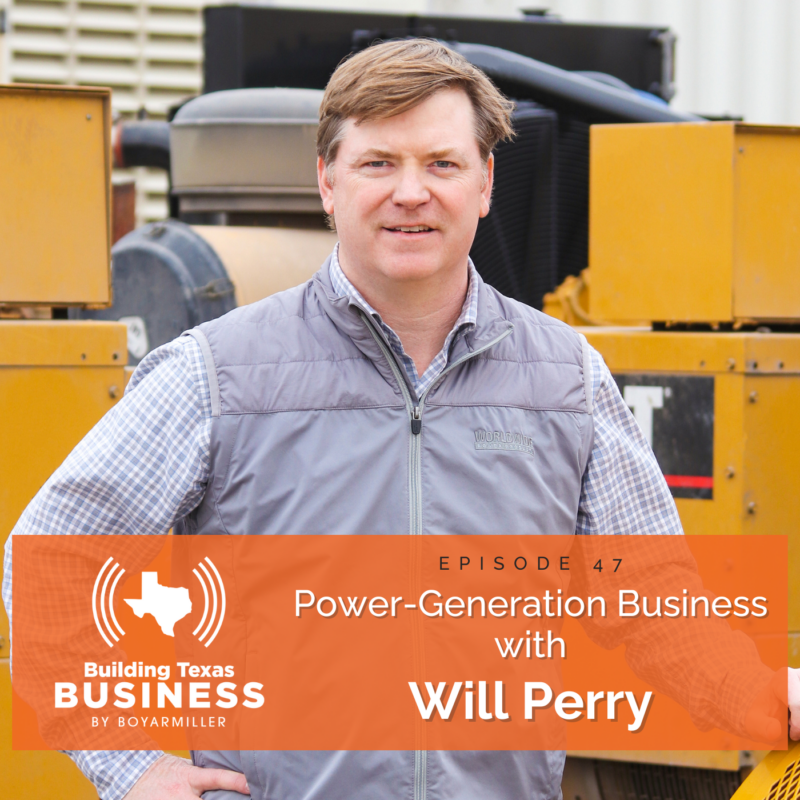
Will Perry, Founder & CEO of Worldwide Power Products, is the latest featured guest on the Building Texas Business podcast. Based in Houston, TX, Worldwide Power Products is a full-service power-generation equipment provider that has been making waves in the industry for its exceptional services and top-of-the-line products.
Will shares his entrepreneurial journey, from the inception of his company to being named one of Forbes Magazine’s 100 Most Promising Companies in 2011, and earning a spot in the Inc. 5000 Fastest Growing Companies in America for four consecutive years (2012-15).
Will shares insights on his leadership style, the challenges he faced in building a successful business, and how he navigated the ever-evolving power-generation industry.
Transcripts are generated by machine learning, so typos may be present.
Chris Hanslik: In this episode, you will meet Will Perry, founder and CEO of Worldwide Power Products. Listen and learn why Will believes that finding more who’s are the key to scaling your business, and that once you have the right people, focusing on employee recognition and feedback is the key to success. Will, I want to thank you for taking time to come join me for the podcast this morning.
Will Perry: Well, I appreciate being here, Chris.
Chris Hanslik: So you’re the CEO of Worldwide Power Products. Why don’t we start by you just telling the audience a little bit about what Worldwide is known for. What do y’all do?
Will Perry: We are a turnkey power generation solutions provider, which means we provide backup power for industrial, commercial, municipal applications. So for buildings, water treatment, water plants, water towers, It could be buildings downtown to NRG stadium, you know, where the Texans play. So we got away a little bit from the oil and gas market because that was a little dangerous there for a while. So we focused really on the industrial commercial side along with municipal. So we have four lines of business, sales, rental, service, and parts. So we started out in sales and buying, selling. new and used equipment, mostly Caterpillar, Cummins, big name brand generators, and that kind of evolved into complementary services, service, doing preventative maintenance, repairs, so, and then we added on division to rental and then added a parts division years later, so. We are really focused with the name Worldwide Power Products. We do business all over the world, but we have in the last really six years pivoted and really focused here, Texas Gulf Coast area. So we still do business around the country and around the world, but the bulk of our business and focus has been Texas Gulf Coast.
Chris Hanslik: I figure in that region, there’s plenty to keep you busy. Absolutely. You started the company a little over 10 years ago, right?
Will Perry: We just celebrated our 15 year anniversary. Wow.
Chris Hanslik: So what inspired you to get into this line of business and start this company?
Will Perry: Yeah, so come from entrepreneurial Family had always done different entrepreneurial things growing up through school, college. I’d always wanted to own my own business. I didn’t know what it was going to be. I couldn’t have dreamed it was going to be in the generator sector. So it really just kind of came through out of school. I started in the printing industry doing sales, did well with it, but didn’t I loved that industry, got into selling generators, didn’t know anything about generators, but fell in love with the business of buying, selling, trading, it being very relationship driven. And so from there I did sales at a company in Houston for two years and then decided to start my own business. Got married in February 2008. decided to quit my job two weeks after that and start the business and scared my father-in-law and mother-in-law half to death.
Chris Hanslik: And maybe the new bride? Yeah.
Will Perry: Absolutely. She’s been amazing though and supportive through it all. It hasn’t always, we’ve had some amazing years and a lot of growth, but there has certainly been some tough years and you’ve helped us through some of that.
Chris Hanslik: Yeah, it’s been fun to be part of that journey with you. That’s interesting. So let’s kind of stay in the beginning. You started this company in February 2008, and obviously, none of us knew what was coming later in the year 2008. What kind of impact did that financial crisis have back in 2008? on your new business and how did you manage through that to keep things going?
Will Perry: Sure. Well, fortunately, it was just me and a part-time assistant the first year. So I started it out of my house. I had basically about $50,000, which will buy you maybe one generator or half a small one. So did not have a lot of capital. Thought I could go raise a lot of capital easily. That was not the case. The overhead was low. It just got married, no kids. We didn’t have a facility. We got one soon, later that in 2008. But when the financial crisis hit, I didn’t have to pull rabbits out of the hat to do well for such a small operation. But what we did do, we had Hurricane Ike hit in 2008, which really kind of sped my business plan up a lot quicker. A lot of generators were needed. A lot of generators were needed, and you know, it’s just still a small, very small business. Me, a part-time assistant, but I was able to sell enough generators to really kind of push my business plan to what was probably year two or three, hire some people, get into a small facility, and really just add good people to continue the growth.
Chris Hanslik: See, that’s interesting because, and I know you’re not alone in this, but it’s always interesting to hear that businesses that you have this financial crisis and there was actually, and I guess the hurricane helped, but the opportunity, you kind of had that spurt of growth when most people were just trying to keep the doors open.
Will Perry: Right. There was a bill, Senate bill passed in Texas, I think it was Senate Bill 365 that required all municipals in certain population sizes to have backup power like on a lift station or water treatment plant. And so we really just focused on that market and still are very involved in that municipal wastewater market today. So that was really what helped us get through the 08, 09 time period, really 2009 and 10. But we had great growth through those first several years. It was a lot of fun. Small team, but totally different business today. Still more demand than ever though. Is it really? Yeah.
Chris Hanslik: So almost 15 years now, you mentioned a couple of times how your team grew. Let’s talk a little bit about that. What are some of the things you’ve done as you’ve tried to build a team there worldwide to service your customers, to nurture the business? How has it grown? learned along the way, good and bad.
Will Perry: Sure. Plenty. I could tell you stories for days on the mistakes and challenges, but I think that’s where we learned the most. As we’ve grown this business, I realize more and more Really, the employees, our technicians are the backbone of our business. And if we take care of our employees, they’re going to take care of our customers. And they’re going to be loyal employees, and then we’re going to have loyal customers. And I think that the more tailored to our employees, recognize them, train them, offer professional development, then they’re going to hopefully stay with us, but they feel treated right, fair, and that it’s a place they can see themselves long-term. So that’s been a big transition. I’ve always really cared a lot about our employees. I feel like it’s a family type culture, very entrepreneurial culture, but my empathy scores are crazy high and I’m always trying to figure out ways to improve their experience, which I think in turn will lead to the customer experience being better.
Chris Hanslik: Do you do any kind of assessments in the interview process to try to you know, do the best you can. It’s an imperfect science, right, but try to give you some data points in making the hiring decision.
Will Perry: Yeah, we’ve improved that and continually try to improve it, but we use a number of different tools. Probably the most powerful one that we use is Berkman. So when we’re going to hire somebody, especially in any key role, We use the Berkman personality assessment to really better understand that person and then who’s going to be managing them and that team. How does that personality fit in? What are we looking for? We try to get clear on that role and the job description exactly what we want them to do prior to going out and interviewing for it. So I think that’s another thing we’ve continually and it still evolves it that will never stop trying to get that process better.
Chris Hanslik: Yeah. Any, you mentioned kind of empathy score, so do you also incorporate periodic like surveys within the company to get feedback? If so, tell us about that.
Will Perry: Yeah, so we’re big on recognition with our staff and certainly asking for feedback. We have quarterly check-ins where everybody has certain goals. They also have to have at least two professional development goals each quarter. This is from top to bottom. So it doesn’t matter where you are, what position, there’s something that you could be learning, we all have things we can learn and get better at. So I think communicating and getting, it’s a two-way communication on these check-ins and annual reviews. They’re not fun. I don’t enjoy them, but it’s just a process that we put in that’s absolutely necessary and it kind of catches the things. Employees need to be able to have a voice and sometimes these are the perfect scenarios where we’re able to sit down and decompress and let them talk and give them feedback and that’s been critical for us. So we’re real disciplined about the quarterly check-ins and annual reviews in order to give them feedback and vice versa.
Chris Hanslik: I think it’s, quarterly is amazing because I can see where that’s almost a constant, which is good. Tough to do, but I would have to believe you’re the inference that your employees take away is that you care about them and you’re trying to create opportunity for them to grow within the company so they’ll want to stay.
Will Perry: Right. I hope they see that I’m willing to bend over backwards for them and hopefully that creates loyalty to me and our company and to our customers ultimately. I mean, if I’m willing to bend over backwards for them, hopefully they’ll do the same for the customer and I think that’s worked for the most part.
Chris Hanslik: So obviously in the last couple years has been, you know, challenges with maintaining your employees and the hybrid, the work from home and then the hybrid and, you know, a couple years ago, 18 months ago, we’re talking about the great resignation. Did you experience some of the same things other companies did with, you know, kind of loss of employees, loss of engagement? You know, how did the last couple years work worldwide for you?
Will Perry: We have, but actually we’ve gained more through this time. And I think it’s because we continually improve the employee experience and we try to really find their strengths and their unique abilities. The more we find that. the more energy they have, the happier they are. So really trying to better understand who the employees are. We use strengths finders as another tool. Again, everybody’s got weaknesses and that’s okay and I point them out for myself all the time. I think it’s important to be vulnerable with your team and know that that’s okay, but really to try to steer them in the right direction, and really work on those strengths to ultimately find their unique ability where they just have a lot of passion and energy for that type of job.
Chris Hanslik: So sounds like it’s a very strong family-oriented culture worldwide power. Anything other than these kind of quarterly check-ins that you do to try to foster that and maintain it so that everyone buys in.
Will Perry: We are big on company meals. We cook a lot. We love food.
Chris Hanslik: The quickest way to someone’s heart is through the stomach.
Will Perry: Absolutely. Whether it’s breakfast or lunch, there’s lots of them and that’s a great way to build team morale and opportunities to recognize the employees and teams. Just get to know each other socially. Absolutely. We have unique perks that we offer. We have a hunting lease that we offer for our employees. So that’s been a big change. We do fishing trips. I’m constantly trying to think outside the box in unique ways to have fun, reward them and We even have every quarter each manager is responsible for writing a handwritten thank you note with a gift card to somebody in a different division. So there’s little things like that we do that really make it personal and not just here’s a gift card and thank you, but here’s a personal note that I’ve taken time. And it’s somebody that’s not in your everyday part of your business. I think just when we’re, there’s a lot of process we put in place. that keeps us accountable for making sure we recognize employees. And it’s never enough. We need to do more. So that’ll never change.
Chris Hanslik: That’s good. All right, Will, so we’ve talked a lot about what you do to really focus on your employees and the culture you build. I want to go back to something you said about how you started out in sales of generators and power systems. But you’ve branched now. You have four lines of business. We’ve got listeners out there that are probably facing similar things that you’ve faced over the 15 years you’ve been in business and that is how do you make that decision that it’s time or the right moment to expand into something, another service offering, another line of business as you’re growing? Can you kind of help us walk through that process for you and the decisions you made and what you learned from it?
Will Perry: Sure well as you said we started out just buying and selling generators both new and used primarily Caterpillar Cummins and major brands and we saw a need for service as well as rental and we added parts years later but to add to the service piece we just had a company that was presented to us to purchase a service company. They were servicing generators around Houston and we thought it was a very complimentary service and we could use more technicians in the shop. But the sales business was real lumpy and so we really wanted something that was more consistent cash flow and also exposure and stickiness to customers and the service piece made great sense. It’s the hardest of the four to run because it’s the most people and people sometimes create a lot of problems but it is very rewarding when you get it right and when the team’s humming. But the service piece was next in line and all these are complimentary services. And then rental came thereafter really with us just having rental generators in our sales inventory and said, well, portable and we can rent them and we don’t know anything about this business but I went out and found somebody that did and she’s done a great job for us and running a rental business and she’s still with us and we’ve really scaled that as well as the service side and parts too. So these are just complimentary services that we thought we could add and it hasn’t always been easy in building those but at the end of the day it was the reason they were successful or have been for the most part is the people. And we put a lot of emphasis on that. And if you don’t have that, we’ve also failed in buying a company out of Dallas where we had a branch there, service branch, and we did some rental, but we didn’t have the right people. We weren’t ready and So we ultimately had to just sell off the business there, contracts, and shut that down and really focus back in Houston. And so that was years ago, but it was the right decision, and we’ll get back to that point. But there’s still plenty of opportunity here for us in the service and rental side in the Texas Gulf Coast region.
Chris Hanslik: So did I understand that correctly? You expanded into service through acquisition?
Will Perry: We did. And then rental and parts was just organic. Yeah, and really service was expanded twice the one Houston and Dallas and Dallas didn’t work out Houston has and we still have a couple people from that acquisition 11 years ago.
Chris Hanslik: So let’s talk, you know I always ask guests about this and I do think you said this earlier, but you kind of sometimes you learn the most through failures or mistakes So maybe walk us through a failure or setback that you’ve encountered, you know and running worldwide You know what that situation was? what you learn from it and how it’s actually made you and the company better and stronger because of it.
Will Perry: Sure. Well, what doesn’t kill you makes you stronger and I’ve got plenty of mistakes and plenty of examples. I’d say the one that sticks out the most by far is about six, seven years ago and we busted covenants with the bank. Our line was cut off and we had to run the business on cash while paying down debt, and it was the toughest two years of running the business for me by far, but it also taught me the most, taught our team the most, those that stuck with us, and the disciplines that were created because of that I do not take my eye off of cash flow one week. I mean, it is. I’m religious about it. I do not ever want to go back to where we were at that point. So I’ve got plenty of scars from that as reminders, but good reminders. And I think we have been personally and our business are better off for having gone through that time.
Chris Hanslik: What any kind of details or nuggets that you can pass along to a listener here to say these are from a discipline standpoint and maybe running the business day to day having learned and come out of that or things that someone might learn and avoid.
Will Perry: think leverage was such a big deal. I would ride the lines and the covenants pretty closely because we were heavy assets and we were, I thought we had plenty of collateral, but that doesn’t matter at the end of the day when a bank or a credit manager says you’ve got too much oil and gas exposure, the market’s turned and you’re not meeting, that’s the agreement you agreed to and one relationship or two relationships at a bank is not going to be able to fix that. And so I had relied a lot on relationships and thinking that, well, that I can fix this or I can work with some people that I know and they can pull some strings, but that was not the case. And it was a tough environment back then and it can be at any point. Sure. Staying far from writing those covenants and the lines is really what came as a result in a huge learning lesson. Leverage is very dangerous in running a business, and you end up running it more so for the bank or investor. I can think so much clearer now running the business without having to worry about that. And so really don’t overestimate how much leverage can hurt your business and really change what is the right way to run it profitably.
Chris Hanslik: Right. That’s great advice for someone out there to be mindful of that because as you mentioned, you probably had great relationships and probably those relationships are still intact. But at the end of the day, those bankers are answering to someone else. and they’re going to hold you. When things get tight, they have to hold to the document. Exactly.
Will Perry: You’re a number on a spreadsheet and there’s no relationship. Somebody from some state is responsible for a portfolio and they say, we got a clear X amount out and you can be victim of that. And it’s a hard reality and a hard pill to swallow, but it’s real. And so that was a tough lesson. But again, in a weird way, very happy we went through it and I went through it at an early stage in my career.
Chris Hanslik: So let’s talk a little bit about that Dallas acquisition because I see a lot in clients and helping them as they’re growing and making tough decisions along the way, entrepreneurs are Knowing you like I did, you were passionate about the opportunity in Dallas, thought it was great, and then you get really invested. But when it’s not going well, sometimes you double down when you should cut ties. So what was that like for you from a personal emotional standpoint or just dealing with, okay, owning up that this isn’t working and I got to cut it off? Right. How did you come to that realization?
Will Perry: I think a lot of times you just you know in your gut when something’s right or when something’s wrong and when you have the right team and the right people and I just knew it was really sucking a lot of my energy and time and I had a lot of things I had to tend to in the Houston office and I felt like we were going to fail in both areas and we didn’t have the right people that I could just plug in Dallas. So it was the best decision just to shut it down. It wasn’t the most popular decision in our office and with our employees, I can tell you that. But at the end of the day, they would all agree you know, now or shortly thereafter that it was the right decision and we just weren’t ready and we didn’t have the right people. And that’s, I think in your gut, you kind of know and The times that I haven’t gone with my gut or just delayed the inevitable, it ends up costing more. You lose more sleep. It’s just emotionally a drain, and it really affects other employees too. I can see it.
Chris Hanslik: If it’s affecting you that bad, it’s going to affect you in every aspect of your life, including how you show up for the rest of the team.
Will Perry: Right. You’re only as happy as your least happy child. our employees, our team, it’s like, you know, I don’t treat them like children, but they are, I feel like, you know, I’m responsible for, you know, them. I’m not responsible necessarily for their happiness, but I sure try my best to bring that to the culture and have the team working, you know, well together and people in the right spots. And so sometimes it’s just, you have people that are great people, but in the wrong spots and kind of know in your gut that you got to part ways and, Usually, you’re happier when you do it sooner than later.
Chris Hanslik: No question. I mean, you have this anxiety over making decisions. Once you finally step up and make it, it always feels better. And usually, everyone’s better off, right? Yep. So definitely experience that and learn in the firm here at times. I think the more you do it, the more you learn, okay, it helps you make the hard decisions faster, like learning through experience would, right?
Will Perry: Yep. I think if you listen to your employees and coworkers, and sometimes, again, it’s just not a right fit, certain people or certain initiatives, and you need to listen and go with your gut. If you’re losing sleep over people affecting your culture or initiatives or things that are not working, your gut’s usually right. Just cut bait and move on. You’ll be glad you did. And again, it just frees up so much energy. It’s usually such an energy stuff for me when I have those issues. So I’ve learned to just rip the band-aid off sooner than later.
Chris Hanslik: Let’s segue there. It’s a good point about leadership. How would you describe your leadership style and how do you try to show up every day worldwide as the CEO and leader of the organization?
Will Perry: Sure. I’d say my leadership style is more I’m a visionary and really try to maximize what our people’s potential, what our business potential is with opportunities. But I, but I strive to be as more of a servant leader and that’s really changed over the last couple of years. And I think the more, you know, we put into our people with professional development training and really equipping them, it, we seek, you know, the results of really the fruits of the labor. And so I think that really, you know, Pouring a lot of passion into the employees and really developing them is something that I spend a lot of time thinking about and how we really empower them to do their jobs, which in turn, the less things I have to be involved in. for years was just touching everything and it’s hard to grow and scale when you’re doing that. Self-limiting, right? Yeah. So I think the only way to grow and to really, you got to delegate those tasks and those jobs. Otherwise you’re just going to have your energy sucked out of you and you’re going to be exhausted and frustrated doing things that you’re not passionate about or frankly not good at. I got a lot of things that I’m really bad at and that I don’t enjoy. So I think a book that really hits home to that is Who Not How by Dan Sullivan who’s a founder of Strategic Coach and really to accomplish your goals you need who’s and there’s a lot of people that those tasks and those things that you really don’t like or not good at there are people that are really good and that like those. And so finding your who’s to do those is key to accomplishing your goals and to really growing a business. So really focused on, again, trying to find more who’s and pouring into our employees for professional development training so that they see themselves as a long-term career with us and if it’s not with us at least we’re helping them grow because if they’re not growing if you’re not growing you’re dying and if they’re not growing they’re likely going to leave sure so that’s great i like the you know the finding your who’s right yes it’s you see that theme across so many
Chris Hanslik: leadership Business-oriented books, you know with who first budget, you know Jim Collins about who first and racing on the bus and all those things So it really does I mean the fundamental theme there is it you’re gonna have a successful company You got to have the right good people. Absolutely any mentors you’ve had along the way over the years too many to count and I think that’s been so
Will Perry: critical for me, having mentors and advisors and just sounding boards that have non-biased, they’re not invested in our company. They certainly know about it or know me personally. And I have so many that I rely on for different types of issues or just love learning from them. And I think hopefully you learn both ways, but I really, been fortunate to have so many good advisors, so many mentors, and just a good sounding board. I was in EO, Entrepreneurs’ Organization, initially, and then now I’m in YPO, and it’s just been invaluable to have that and really that group that is non-biased, and you have a sounding board and an accountability group. to really check in and keep yourself true to what you say you’re doing. A check in on how you’re doing personally, family, business, faith. It’s important to have those check ins and grade yourself.
Chris Hanslik: The key to that is you have to be open to listening and learning. Have humility about that, right? Otherwise, a mentor or advisor is useless.
Will Perry: Yeah. And I think just being vulnerable is another leadership style for anybody. And I think the more vulnerable you are, You just break down walls and people that trust can be developed so much quicker and you just you’re real and you can have real conversations. It’s not fake and people respect that and also want to work with people that are vulnerable and just because nobody’s perfect, you’re going to have issues and let’s get them out on the table.
Chris Hanslik: What I’ve experienced is saying I agree with you 100% is the more vulnerable you are and people sense that genuineness, it’s like a cycle of value, you know, just build on itself, right? And they reciprocate and then it, you know, the power of that kind of starts to multiply.
Will Perry: Yeah, absolutely. And the more successful people in business owners I’ve met and that have helped me along the way, Most of them have been through hell and back and they share that with you and it’s certainly nice to hear that and know when you hit those tough times and you look, how did that person do that? Very few just have a hockey stick. It is lumpy and it’s ups and downs and it’s sleepless nights, but if it was easy, everybody would do it.
Chris Hanslik: Amen to that. Well, I appreciate you sharing all this. This has been really good stuff. Not only for the listeners, I always learn from the guests and have some takeaways. Let’s go a little bit on the lighter side. What did you want to be when you grew up?
Will Perry: I thought I was going to be a stockbroker.
Chris Hanslik: Okay.
Will Perry: And I did a summer internship when I guess when it was called stockbroker. Yeah, but it now it’s wealth management. But yeah, that’s what I thought I was going to be and then quickly figured out that’s not where I wanted to head after doing a summer internship. What was your first job? Sacker at Randall’s. Yeah, I thought that was going to be the long-term career when I was 15 or 16. They let me work at 15, but yeah, good first job. I wasn’t great at it though.
Chris Hanslik: I did that for a few summers myself. July, August, taking groceries out to the car is pretty hot. Oh, yeah. So Tex-Mex or barbecue?
Will Perry: Tex-Mex, 1000%. We were spoiled in Houston to have just so many options. Great barbecue options too, but not such a fan of the barbecue sides. And Tex-Mex, just with the margaritas, the queso, it’s hard to beat.
Chris Hanslik: I can go with you on that too. OK, so if you could take a 30-day sabbatical, Where would you go? What would you do?
Will Perry: It would be really difficult for me to go anywhere for 30 days in one spot. I would probably break it up and do, you know, family time, alone time. I feel like I get most of my energy and ideas when I am alone and travel in just quiet time. But it would probably be Italy. I’m going to be going there this summer with my wife for our 15th anniversary. I’ve never been there. We won’t be able to hit all the spots, but I think I’d probably spend a lot of time in that area.
Chris Hanslik: Congratulations on your anniversary.
Will Perry: Thank you.
Chris Hanslik: Again, I appreciate you taking the time to share your journey and your thoughts. Congratulations on 15 years of the business as well.
Will Perry: Thank you, Chris. Enjoyed it.
Chris Hanslik: And there we have it, another great episode. Don’t forget to check out the show notes at boyarmiller.com forward slash podcast. And you can find out more about all the ways our firm can help you at boyarmiller.com. That’s it for this episode. Have a great week and we’ll talk to you next time.
With a deep understanding of your business alongside clear and honest communication, we help clients face challenges fearlessly.
Learn more about our services and how we help clients.