


With a deep understanding of your business alongside clear and honest communication, we help clients face challenges fearlessly.
Learn more about our services and how we help clients.



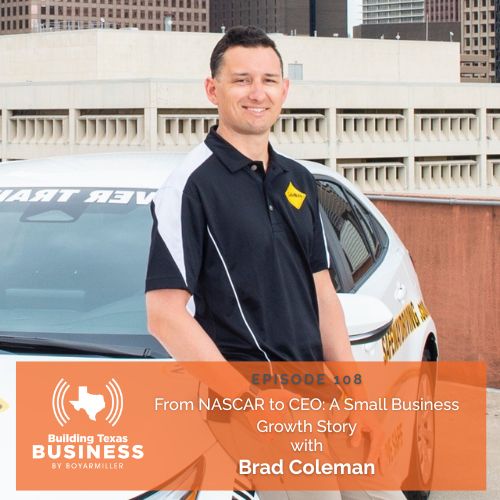
In this episode of Building Texas Business, Chris Hanslik sits down with Brad Coleman, Owner and CEO of Safeway Driving, for a conversation that goes far beyond driver’s education. Brad shares his remarkable journey from racing professionally in NASCAR to leading one of Texas’s most established driving schools, and how that transition became the foundation for a purpose-driven business.
Brad talks about how his passion for cars and driver safety first took shape, what he learned competing at the highest levels of motorsports, and how those lessons carried into entrepreneurship, leadership, and business growth. He also explains how Safeway Driving has evolved from a traditional local driving school into a modern franchise operation with a strong reputation, innovative curriculum, and a measurable impact on driver safety across Texas.
Along the way, the conversation explores topics like overcoming adversity, building the right team, protecting company culture, balancing accountability with empathy, and growing a business without compromising quality. Brad also offers candid insight into the pressure of racing, the mindset required to get back behind the wheel after a serious crash, and how confidence and preparation can make all the difference, both in business and on the road.
It’s a compelling episode about resilience, reinvention, and what it looks like to build a business that is both scalable and deeply meaningful. For business owners, entrepreneurs, and leaders looking for lessons in growth, culture, and long-term vision, this conversation delivers plenty to take away.
Transcripts are generated by machine learning, so typos may be present.
Chris Hanslik: Hey, Brad, I want to thank you for coming on Building Texas Business. It’s great to meet you. Great to have you on the podcast.
Brad Coleman: Yeah, thanks for having me, Chris.
Chris Hanslik: So let’s start. Tell the listeners just a little bit about right now you’re with Safeway Driving. So let’s start with what is that and what’s it known for?
Brad Coleman: Yeah. Well, I’m the owner and CEO of Safeway Driving. It is a driving school here in Texas. It is known for that. We’ve been here for 53 years. I didn’t start it, obviously, but I’ve been doing it a long time and it’s a great company.
Chris Hanslik: When did you get involved with the company?
Brad Coleman: Yeah, so I originally got involved when I was a student. I went through to get my driver’s license when I was 15 years old. I mean, the day I turned 15, I was in that door starting the class. Becoming the owner happened later on in my life. I became a NASCAR driver—we’ll get into that. But getting out of that, I was like, “What do I want to do with my life?” And I love driver safety. So I ended up going back to my coach and talking to him, and he wanted to sell. So that’s how I became part of it in 2010.
Chris Hanslik: 2010, okay, that’s great. So, let’s not bury the lead. So before you were at Safeway, you were a NASCAR driver. How did that come about?
Brad Coleman: Yeah, well, it was a dream of mine ever since I was a little kid. I loved cars, loved watching TV. And I learned at 13 years old that you could actually race go-karts, that they weren’t something you just went out onto some property and went driving around. They had full-on races; they looked like little Formula One races everywhere you went. So I jumped into that and ended up moving into bigger cars. When I was 16, I raced the 24 Hours of Daytona in a Porsche, which if you’re a race fan, you know that race. If you’re not, it’s a 24-hour long race at Daytona in sports cars. It’s a very grueling event. I ended up getting seventh out of 64 cars there, which was a ton of fun. And yeah, eventually ended up getting into NASCAR with Joe Gibbs Racing and did that for five years and just had a blast doing it.
Chris Hanslik: Well, and I know you said you started with Joe Gibbs, but you ended, I guess, with another team before you decided to, I guess, retire. So tell us a little bit about that team.
Brad Coleman: Yeah. So when I first got into NASCAR, I had this decision to make. I was 18 years old. I was just about to graduate high school, and I got accepted to college. And I was planning on doing that, and then I get this call from Joe Gibbs, the Redskins football coach and NASCAR team owner, saying, “Hey, will you come race for us?” And I was like, “Well, I could always go to college. I can’t always have this opportunity.” So I put college to the side and went racing with Joe. I did that race with him for a couple of years and then ended up in the NASCAR Cup Series with a team called Hall of Fame Racing, which was owned by Roger Stalbach, Troy Aikman, and a group of investors in the professional sports world. So I got to work for a lot of my idols growing up, which is really cool.
Chris Hanslik: Like a dream come true, I’m sure. So then you go through that, you decide to come back and buy this opportunity to buy Safeway. That had to be a little bit daunting, right? You had no college education, no business experience. So what were some of the things that I guess you felt like you had to overcome and getting comfortable that this was not only something you actually wanted to do, but that you could do?
Brad Coleman: Well, it was honestly a perfect fit for me. I’m passionate about driving, love it, love cars, everything to do with it. I mean, you put me behind a steering wheel, I’m happy. What originally started with the idea of acquiring Safeway was while I was still in NASCAR, Nationwide Insurance was a big sponsor at the time. And they had driver obligations. So we had to go to different events and speak at these events. And a lot of us drivers did not enjoy that very much because we’d rather just race, but it’s part of the business. So every week, we were in a different city all across the country for the series, and they would have us go out to a high school to speak to the teens about the dangers of distracted driving. I was fresh out of high school, so I didn’t want to go talk to high school kids. I was not one of the cool kids. I didn’t want to be there, but I did it. And there was this moment where one of these kids—I could tell something sparked. Like we had him in a simulator, we gave him a phone, he crashed into the wall. He was trying to be cool in front of his friends. But something clicked, and I noticed I was like, “I think I can make a difference in these people’s lives.” And it went from a sponsor obligation to something I really enjoyed and looked forward to doing. Eventually, I told my dad, who’s a successful businessman here in Houston. I said, “I have this passion. What do you think of that?” He said, “Well, why don’t we go talk to Coach Walker at Safeway Driving where you went to learn and just talk to him about it.” So I went and met with Coach Walker, and it turns out he wanted to retire, and it was just a perfect transition to acquire Safeway.
Chris Hanslik: That’s great. So then you acquire this company at the time you acquired it, give us, I guess, a size like number of employees and locations.
Brad Coleman: Yeah, so they had about five locations across Houston in the Bellaire area, Woodlands, Kingwood, Klein, and Memorial area, which is where the hub has been for 53 years. And a big part of it was my dad with his business experience. So we came in really as a team. I’d call him the branding genius, marketing genius. He came in and saw this opportunity to take this driving school—which is what you imagine when you think of a driving school: dusty classrooms, folders everywhere, not really thought out very well—and modernize it, clean it up, and make it a fun place to be. Then I took the driving side of it. I took the curriculum, the instructor training, and what we trained our teens. I took my knowledge from racing and everything I learned there on how to drive and really applied it there. So we doubled up on that. It turned out to be really good.
Chris Hanslik: That sounds really cool. So you become the owner of this business. What were some of the lessons you learned while driving NASCAR and being on those teams that you think kind of became things you drew upon as owning a business?
Brad Coleman: So it’s interesting when you think of a NASCAR driver, a race car driver owning a driving school. People go, “Why would I want to learn how to drive from somebody who goes really fast?” But it actually works really well, because a big part of racing is, yes, going as fast as you can, but another one is avoiding crashes.
Chris Hanslik: Right.
Brad Coleman: And also analyzing your competitors, knowing what they’re going to do, being able to predict movements, and putting yourself in the best position to win the race, which actually works really well on I-10 when you’re out there just trying to get to a destination.
Chris Hanslik: Well, there’s that old saying, rubbing’s racing. So I mean, you know.
Brad Coleman: True. Very true. And it is. Out here, it’s no fun on I-10. You have to learn how to put yourself in the best situation to get to your destination. But on the business side of things, racing really prepared me well with a lot of aspects. I got to be a part of huge organizations with very successful businessmen. I was in meetings with them and also these brands that I was a part of—Kimberly Clark (who owns Kleenex, Cottonelle, all those), Broudy’s Barbecue—I can list all these companies that I was an ambassador for. So I would be in a lot of meetings with them, I would represent them, I would do speaking engagements, and it really helped me just prepare for this.
Chris Hanslik: That’s great. I love that and I can see how that would be a great training ground—not formal education, but a kind of school of hard knocks seeing it real time. As you moved in with your dad taking over this business, what were some of the things you felt like that you’ve—I think you’ve touched on it, but I wanted to hear more of the detail—what are some of the innovative things you think you and your dad did to kind of separate Safeway from your competition?
Brad Coleman: Yeah, I think one of the biggest things we did was just the branding in general.
Chris Hanslik: Make it something cool. I mean, it’s hard to make Driver’s Ed cool. You know, people aren’t going to walk around in our Safeway shirts when they graduate. Like, that’s fine, we understand we know who we are, but we want it to be an enjoyable place to be while you’re there. So, one thing we did is, you know, Driver’s Ed was all in the classroom and then you go get in the car. So in the classroom part, you’re sitting there with 30 other kids watching a teacher. We were the first driving school to create an online curriculum. So we did a lot of work pioneering that. We had to pioneer that with the legislative side, you know, in the state of Texas, and show them how it’s not going to hurt their education, but actually help set them up. We think, you know, the majority of the learning happens in the car when you’re actually doing the thing. The classroom prepares you for that. So when kids are tired after six to eight hours at school, then they have to go sit in driver’s ed, they’re not really paying attention. So when they can take it at their convenience, it really sets them up better to be successful in the car. So that was something that we really pioneered.
Brad Coleman: And I think, you know, that generation, as you think about kids about the time you took over, are continuing or learning more from videos than they are just traditional instruction anyway. So you kind of adjusting that education and that curriculum to meet them where their educational kind of strong suits are, it seems like.
Chris Hanslik: Yeah, and attention spans continue to just get very short. So when you have almost bite-sized learning modules that they can do where they can say, “I’m waiting in line at Starbucks, I’ve got five minutes, I’m going to do some driver’s ed,” in little chunks when they’re waiting on things or when they’re lying in bed and just resting, it’s actually better for their learning.
Brad Coleman: So have you expanded since taking over outside of Houston?
Chris Hanslik: We have. One of the things that my dad and I really looked at was how do we grow this? Because something that’s really cool is the state of Texas releases crash statistics on driving school graduates every year.
Brad Coleman: OK.
Chris Hanslik: So we can see how successful we are as a driving school versus other driving schools. And what the data shows is that Safeway Driving graduates’ chances of getting in a crash is nearly half…
Brad Coleman: Wow.
Chris Hanslik: …the average driving school in Texas.
Brad Coleman: That’s got to be a great marketing tool right there, just an end of itself, right?
Chris Hanslik: Yeah.
Brad Coleman: And that’s not your data. That’s state of Texas.
Chris Hanslik: That’s state of Texas. Yeah. That’s not us saying, “We’re the best driving school, trust us.” It’s like, “No, look at this data.” What we do is making a difference. And it’s because we have such a great curriculum that we really work with the kids in the car and we work with adults too to prepare them. It’s foundational and it builds on itself. It’s not just getting in the car. “What do you want to do? Take me to the dry cleaner,” like a lot of driving schools. No, we’re going to do work. We’re going to make you a good driver, put safe habits in you for life.
Brad Coleman: So you took that data and used that to target places to expand beyond Houston.
Chris Hanslik: Yeah. So when we saw how much of a difference we were making, we were like, “Okay, well, how do we grow this? How do we get this in front of more people?” Because if we do that, I honestly believe we’ll see the crash statistics in the entire state change for the good. So we looked at two approaches. We were like, “Okay, we can open our own corporate-owned stores as we grow, or we can look at the franchise model.” And what we love about the franchise model, which is what we ended up doing, is that you get local owners in their communities that live there, that are part of it, that know the people there, that care about it, that want to see them impacted for good. So they get to run it, and they get to make a difference while making money. So we’ve partnered up with a lot of local owners in different communities. We’re in Dallas now, in the Highland Park area. We’re in San Antonio and Schertz. We’re in College Station. And then all across Houston, we’ve got over 20 locations as we’re growing through franchising.
Brad Coleman: That’s great. So what then have you done to kind of work with those franchisees to help make sure they’re set up for success?
Chris Hanslik: Yeah, so we’ve worked hard to develop the system. I mean, it was already up and running for over 40 years by the time we decided to franchise, and we just continue to develop and improve on it. And we’re really there for them support-wise. It’s really important to have that initial training that sets them up for success, but then also the ongoing support. Any questions you have, any help you need, you can refer to our manual, you can ask us—we’re always here—and we’re setting them up to be successful. And it’s cool because they get to see the impact they’re making in people’s lives that they know while making money at the same time. So it’s really win-win.
Brad Coleman: Good. As you’ve grown, have those statistics stayed consistent as far as your graduates staying safe on the road?
Chris Hanslik: Yes, they have. They’ve stayed good. And it’s cool because we set it up to where we’re going to start to be able to see per franchise location how those crash statistics are. So that’d be exciting.
Brad Coleman: So you’ve taken this over the last, I guess, 15 plus years now. As you took over and have grown it, what are some of the lessons that you’ve learned that you think other aspiring entrepreneurs would benefit from knowing kind of the ups and downs of that hands-on ownership?
Chris Hanslik: Yeah, that’s a good question. For me, it’s really putting people around me that know what they’re doing, are good at it, and care. We’re really lucky in that the people that work with me on the corporate team have been—some of them have been here at Safeway longer than me. A lot of them have been there 15 years; I think the shortest term is like six years. So we have people there that have been there a while and they really care. So, getting good people around you because you can’t do everything as an entrepreneur. I know one thing I struggle with is wanting to just do everything and struggling to delegate. But that’s something I’ve really worked on and learned. And I’ve seen the result in that we’re actually better as a business, we’re better as a team. It’s better for the franchisees. It’s better for the customers. When I delegate to people and we all do what we’re good at, it helps the business overall.
Brad Coleman: Yeah. Hiring where you have weaknesses, right? So you have someone that does something better than you and trust them and give them the autonomy to do that job.
Chris Hanslik: Yes. I need a lot of people that do stuff better than me for sure.
Brad Coleman: So as you’ve built the team then what have you done to try to nurture and how would you describe the culture at Safeway?
Chris Hanslik: It’s a great culture in my opinion. Now, if you ask my team, I think they would say the same thing. We’ve worked really hard and we did it together in setting the values that we want to live by, that we want to just do everything we do day-to-day. Right. And it’s really cool to see how far we’ve come with it, and I think it’s a great environment.
Brad Coleman: That’s good. So we always talk about hiring being a very challenging thing to do as an owner, right? To make sure you get the right person on your team. Anything that you’ve kind of learned throughout these years on what has made you more successful in your hiring process versus maybe things that you stopped doing that weren’t working.
Chris Hanslik: Yeah, someone said something to me about a “hire slow, fire fast” kind of deal. And I’m like, “Oh, I don’t understand that.” But through this business, I found out who you have in your business is everything. So if someone’s not the right person, hopefully you can find that out before bringing them in. But a lot of times you can’t. And it’s not because they’re a bad person or they’re evil or whatever. It’s just sometimes it’s not a good fit. So it’s finding that good fit.
Brad Coleman: We say that here all the time, right? I mean, every business has a culture, whether you know it or not. So you ought to try to nurture it and mold it, but we’re not trying to…
Chris Hanslik: The business that can employ everyone in the world. So if it doesn’t work, it’s okay. There’s just a different organization for that person that they’re going to connect better with and where they’re meant to be. It doesn’t make them bad, doesn’t make us bad. It just wasn’t a good fit.
Brad Coleman: Yeah, my job really at this point is to protect that culture that we’ve all worked really hard to build and it’s to allow the people in it to do what they do. And so anyone we bring in, anyone that we may have to leave, I’m just protecting the culture so that everyone can just have a good life and enjoy their work and do what they do.
Chris Hanslik: That’s a good transition into leadership. So how would you describe your leadership style?
Brad Coleman: I don’t even know how to describe that. Probably too lax at times, and then probably too strict at others. I’m really easy going. I want to create an enjoyable environment. I don’t want people to be scared if they’re having a meeting with me. But at the same time, I want a place where it’s like, “No, you’re accountable. What you said you would do is what we all agreed upon. If you don’t do that, you’re going to feel the hammer.” But I’m kind before that.
Chris Hanslik: That’s a good balance, right? You walk a tightrope of, you know, setting standards and accountability, but also demonstrating grace and empathy, you know, at the same time and trying to walk that tightrope as a leader to push your people, but also make it a safe place for them to try, maybe fail, as long as everybody was clear about what the objective was and going in the right direction.
Brad Coleman: Yeah, I’m actually really cool with people failing, as long as somebody doesn’t get hurt in the process. Like an instructor in the car failing with a kid, that’s not something I’m okay with. We’re very strict with our instructors; we’ve got great instructors. But people on our corporate team, if they want to try something and they fail, I am totally fine with that. As long as they admit to it, as long as they share with it, and they don’t try to stuff it, hide it, or blame somebody else. I’m like, “If you’re accountable, that’s correct.” I just love honesty and open accountability. That’s what I care about a ton. And I also put people on my team that can help me, that maybe would be a little more strict so that they can help balance me. I’m like, “Hey, here’s the situation. Let me know your thoughts.” And they say, “Oh, you’re being too lenient. We need to do this.” “Okay, let’s find a middle. Where can we go with this?”
Chris Hanslik: That’s good. No, you need that, I think, to balance out the leadership team. All right. So take us behind the curtain a little bit, back to the NASCAR days. You’re a leader of a business now. When you’re the driver, I mean, I can make all kinds of assumptions, but who’s really leading that team? You know, because I know there’s more than just the driver, right? You’ve got a whole crew around you and all that. So what is that dynamic like? Did you feel like as the driver, you were the leader, or you—I mean, I know it was a team effort—but what were the dynamics like when you’re behind the wheel, preparing for the race, and then executing on race day?
Brad Coleman: It’s a crazy sport, because when people see it on TV, they don’t think about how much of a team sport it is. It’s massive. Like Joe Gibbs Racing, for example, when I was there, there were 600 employees for race cars to go around the track for one driver to sit in it. So the driver is a leader in a lot of ways. They help set the direction for how the car is set up, which sets the direction for how everyone in the shop is doing work. When I look back at it now as a 38-year-old man who’s got more life experience and more leadership experience, I wish I could do it again and use some of that leadership skills, because there’s a lot I just didn’t know. I loved driving the car; I was good at it, and I had a lot of fun. Leadership-wise, I could have been better, I could have been more of a leader in that. And that’s just part of life. But the leaders were really the crew chief, I would say, is what they’re called. They’re a guy who’s in charge of all the team that builds your car. The driver and the crew chief are just attached at the hip. I tell him what’s going on with the car and what I feel. He then tells the team, “Here’s what we need to change to fix what he’s feeling.” He really translates what the driver talks about. So, it is a lot of feel from the driver—what you feel going around the track in the seat of your pants and in the steering wheel. Most of what you feel is just right here. You are bolted into that car. It’s a carbon-fiber seat, very rigid, with a six-point harness. I mean, you’re not moving in there. So you feel everything the car does. You could feel in the seat what’s happening in the car, if it’s the right rear, or if it’s the right front. Is it the spring rate? Is it the sway bar? Is it whatever it is? You just feel that in the seat. As a driver, you could say, “Okay, going into Turn 1, it’s a little too loose,” which means the rear end wants to come around, “but once I get to the middle, then it gets tight, it won’t turn.” So they go, “Oh, okay, well, we’re going to do these adjustments to fix it.” So I don’t tell him, “Go change the spring rate. Go move the sway bar.” I say, “Here’s what the car is doing.” He translates it and tells the team how to do it.
Chris Hanslik: Yeah, that’s pretty fascinating. All right, so, scariest moment as a driver: a bad wreck?
Brad Coleman: It’d be on the street. On the racetrack. If you were talking about the racetrack.
Chris Hanslik: If we race at Houston.
Brad Coleman: Yeah, ooh, racetrack. It’s tough because the scariest moment was one that I don’t really remember. So it wasn’t scary at the time, but looking back, I’m like, “That was really scary.” It was my second ever NASCAR race. And there is a lot to NASCAR racing and racing in general to learn. One of them is how the aerodynamics work—how air flows over the car.
Chris Hanslik: Sure.
Brad Coleman: When another car gets on the outside, it takes air off my rear spoiler and it makes my car want to spin out. And I learned that when I was passing somebody, and I spun out, and I hit the driver’s side flush onto the concrete wall. There was a metal piece that wasn’t installed quite right where the net bar goes in in the car, and I hit my helmet on it, cracked my helmet, and knocked me out. And I woke up in the hospital with a neck brace on and had no idea what happened. And it was terrifying. I ended up having to stay the night. There was a blood spot on my brain that they’re like, “Hey, we’re going to monitor it every hour. If it doesn’t get any better, we’ve got to drill and drain.” I’m like, “What’s going on?” It knocked me out for the rest of the year. It was a really bad concussion. Super nauseous after that. It was brutal. And we didn’t know as much about concussions then as we do now. So that’s the scariest looking back. The scariest that I could remember in the moment is probably when the brakes failed. I went to hit the pedal, and it wouldn’t stop, and I just went straight into the wall because I could see it coming. I’m like, “There’s nothing I can do about this. I’m going over a hundred miles an hour. I’m going to hit this wall. Hold on.”
Chris Hanslik: Oh, wow. Made that one out. Okay.
Brad Coleman: Yeah.
Chris Hanslik: Yeah.
Brad Coleman: I think I’m okay. I rung my bell a couple of times, so you probably have to ask my wife or friends if I’m okay.
Chris Hanslik: I’m sure it’s situational for her too. Overall, I’m good. Okay, so I’m going to take you back, because that’s great stuff. I knew I was kind of thinking when we started with you being a NASCAR driver, if I didn’t go deep into NASCAR with you, the listeners would be revolting. But a lot of NASCAR fans.
Brad Coleman: Yeah, well, I don’t know.
Chris Hanslik: I mean, just cool, right? I mean, it’s not every day you meet a former NASCAR driver who is now a business owner and entrepreneur. So you’re unique in that, I think. So, that second race accident—you wake up in the hospital, you described all that. Now describe the first time you got back in the car on a track. And because I believe we learn most in overcoming adversities, I have to think there was a ton of stuff going on for you to get back in the car to begin with and get on the track.
Chris Hanslik: And I’m sure you apply whatever those learnings were to what you do today at Safeway and in your daily life. So take us back to that moment and share a little bit of what that was like and what you did to overcome that.
Brad Coleman: Yeah, you’re going to get me emotional over here. It’s okay. It’s something I haven’t thought about.
Chris Hanslik: We’re okay with profanity and tears on the spot.
Brad Coleman: Yeah, I haven’t thought about it in a while, but when I look back and I remember those moments, there were two more races that year that I was supposed to do that I couldn’t do because of that crash and because of the concussion and just how my body felt. It wasn’t even because the doctor didn’t approve me. It was because if I got in a street car to go drive one mile, I got super nauseous and dizzy. And it really threw me off. It was scary. It’s like, “Am I ever going to feel better? Is this how I’m going to be the rest of my life?” That happened in October, and it wasn’t until March that I actually got back in a race car for the first race of the next year. It was down in Mexico. In NASCAR, you race on ovals—you know, people used to say you only turn left—but also road courses where you turn right and left. And I had a lot of road course experience. So it was a great “getting back on the horse” situation because it was a fun track. I was really looking forward to it. The first time I went around, I went slow. Kind of like Ricky Bobby in Talladega Nights, where you think he’s going super fast and he’s just cruising around really slow. That was me for a lap. But man, as a race car driver, you’re either going to be right back in it or you’re done. If you can’t get right back in it, you might need to do something else. Honestly, when it comes to that, because that’s not a sport you could be scared in. Fear hurts people; it hurts yourself, and it hurts other people. You have to be confident. You have to know what you’re doing. And if you get scared, that’s for a lot of drivers—that’s really the gut check of like, “Maybe I shouldn’t be doing this anymore.” Maybe I had kids and I’m scared, or I had a bad wreck. And that’s okay. But luckily, I wasn’t scared, and it was fun. The first lap was a little scary, but after I did it, I was like, “Oh yeah, I know why I do this.”
Chris Hanslik: Yeah, that’s great. Well, I mean, it occurred to me as you answer that, you’ve taken that mindset to your students now at Safeway, right? Be confident because I think driving out of fear on the Houston freeways or the streets of whatever can also not only impact you, but drivers around you. So you have to teach confidence.
Brad Coleman: Well, the scariest drivers and most dangerous are the scared ones for other people. I mean, when you’re getting on the I-10 out where I live, the speed limit is 60. If you’re going 30 miles an hour because you’re scared of the freeway as you try to get on, those cars are flying by you. It’s going to be even harder and scarier to merge, and it’s dangerous. But if you just conquer that fear and you are confident and go 60 miles an hour, it’s a lot easier to merge. We share that with the students. And that’s why what I love about our system is we start with them in a parking lot. When someone’s never driven a car before, you can’t just take them out on the road. It’s terrifying. Start in a parking lot and show, “See, this thing isn’t as scary as you thought. You can control it. Look how good you’re doing.” Okay, now let’s move up. It’s not until their sixth lesson that we’re taking them on I-10 and showing them like it’s not as scary as you think.
Chris Hanslik: Well, I feel good. So I have two daughters that took the driver’s ed. They did driver’s ed as well, but we started in parking lots. I did something right. Yeah. But you had to do all that parent time.
Brad Coleman: Was it in your car?
Chris Hanslik: Yes.
Brad Coleman: That was a smart investment as well. Right.
Chris Hanslik: But you do all that, you know, the parent time or whatever and keep track of logging those hours as well. And so thankfully, if there’s some wood around here, they’re doing pretty good. So, all right, well, let’s take it back to Safeway. So what do you see as the vision and the future and the opportunity for Safeway as a company, but also as a company that is trying to capitalize its business within the state of Texas and what opportunities that provides?
Brad Coleman: Yeah, we are a Texas company. I mean, I love Texas—born and raised. So we’re trying to just grow across Texas. We have been in Houston for 52 years, now on our 53rd. We’re in Dallas, we’re in San Antonio as well. So, it’s getting what we do and the impact we’re making to as many people as we can. That is my goal. And that’s purely what I’m focused on while making sure we don’t sacrifice what makes us great in our quality that we deliver. I want to grow. I’m not going to grow with the wrong people. When you’re trying to bring on a new franchisee, you have what we call observation day. They come in, they see what the business is all about, they meet the team. I tell them, one of the first things: “My job is to try to convince you not to do this. I’m not here just trying to sell you, like, ‘come do it.’ Is this a good fit for you? Is this a good fit for us?” Because what we do is too important to just care about the money and just care about growing. I care very much about quality. It’s probably a weakness a little bit, but it’s because of how much I care about driving and our customers. I will not sacrifice quality just to grow, but we’re wanting to grow.
Chris Hanslik: That’s great. Kudos to you, because I think the franchise model probably gets a lot of flak for the view that a franchisor is just happy to sell the franchise to anybody to get the fees, et cetera, and all of that. So it sounds like you’ve taken that franchise model, but actually you’re executing it as if you’re growing it as a corporate-owned store model. So you’re very picky in particular about who you let in.
Brad Coleman: Yeah, and we tell people, if you’re looking for mailbox money, this is not it. You’re going to be involved. You’re going to be in your community. People are going to know you as the Safeway Driving guy or girl. It’s what you’ve got to do. And we have franchisees that love it, that are thriving, that love the impact they’re making and the lifestyle they’re able to have because of it. So it’s really good when we partner with the right people and it’s a good fit for all of us.
Chris Hanslik: Yeah. All right. So how bad do you miss NASCAR racing?
Brad Coleman: It depends on the day, but I miss just driving your car, being alone in the car, going as fast as you can in a controlled environment where I don’t do that on I-10, scares the life out of me to go fast on the street. But yeah, I miss the sensation. There is nothing like it.
Chris Hanslik: Yeah, that’s cool. What do you do kind of in your own personal time to just recharge and relax?
Brad Coleman: Well, I was about to say in my personal time, I’m with my kids and my wife, my five and four year old boys, but then you said recharge and relax.
Chris Hanslik: Those don’t go together.
Brad Coleman: Absolutely love being with my family. We went to a motorcycle race out in Austin last week. We go to different races with them. They like racing, surprise, surprise. I have a racing simulator in my house, so I still get to do some racing, but it’s virtual. It has a motion platform, and three screens that wrap around me. And I’ve got buddies all across the world and country that I’ll do races with where we team up and switch off. I have a lot of fun doing that. I did a lot of golf when I was racing. Every race car driver pretty much golfs—I don’t know why we all love it. So I’ve gotten big back into that and love just getting out on the course and being out in nature.
Chris Hanslik: So you have a race simulator, not a golf simulator.
Brad Coleman: That’s right. Yeah.
Chris Hanslik: I chose the race simulator. That’s very good. So as a native Houstonian, You prefer Tex-Mex or barbecue?
Brad Coleman: Barbecue. Give me a good moist brisket any day. And that was one thing. I moved to Virginia for racing when I was in high school. I did not know there were different kinds of barbecue. I got there. They gave me pulled pork. They put this vinegar sauce…
Chris Hanslik: …on it. “What in the world are you giving me?”
Brad Coleman: I was going to ask, having been in the Southeast with NASCAR, because there is this different barbecue and different sauces. So I was like, “Did they convert you or are you still a Texas barbecue guy?”
Chris Hanslik: I’m Texas barbecue. I’ve learned to appreciate that it is different. I thought they were just doing a bad job with Texas barbecue, but no, there’s Virginia barbecue. There’s South Carolina with their golden sauce, which is very good. So, Memphis with their dry rub ribs.
Brad Coleman: Yeah.
Chris Hanslik: I learned to appreciate all the different types of barbecue.
Brad Coleman: Very good. Well, Brad, this has been great. Thanks for taking time. Your story is amazing. Very unique. Congratulations for all the success you’re having at Safeway and keep it up.
Chris Hanslik: Thanks, Chris. I appreciate it. It’s been fun. Yeah.
Brad Coleman: Take care.
Chris Hanslik: Thank you.
With a deep understanding of your business alongside clear and honest communication, we help clients face challenges fearlessly.
Learn more about our services and how we help clients.