


With a deep understanding of your business alongside clear and honest communication, we help clients face challenges fearlessly.
Learn more about our services and how we help clients.



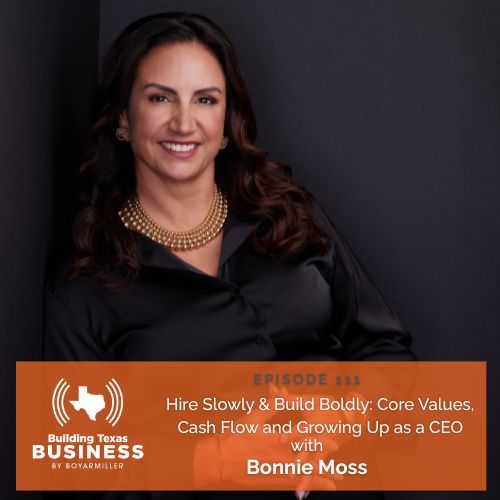
In this episode of Building Texas Business, Chris Hanslik sits down with Bonnie Moss, President and CEO of MBCO, a civil engineering, surveying, and subsurface utility engineering firm she founded nearly 11 years ago. Drawing on close to three decades of industry experience across Texas, Bonnie shares what ultimately pushed her from regional manager to business owner, and how sometimes the best entrepreneurial decisions are the ones you make before you have time to overthink them.
Bonnie walks through the real lessons of transitioning from engineer to business owner, including learning the hard way about accounts receivable, reading profit and loss statements, and the critical difference between being able to do a project and actually making money on it. She also reflects on the growth pains that come with scaling too quickly, what happens when business development takes a back seat to delivering work, and why hiring slowly and controlling costs are two disciplines she wishes she had internalized sooner.
The conversation covers how MBCO built its culture around core values, autonomy, and a willingness to embrace failure without shame. Bonnie talks about adapting the organizational chart to fit the people on the team, surrounding herself with those who are stronger in areas she is not, and learning to lead by listening more than speaking. She also addresses the emerging pressures facing the engineering industry, from artificial intelligence automating design alternatives to autonomous grading equipment changing jobsite operations, as well as the importance of client diversification when government agency budgets slow down.
Bonnie also touches on leadership fatigue as a real and underappreciated risk for founders, the value of programs like Goldman Sachs 10,000 Small Businesses for early stage entrepreneurs, and why growing fast is not the same as growing well. Her advice to anyone thinking about starting their own company is grounded and direct: control your cash, seek counsel from people who have been through it, and trust your gut.
If you are a business owner, entrepreneur, or aspiring founder in the engineering or professional services space, this episode offers a candid and practical look at what it actually takes to build a firm from the ground up, sustain it through setbacks, and position it for long term growth in the Texas market.
Transcripts are generated by machine learning, so typos may be present.
Chris Hanslik: All right. Bonnie, thank you for coming in today. I appreciate you taking the time to join us on Building Texas Business.
Bonnie Moss: Thank you for having me. It’s a pleasure to be here.
Chris Hanslik: So, let’s start. MBCO is a company that you founded and where you serve as the president and CEO. Tell us, what does the company do, and what is it known for?
Bonnie Moss: Well, the company is a civil engineering firm. It’s not just engineering; it’s surveying and subsurface utility engineering. Most of our clients are government agencies, such as TxDOT, counties, cities, and so forth.
Chris Hanslik: Okay.
Bonnie Moss: Yeah.
Chris Hanslik: I know you founded the company about 10 or 11 years ago, correct?
Bonnie Moss: Yes, we’ve been in business for 11 years. I’ve been in the industry for close to 30 years and have worked for some amazing organizations across Texas in roles ranging from graduate intern to project engineer and regional manager. It was at that point that I decided to take all that experience and go out on my own.
Chris Hanslik: Let’s talk about that. What was the inspiration or motivation to take that step? It’s not easy to go out on your own and try to build something yourself.
Bonnie Moss: I think I always had it in my head, but for the longest time, I couldn’t get past the details. I had been in the industry long enough to see different things; I worked for many different people and realized what I liked and didn’t like about various companies. I wanted to combine the best ideas and create a company the way I wanted to. Quite honestly, I didn’t overthink it; I just did it. Sometimes, ignorance is bliss.
Chris Hanslik: Well, there’s a lot of that.
Bonnie Moss: The next thing you know, we’re signing a lease to an office.
Chris Hanslik: And then it’s real.
Bonnie Moss: And then it’s very real.
Chris Hanslik: That’s a common story. If people overthink it too much, they might never take the leap. It’s a truth among entrepreneurs. No matter what you plan, a curveball is coming as soon as you implement it. Did you have partners in the beginning? I know you have partners in the business now.
Bonnie Moss: You definitely have to change your mindset. Personally, I feel that comes from experiencing failure. When we started, we were the engineers; we knew how to do and deliver the projects. Suddenly, you turn from an engineer into a business owner. You learn quickly that you have to invoice for your services, and then you learn about accounts receivable when payments don’t arrive in 30, 60, or 90 days.
Chris Hanslik: Right.
Bonnie Moss: And then you learn how to read your profit and loss statement. That takes a long time, too. So it’s an iterative process.
Chris Hanslik: For sure. So you’ve grown this company now, you and your partners. You mentioned in the intro the different business lines. What do you feel have been some of the biggest lessons learned as you’ve grown, whether from failures and mistakes or from the success stories that have come around?
Bonnie Moss: Yeah, so one of them, I will use my surveying business as an example, is to make sure you hire very slowly.
Chris Hanslik Okay.
Bonnie Moss: To grow that and control your costs. Because it’s really easy to, you know, as I said in surveying, we’re buying trucks, we’ve got our logo on them, we’re excited. We’re spending lots of money on GPS units, and then all of a sudden it’s taking a long time to get paid. So if I had to do it over again, maybe I would just slow it down a little bit.
Chris Hanslik: You mentioned hiring slowly. Have you developed systems within the company to follow a specific process for recruitment to improve your “hit rate”? You won’t be perfect, but if you know your organization and its core values, you can implement a process that finds people who truly fit.
Bonnie Moss: Yeah, absolutely. And that also is an iterative process.
Chris Hanslik: Yes.
Bonnie Moss: You don’t know what you don’t know; my business partners tease me because I say that a lot. In the beginning, we just tried to fill seats and keep moving. Then we wondered why people were leaving. We realized the culture wasn’t always the right fit. Establishing core values was the turning point. Those values became our guide for hiring and firing. Once we put that in place, hiring became easier and attrition rates lowered.
Chris Hanslik: It’s funny you say that; we use the phrase “hire and fire for culture” here as well. For us, culture is about behavioral standards. I’m curious about your experience leading the company. Many people find the human element and unanticipated personnel challenges difficult. How have you learned to handle those while maintaining momentum and a positive mindset?
Bonnie Moss: It’s all about finding the right people. If the attitude is right, you can find a place for them. Like the book “Good to Great” says, it’s about getting the right people on the bus. If they’re the right people, you can find the right seat for them.
SPEAKER_02: Right.
Bonnie Moss: And don’t be afraid to change your organizational chart.
Chris Hanslik: Yeah, I like that. So what was the circumstance that, I guess, presented itself where it sounds like you changed your organizational chart to fit the team you had?
Bonnie Moss: For example, I hired someone near the very beginning who is a great thinker and provides immense value. She helped with proposals and almost everything else. Recently, we needed help on the operations side. Even though she didn’t have direct COO experience, we moved her into an operations role because she is excellent at having those uncomfortable, necessary conversations.
Chris Hanslik: Yeah.
Bonnie Moss: Yeah. So it’s, it’s things like that.
Chris Hanslik: Okay. Yeah. Being a little bit of intuition, right?
Bonnie Moss: It’s about intuition and adapting to the situation. Sometimes you develop a plan only to realize it’s horrible. You have to be able to throw it away and start over without feeling bad about it.
Chris Hanslik: Right.
Bonnie Moss: The first time a plan of mine failed, I felt horrible, like I didn’t know what I was doing as a business owner. But you just have to keep trying.
Chris Hanslik: You mentioned that before, too. I think people are scared to admit failures. But what I’ve experienced personally, and what I’ve heard from so many, is that there’s so much learning in those failures. When you look at a company like yours and others that are experiencing great success, the founders and owners will tell you that it’s because of huge mistakes or failures they’ve made along the way; they never would have gotten to this point without them.
Bonnie Moss: That’s right.
Chris Hanslik: Could you share an experience or two of a failure and how that helped accelerate your learning and growth, and therefore the company’s growth?
Bonnie Moss: One year, we invested in a new business line and found key hires for it. That was the right move, as it’s paying off now. However, the following year was difficult due to various reasons like employee issues or project delays. Having those compounding tough years taught me that since you can’t predict the future, you must have a nest egg and plan for the worst.
Chris Hanslik: Yeah. Contingency plan.
Bonnie Moss: Exactly. Yeah. So things like that. I would say a lack of planning could be a failure. This was things that nobody sees.
Chris Hanslik: It would be nice to have a crystal ball. But I think that’s a great point. The whole idea of if and when to start a new line of business or product can be a scary decision to make. When is the right time? I think right planning helps with that, to your point.
Bonnie Moss: Absolutely.
Chris Hanslik: So let’s talk a little bit about what’s going on just in your industry specifically. What kind of things do you see that you’re trying to do to kind of leverage technology or be innovative within the organization?
Bonnie Moss: There are so many things happening in the engineering industry right now. We’re seeing AI automate roadway designs. Where a client used to wait for two or three manual alternatives, you can now input parameters and have multiple options generated instantly. It’s a big shift from the old school paper-and-pencil methods.
Chris Hanslik: And it happens fast, right?
Bonnie Moss: It does happen fast. In our industry also, you see a lot of automation of robots, the grading of autonomous vehicles. They’re out there grading a project, and there’s no human out there. And I guess it’s a good thing because it’s eliminating errors, human error, but yeah, things like that. Absolutely.
Chris Hanslik: In what you’re seeing then, everyone talks about how AI may automate some things and eliminate jobs in one area, but create jobs in another. Are you seeing that in your industry? You mentioned automated grading machines eliminating jobs; are there other opportunities where new jobs are being created because of that emerging technology?
Bonnie Moss: Yeah, I don’t know. I haven’t really seen that aspect in our business.
Chris Hanslik: How about just being here in Texas? I mean, what have you seen? You mentioned even before you started your own company, you were operating all over Texas. As a business owner, what are some of the advantages that you’ve seen and experienced about being in Texas and being based here in Houston?
Bonnie Moss: Being in Texas is awesome. I moved here in 1988 and never left. It’s a great place for business because the economy is so robust. Even during a recession, Texas is often the last one in and the first one out. With so many people moving here, there’s a huge need for infrastructure, which creates a constant demand for engineers and surveyors.
Chris Hanslik: Going back to the core of the company, you mentioned core values. How would you describe the culture you’ve built at MBCO, and what are some of the key aspects of it?
Bonnie Moss: The culture is pretty much letting the employees do what they want to do with respect to experimentation. without feeling like they have a fear of failure.
Chris Hanslik: Interesting. So autonomy.
Bonnie Moss: Yes.
Chris Hanslik: I’ve seen on your website that you talk about your employees and customers being your biggest assets. What have you done day-to-day to promote and encourage that autonomy and freedom from the fear of failure? You can’t just say it; there have to be behaviors that show up so people actually believe it. Regarding the management team, how have you built a team around you to further your vision and ensure that the culture remains paramount?
Bonnie Moss: Well, just sharing the vision of the company, you know, being very transparent and open about all that is important. And then hiring people that are smarter than you.
Chris Hanslik: That’s the biggest one, right?
Bonnie Moss: So I can remove myself to work on the business, not in it. People talk about that, so that’s important. Yeah, just sharing the vision of the company, sharing ideas, and getting people’s input. Absolutely, making sure that the clients are taken care of ultimately, but sharing the vision and having complete buy-in from everybody on the vision of the company. And we’re on the growth strategy, too.
Chris Hanslik: When you think about looking ahead, Any kind of headwinds that you see that either you’re already starting to prepare for or that you think may be around the corner in the next 12 to 18 months?
Bonnie Moss: I would say that leadership fatigue is a real thing. We have to ensure we are delegating enough, staying healthy, and taking vacations. It’s important.
Chris Hanslik: That’s a term I haven’t heard, but it’s one I’ve felt. I think it’s been accelerated since 2020. That took a big toll, and while there’s been lots of good, there’s been a lot of uncertainty in the last five and a half years with many ups and downs. In our legal practice, we see a lot of M&A transactions where founders are selling because they’re tired.
Bonnie Moss: Yeah.
Chris Hanslik: They’re ready to sell because they’ve had enough. They are proud of what they built, but they’ve reached that stage of leadership or ownership fatigue.
Bonnie Moss: It is a real thing, and I keep an eye on it for myself and our leads. Beyond that, navigating the economy is a challenge. Currently, TxDOT has a bit of a slowdown, leading to layoffs in the industry. That makes diversification vital.
Chris Hanslik: Sure.
Bonnie Moss: Right. That’s true for any business. With us, we do county and city work, as well as work for Metro. Diversification is key. Sometimes that’s overlooked by business owners who have a huge amount of TxDOT work and don’t look beyond that.
Chris Hanslik: Right. When you have one or two big clients, things are great, but you can lose sight of the need to diversify. Dealing with government entities can be frustrating because projects can get hung up on budgets or votes that are completely out of your control.
Bonnie Moss: Yeah, absolutely. Yep.
Chris Hanslik: That leads me to thinking about overcoming challenges in leadership. I know from what I’ve read that you’ve overcome a lot to get to where you are today. To the extent you’re willing to share, how do you think that has helped shape you as a person and as a leader?
Bonnie Moss: Many engineers are very conservative and risk-averse. My background is a bit different, and I’m not particularly risk-averse. That can be exciting and help you think outside the box, but it can also be a bit scary for the people you’re working with!
Chris Hanslik: Many entrepreneurs are chasing an idea, but at some point, they need structure around them. While the company needs a visionary to grow and scale, you also need balance. As you said earlier, you have to hire people smarter than you. How has that dynamic worked inside the company to allow you to be yourself while learning to delegate to your partners or others who provide that structure?
Bonnie Moss: Absolutely. That’s why I work with people, a lot of great people who do like structure and they’re very good at implementing the structure. And then that’s where it comes to helping them out and having them have the buy-in in the company and the vision, allowing them to do what they do.
Chris Hanslik: So you as a leader, how would you say, well, first, how would you describe your leadership style?
Bonnie Moss: Oh my gosh, kind of crazy. I haven’t heard that one before. Kind of crazy, you know. Leading by example. First and foremost, you have to lead by example. Really know you can have bad days, but really try not to let anybody see it. Just, you know, if you need to have a bad day, just go in your office or work from home, you know, that way.
Chris Hanslik: Take a walk.
Bonnie Moss: Take a walk. Take a breath. You know, the leadership is learning to listen and don’t talk. Yeah. Or talk less.
Chris Hanslik: Yeah.
Bonnie Moss: You’re a very good listener. It’s so important.
Chris Hanslik: Well, they say we got two ears and one mouth for a reason.
Bonnie Moss: That’s right. I always said that. Right.
Chris Hanslik: From my own experience as a leader, it’s challenging because people look to you for vision or direction. But to develop good direction, you have to listen—not just within the organization, but outside as well. What’s going on in the market? What are your customers saying? You have to gather that information.
Bonnie Moss: I think it’s also observing people. Paying attention. You know, it’s, you can walk by somebody’s office or cubicle and see that they’re like, something’s not right. And just having a good pulse and just paying attention.
Chris Hanslik: That’s bringing empathy into the workplace, along with emotional intelligence. It’s great that in the last five years or so, there’s been a lot more written and spoken about it because there’s less of a stigma now.
Bonnie Moss: That’s right.
Chris Hanslik: So you said you’re a crazy leader.
Bonnie Moss: I have crazy ideas.
Chris Hanslik: But how would you, I guess, how do you feel like your leadership has, or style has evolved since starting the company into where you are today?
Bonnie Moss: Well, it’s about letting talented people do what they do best. At the beginning, we were hyper-focused on being a “fun” engineering company. While that’s still important, we’ve grown up. We’ve learned to be less like a frat house and more like a serious business with more structure. It’s easy to go crazy when you’re only seven people, but now we ensure that while we have fun, it’s more balanced.
Chris Hanslik: When you are in growth mode, you have to have a little more structure. We’re going to work and we’re going to play, but we have to be careful about mixing them too much. As you grew from seven people, what kinds of things did you have to implement to maintain that balance?
Bonnie Moss: That’s a great question. It hasn’t been easy. Every time we grow in increments, things have to change. What we’ve really put in place are more processes. We aren’t perfect yet, but we are definitely more process-oriented.
Chris Hanslik: Any examples that you can share?
Bonnie Moss: Yes. Sometimes we used to just jump into a project without paying enough attention to the budget, scope, or fee. Now, we have standardized ways of handling proposals, invoicing, and project management. Checklists have been huge for us.
Chris Hanslik: One thing I hear is that when you’re starting out, you’ll take almost any project. Then you have to learn the discipline of asking: is this the right project for us, and can we actually make money? We can do the work, but can we make money doing it? Learning the difference is vital.
Bonnie Moss: That’s right.
Chris Hanslik: So that’s where the processes and checklists have come in to help you and your team differentiate between the two.
Chris Hanslik: So I guess that’s kind of where the processes and the checklist have come in to help you and your team differentiate between those two.
Bonnie Moss: Oh, absolutely. I mean, when we first started, it was just the Wild West, and we were taking everything in, every project. Of course, that’s what you do, right? And then now that we have these processes in place, like a checklist for how we had the project kick off meeting, and then looking at past projects, did we make money on this type of project for this client, et cetera. So, yes.
Chris Hanslik: So in the military, they call them after action reviews. I find it for us to be one of the hardest things we do because you get a deal done and there’s others waiting, especially if you’re lucky. The hope is where you have enough of a pipeline. It takes a lot of discipline to go, yes, we have to get on to the next deal, but we also need to pause to look at what just occurred and what did we learn. Right?
Chris Hanslik: In the military, they call them after-action reviews. It’s one of the hardest things to do because when a deal is done, there are others waiting. It takes a lot of discipline to pause and look at what occurred and what was learned before moving to the next one.
Bonnie Moss: Yeah. Yeah. So that’s when your project closeouts. So we developed a product process for that.
Chris Hanslik: That’s great. Sometimes you’re successful despite yourself, but you should know when that happens versus when it’s because you actually did a good job. Let’s talk about lessons learned as an entrepreneur. Looking back, what are some things you had no idea about? Someone listening might avoid a mistake by hearing your perspective.
Bonnie Moss: Pay attention to and control your costs. Having a big vision is great, but it won’t happen unless you’re generating short-term revenue to build toward it. Surround yourself with people who have “been there, done that” and seek their advice. I was fortunate to participate in the Goldman Sachs 10,000 Small Businesses program in 2017, which was huge. It taught me how to truly understand my profit and loss statements and balance sheets. Always ask questions.
Chris Hanslik: Yeah.
Bonnie Moss: Yeah.
Chris Hanslik: It’s funny. I think you’re the second guest I’ve had on the podcast who did the Goldman Sachs program and spoke highly of it.
Bonnie Moss: That’s wonderful.
Chris Hanslik: When you think about those lessons and paying it forward, what would you share with someone who is thinking about starting their own company?
Bonnie Moss: someone that is thinking about starting their own company uh yeah i would say um seek advice from other people for sure get to know other business owners probably in the same industry is good but not necessarily yeah because sometimes people in different types of businesses have a different perspective and that’s a good thing um and i would say Control your cash. Cash is king. I would say that. So grow, growing fast is good, but you don’t have to grow fast to be successful. So keep that in check. And I would say, you know, listen to your gut.
Chris Hanslik: Those are good points. You don’t want that unchecked growth, because sometimes you can grow yourself out of business. It’s about balancing that growth with cash and reserves; sometimes going slower is better.
Chris Hanslik: Those are good points. Well, I think that you don’t want that growth, right? Because sometimes you can grow so fast, you grow yourself out of business. And it’s balancing that. making sure you have the cash, the reserves, or whatever to support the growth, and sometimes going slower is better.
Bonnie Moss: We experienced that around 2016 or 2017. We were growing very quickly and doing everything ourselves. We were so focused on the engineering work we had just brought in that we neglected business development. Suddenly, we had a bunch of staff but the backlog had dried up. We learned that lesson the hard way, and it won’t happen again.
Chris Hanslik: I mean, I think that’s why failure… Learning from failure is so valuable because you don’t forget it. Right? That’s right, yes. And the panic of, we forgot to keep selling? Yeah. Yeah. All of a sudden, someone’s got to be focused on selling all the time.
Bonnie Moss: Yeah.
Chris Hanslik: While we have the doers.
Bonnie Moss: We just took it for granted that the work would keep coming in. We forgot that the abundance of work we had was a result of previous business development efforts.
Chris Hanslik: But you overcame it. Fundamentally, if you have an idea, go for it. It will be harder than expected and there will be setbacks, but don’t let them stop you.
Bonnie Moss: It’s like Richard Branson’s motto: “Screw it, just do it.”
Chris Hanslik: Learning from failure is valuable because you don’t forget it. The realization that you forgot to keep selling is a tough lesson. You need someone focused on business development at all times.
Chris Hanslik: You know,
Bonnie Moss: Got to keep that in check, too.
Chris Hanslik: He’s probably under the definition of crazy leaders, too.
Bonnie Moss: There you go.
Chris Hanslik: So you mentioned that 1988, you came to Texas. You haven’t left. So what are some of the favorite things you like to do for just enjoyment, personal enjoyment in Texas?
Bonnie Moss: When I first moved to Texas, I thought it was the greatest place ever. You find work and fun here. I love going to the Texas Hill Country; the Enchanted Rock area is probably my favorite.
Chris Hanslik: Beautiful there. So do you like Tex-Mex or barbecue?
Bonnie Moss: Tex-Mex. Okay.
Chris Hanslik: It’s beautiful there. Last question: you mentioned the Hill Country, but is there anywhere else you go to rest and recharge? Do you have a specific way you take a moment for yourself so you can get back to it?
Bonnie Moss: So I used to do that. I used to do the Bonnie retreat and go out to the whole country, but no, not so much. So most recently I’ve learned explored cruises. Okay. Being right here at Galveston, you can just drive down there and jump on one, and it’s great. There’s something about seeing the sea and the ocean, and you really feel like I’m getting away from everything.
Chris Hanslik: Right. So, yeah. And cell phones don’t work for a period of time. A period of time.
Bonnie Moss: I’m sorry I couldn’t catch that call or whatever, but, yeah, that’s my way. I love it.
Chris Hanslik: Well, thank you for taking your time to come on. I love hearing your story, and congratulations on all the success.
Bonnie Moss: Thank you for having me. It’s been a pleasure. Yeah. Awesome.
With a deep understanding of your business alongside clear and honest communication, we help clients face challenges fearlessly.
Learn more about our services and how we help clients.