


With a deep understanding of your business alongside clear and honest communication, we help clients face challenges fearlessly.
Learn more about our services and how we help clients.



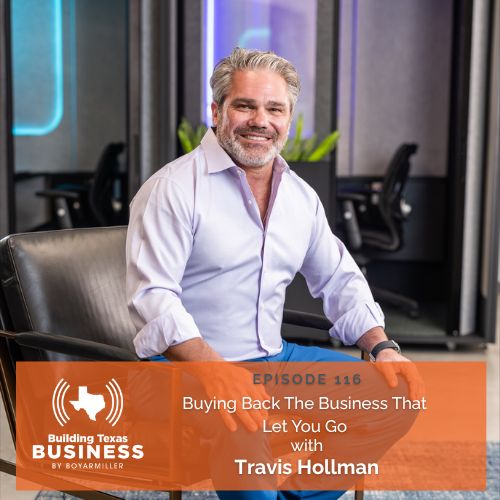
In this episode of Building Texas Business, Chris Hanslik sits down with Travis Hollman, owner and CEO of Hollman, the largest manufacturer of lockers in the United States and the world. Travis shares the story of a family business his father started in 1976, one he bought in 2016, and how it grew into the company behind the locker rooms you see everywhere from Notre Dame, USC, and the Houston Rockets to Equinox, Goldman Sachs, and Bank of America branches across the country.
Travis talks about his winding path into ownership, including getting let go by his own father, launching seven or eight companies of his own along the way, and returning to rescue the business as it slid toward bankruptcy. He reflects on the value of finding work that naturally fits how you think, using tools like Culture Index and Myers Briggs to understand yourself and build the right team, and why starting a company from the ground up is one of the hardest things an entrepreneur can do.
The conversation moves through innovation, culture, and the discipline of keeping a fifty year old company feeling like a startup. Travis explains how his MeSpace concept for neurodiverse offices reshaped the way his team designs sleepable, function first locker rooms, how his new AI division is transforming billing, renderings, and shop drawings, and why he believes honesty is the only real policy when a customer relationship goes south. He also opens up about Texas as the ideal place to build and manufacture, sharing a memorable story of staying open through COVID with the help of a responsive local government.
Chris and Travis also explore leadership and authenticity, from Travis embracing his direct, bullet point style to surrounding himself with good cop VPs who balance him out. He closes with a moving look at the educational foundation he and his wife created, funding college for the children of his Hispanic plant workers so families can build lasting security across generations.
If you are interested in manufacturing, family business, innovation, leadership, and building a company that stays true to its values while embracing new technology, this episode offers an honest and energizing look at what it takes to lead with authenticity and purpose.
Transcripts are generated by machine learning, so typos may be present.
Chris Hanslik: Travis, it’s great to meet you. Welcome to Building Texas Business. I’m glad to be here. So let’s get started. Let’s introduce yourself to the audience. Tell us kind of, you know, what you do and what your business is known for.
Travis Hollman: My name is Travis Hollman. We’ve been, I work for a company that, or I own a company. We’ve been in business 50 years this year. Started by my father in 1976. I’ve owned the company since 2016 when I bought it from him. We’re the largest manufacturer of lockers in the United States and actually in the world. Do everything from, you know, Augusta National and Pebble Beach and all those things for golf to, you know, every Equinox and LA Fitness and Planet Fitness and Crunch and all those jobs you’ve seen out there. We do all the hospital work around the country. And then all the stuff from JP Morgan’s, Goldman Sachs, all the banks. We’re doing Bank of America right now. We’ve got lockers in every single branch that’s been going on for about two years. And then we do the fun stuff that everybody knows us for. They see this. We do all the football and baseball and all the stadiums from high schools all the way up to the pros. We just installed Notre Dame. I got installed and released to the public like two weeks ago. And USC released last week to the public. And we’re working on Oregon. The Tennessee Titans are coming out. The new ballpark for the A’s in Vegas are coming up. So that’s kind of what we do. We have got a good company, good market share. It’s been a fun ride, and it’s been a challenging ride also.
Chris Hanslik: Sounds like it. So we said locker, so it sounds like from the very kind of basic locker to the things we see on social media and the news to the kind of the over-the-top elaborate, you know, sports locker rooms and all the major Division I schools, as you mentioned, as well as the pro leagues.
Travis Hollman: Yeah, we’ve done everything from a Planet Fitness locker that might be – you know, $150 to a most expensive locker we’ve ever done is the Houston Rockets. They were about 30 grand a locker. All right. All right. So it sounds crazy. Everything in between that we’ve touched. But it’s fun. It’s a fun business. It’s fun talking to, talk to team owners and coaches and stuff. And you’ve also talked to people that are running fitness clubs that are in the fitness industry. They’re always high energy. And then you’re talking to senior people, Goldman Sachs. And it’s really a unique, interesting thing. We always laugh because, you know, we can’t time the stock market quite like Nancy Pelosi, but we know usually what’s going to happen because we can see the buildup coming from just the, you know, it’s not data, it’s data anybody can have, but we’ll all of a sudden see a group just starting to come and you can see the order starting to come in and the growth starting to come. And we always laugh, we should just start investing in these things beforehand, but we never do. And we always kind of laugh at ourselves afterwards, going, that would have been good because we knew it was coming. Because construction is kind of where you’re building buildings and doing things. When companies are starting to grow, that’s where they start spending some money because they need more resources. Yeah, kind of a lead indicator, right?
Chris Hanslik: It’s a lead indicator, yeah. So you mentioned 50 years in business, your dad started it. I guess, you know, what kind of led him into this? And maybe when you took over in 2016, you know, what was the passion you had for it to take it over? And how have you kind of changed the direction of the company if you have or gone into new markets?
Travis Hollman: So, you know, my dad started in 1976 building Racquetball. He loved playing racquetball. He was a home builder, got out of that. And he decided to, he was going to build his first racquetball club. And back then they did tilt up construction on racquetball clubs, which was crazy because back in those days, every racquetball club was like 20, 30 courts. It was a crazy design and almost a mess to build. He started doing a panelized court, which is basically Formica on top of a particle board. He tongue and grooved it, called it the Hollman Court Systems. And that is what kind of started leading. That was started in Portland, Oregon in 1976. Then he had some, you know, he had some things that went on in the business. And so 19, mid 1980s, he moved to, he moved to Oklahoma. And he, right outside of Oklahoma City, and he started building racquetball courts there. And he started building the locker business. At that point in time, there were really no fitness clubs. It was almost all golf. And that business started going fairly well. I came there in 1994 and started working for him. I got out of college. I’d owned my own business. I’d sold it. I thought I was very wealthy at the time, which was, looking back, is funny. But when you’re in your 20s, you have a few dollars in your pocket. You think you’re king of the world. I know everything, by the way. And I came there in 1994 and basically pretty much ran the place until my dad came back. He went over to Asia. He was in Vietnam War and loved the culture over there and stayed there. Came back with a wife and new kid. It was kind of a surprise in about 2000. Moved back to Dallas. We’d moved to Dallas in the meantime and wanted to run the company and enjoy his new family. And so he, we had a conversation with me and I got let go in 2001, which was shocking to me. And I went out and started a couple other businesses, started about probably seven, eight different companies after that, including the Marshmallow Fun Company. We made the Marshmallow Guns. I had a day spa, bars we had, we did a tv show, i did a movie, did a bunch of really crazy stuff, learned a lot about myself and then got a call from his CFO and his and the guy that was running the plant and they had gone from a near a 30 million dollar company back down to a six million dollar company and they said your dad’s not here he had gotten divorced, moved back to asia and He said, your dad hasn’t been around for a couple of years and this place is going to go bankrupt. Oh, wow. And what’s interesting is when I was there the first time, I tell everybody this that talks to me, they always say, what do you want to do with your, you know, how do you figure out what to do with your life? I just got lucky. When I got in here the first time, it was, I just understood the business. It’s a business to business type of transaction thing and manufacturing. But we’re selling direct to end users almost all the time. And I don’t know why, I can’t tell you why that just clicked in my head. And to this day, when I make a decision in this business, I think I’m usually right or make the right decision about 90% of the time. I got into the film business. I could have flipped a coin and got the same answers I got in the film business. I knew nothing about it. It didn’t naturally fit the way my thinking goes, just my logic I have and the way I think. And that creative environment just didn’t work. So I always tell people, if you’re going to get in business or whatever, you’d be very lucky in life to find something that you just understand naturally. It’s the only way it’s described. It’s almost a natural thing. Yeah. And I just found the right business. So when I had the opportunity to come back, got the phone call. I loved being here. It was the best thing I ever did when I was younger. And I took that opportunity, came back in in 2011. Was supposed to buy it, couldn’t get him to come back from Asia. It took five years, but we had a high growth rate from there and there was a lot of work, but it was fun work because I, you know, just something I like and something that naturally fit my abilities. You know, people always try to, and we have people that come in here, we use this thing called Culture Index, which kind of like a Myers-Briggs. Yeah. And people all the time, they come in here and they go, I want to be an engineer. Well, why do you want to be an engineer? You’ve got no detail. We took this thing that you’re going to hate it. Engineering is a slow-paced, high-detail thing. And you’ve got this high-energy multitasking. No detail. You should be a salesperson. That’s what salespeople are good for. And, oh, my dad was an engineer or something. And we’re like, just for all the people listening, go and find Culture Index, Myers-Briggs, find something that, study what kind of naturally fits your tendencies and you’ll become very good at something and you’ll enjoy what you’re doing. When you enjoy what you’re doing, you’ll make a lot of money, you’ll have a lot of success and things will naturally just feel good. And that’s how I feel about this business. In my the other businesses I was in, some of them I felt good about but especially when I was in the film and tv business, oh my god i’d get asked a question it’s like my brain couldn’t wrap itself around the answer and it was correct so You get in those businesses, you can lose a lot of money fast and not have any fun.
Chris Hanslik: Well, I think, you know, to your point, if you can figure out kind of what your strengths are, right, and what your capabilities, you know, tend to support and marry that up with something you’re kind of passionate about and feel connected to, then you’ve really got a good combination, right? Because it doesn’t feel like work, kind of feels natural. And I love what you said about using Culture Index, which I’m familiar with, as well as Myers-Briggs, to kind of build your, one, understand yourself, but then build the team around you, right? And it helps you put the right person or get the people in the right seats in your organization. So then you can actually delegate and lean on them. And that’s how you can grow a company to be successful.
Travis Hollman: So I’ll give you a story. When Culture Index came in, this guy named Jason Coase, which is a good friend of mine, Sold it to us. And, you know, I took it. And, you know, everybody’s nervous about taking this thing, right? Right. So we had this big meeting. And he read what would make me happy and the kind of job I would like. And people were cringing. And so he’s calling me and said, what are you thinking? Oh, my God, that person just sounds horrible. It finally goes to me. He goes, I go, I love that person. But I knew what he was doing. And what’s funny is it sounded horrible to them because they were slow-paced and this and that, wanted security. And I’m the kind of guy that would – I would take a job in sales, 100% commission. The commission’s good. I don’t want a base. Give me 100% commission. I’m going to go out and do it that way. Well, that scares the hell out of some people. And when they read it, they would read – you know, there’s to me type of thing, what he would dissect it. And I’d be like, Oh my God, that’s horrible. I would hate to do one thing all day. And, you know, so we’re all built. The point is we’re all built differently and you got to find out what you’re, how you’re built. And if you can find something that radiates those things together, you can, you’re going to be really happy with what you do. And if you’re happy, it doesn’t matter. I mean, engineering is not my strong point. Elon Musk is a trillionaire now. Obviously, you can make a lot of money in engineering. And there’s just certain ways of thinking. People, I think, a lot of time are on the wrong job and they’re on the wrong thing. And if they got into the right something that makes them happy and something that fits their style of thinking and their work style, I think it would change their lives.
Chris Hanslik: No question. And I think as a leader in an organization, right, Part of the role I think a good leader plays is helping people figure that out for themselves. Because it may be they’re not right for the organization. So they’re not going to be helping themselves or helping the organization. But if you can help them figure that out and, again, put them in the right role, then they can flourish. And as a byproduct, the company flourishes. Let’s talk a little bit. You mentioned that, I guess, in that hiatus from the 90s to 2011 or whatever, you started a few companies. You mentioned the Marshmallow Fund Company, I think. What were some of the lessons learned about starting these companies from the ground up? Looking back, you’re like, man, those were some tough lessons, but I learned so much from them. Anything you can share from those experiences?
Travis Hollman: I think starting a company from the ground up is one of the hardest things you can do. There’s a reason why private equity only invests in companies that have some market share and that are moving. You don’t ever see private equity people getting an idea together and going starting a company. Doesn’t happen. They figure that out. A running operating company with a system involved, even if it’s not the best system, and some of these private equity guys are great at bringing other systems, is so much easier than a startup. A startup, you’ve got to go find… Marshmallow was amazing. The idea of shooting a marshmallow out of a gun had never been done before. When my business partner said he was at his thing, came up with the idea, I said, I’m sure someone’s done that. I Googled it right there on my phone, driving pretty much. And it was just, no, it hadn’t been done before. We took that out and we had a prototype and we sold truckloads on our first go. because it was such a unique easy to sell thing that is an anomaly business that was the easiest thing i’ve ever done to start that right then you go into you know building something from scratch where you’ve got to create you know from the accounting systems to the management systems to everything else is just hats off to people that do it that is i’ve done it before it is painful um And it’s really tough. If you can buy into an existing business, even if it’s not making a lot of money, but they have some customers, they got some product that you can improve on. I mean, that’s what private equity does. There’s a reason they’re so successful at what they do. I hate them because most of them don’t do anything. They come steal our stuff and then make all the money. That’s what they do. They come in and they see something they can operate better. They’re not coming in with new ideas. They’re not coming in with new product that they’re going to build. They’re not building it from scratch. So building it, the people out there, hats off. If you build something from the bottom up, there’s not very many of us. And it’s a very, you understand how difficult.
Chris Hanslik: Absolutely. You have to have the passion and really love it. to go through the aches and pains of what it takes to get a startup off the ground and be successful. Right.
Travis Hollman: And you got to do everything. I mean, I’ve laughed at my, I had the Riviera day spa and I, you know, a single time these girls go, Oh my God, you probably get massages and stuff all the time. I massaged like two years. I’m the guy that’s plumbing. That’s you know, fixing the toilet. That’s still, I mean, that someone doesn’t, one of my, my front desk drank a little bit too much on Friday night. Didn’t show up Saturday morning. People were outside. I drank till four o’clock in the morning with my buddies that were in town. And now I’m up at 7am working the front desk because you own the place. Yeah. Owning the place isn’t always fun. My best job, I love selling. I had more fun even at home and selling product than, uh, being the owner.
Chris Hanslik: Owner’s tough. You mentioned too, I guess, that you moved to Dallas from Oklahoma. It sounded like at some point. Talk a little bit about the state of Texas and owning and running a business here and the advantages that you think that the business has taken advantage of because it’s Texas-based.
Travis Hollman: I mean, Okay, I give my Texas speech because I give it to people all the time. This is, you’ve got American laws. You’ve got your own power grid for manufacturers. What we do is incredible. The electricity cost here is amazing for us. And you’ve got this can-do winning spirit down here. We’ve got our own military. We’ve got our own ports down here. All of these resources that Texas has, because all the shipping lanes, all the trucking lanes, all come through North Texas. Dallas, in my estimation, is the epitope of any city in the entire world for business. I think it’s the best place to do it. Example would be, during COVID, we run about 300 people here, got three plants. Our biggest plant, the fire suppression goes out, the board. I grew up in Portland, Oregon, where it’s very different politically and very different manufacturing. I’ve done a lot of business in California. You know, all these places would have shut me down. I can’t, my sprinkler systems, nothing works. My alarm systems, nothing works. I called the mayor up that day. First of all, we called the people to get a new board. They said, we’re closed for COVID. It might be six, eight months, nine months. We don’t know. but it’s not going to be soon. They’re up in the Northeast. So I called the mayor up. I said, hell, what do I do? And he goes, first of all, Travis, don’t worry about it. I’m going to come out there. I’m grabbing the fire chief. We’ll be out there in an hour. You’re going to stay open. And I’m just like, that’s the first thing he said to me. So now the worry’s off you. This wouldn’t happen anywhere else. Then we get up there. They come here and they go, Fire is like, okay, well, yeah, we, you know, Mary says, we’re keeping you open. We’re going to keep you open. We want you to, you know, walk the floor, every whatever. We’re going to come there twice a night, every single night and drive by you to make sure everything’s good. You guys have to walk the floor, do this. I mean, we know this is stuff to do. It wasn’t big. Yeah. And we did that for six months. There is not more than three or four States in America that would allow you to run a hundred. That building has 120 people in it. for six months with no fire. Wow. But what else do you do? You’re in COVID.
Chris Hanslik: Do you shut the whole thing down and tell everybody to go home? Right. Like you said, that kind of can-do attitude and you have a government system that says, no, we’re going to find a way to say yes to keep the business going. Been in conversations just like you with people from other states to go during that time of COVID. We saw what was happening in Texas and just wish our state would have… you’ve stepped up and done the same thing.
Travis Hollman: During COVID hit, and I told all my people here, I said, hey, you know, we’re going to stay in business and we are going to continue to make sure you guys get paid no matter what. And I actually sent out a tweet. I was one of the first CEOs in the country to send out a tweet. Mark Cuban commented. I mean, everybody commented on it. It actually went viral. But it was, you know, we made a commitment to our people early on in COVID before we knew it. And during COVID, we got letters from government saying we were One was from the governor of Nevada saying we’re doing the Raiders project, saying the Raiders project needs to continue. We need to get this out on time. So we continued to work. We worked very closely. We took precautions. And everybody here, we worked all through COVID, every single person here, everyone 100%. We had two or three people quit in the very beginning because we were going to come back to work, two or three out of 300. Everybody was so thankful that we worked together. We would have cocktail hour here at nights on Fridays and stuff just to get everybody to socialize a little bit because no one was having any social, nothing was happening. And people to this day are like, man, thank you for keeping us going. Everybody that sat at home for six, nine months and whatever, they’ve never really got going again. They’re still arguing whether they come back to work. Yeah, no question. Four years, you know?
Chris Hanslik: Crazy, right? uh let’s talk a little bit about innovation because i mean i’ve seen you know lots of in the last few years lots of new locker rooms you know how have you incorporated that kind of innovation or you know creative spirit within the company to be you know then you know delivering these kind of cool new products to your customers well a couple things first of all
Travis Hollman: I’ve got an R&D department here, which I really enjoy working in. We always have something going on R&D. My thought process is a little bit different than probably, you know, venture capital for sure, is even if the project doesn’t turn out well and we’re trying to figure something new out, just by always innovating, it keeps your company spirit alive. alive if you would ask anybody that works here we’re 50 years old now um if you asked him do you feel more like a startup or an old company i i would say 95 would say if we feel like a startup yeah because we’re always doing new things whether they work or not we’re always trying things we’re listening everybody here everybody’s got ideas um i think it’s very important to keep that entrepreneurial you know like almost a brand new feeling spirit alive everybody The works here, I can’t believe we weren’t in business 50 years ago. It’s kind of like a vibe, right? It just gets infectious. It’s an infectious vibe. So, you know, we did MeSpace, which was kind of our last one. I’m dyslexic, ADHD, so are my kids. Neurodiversity is a massive thing right now. And I’ve gone out to, we do all these things for J.P. Morgan and Goldman Sachs and all this stuff where they’re doing these flat offices. I go in those offices and honestly, it almost makes me sick. Thinking about working inside of one of those places with people walking behind me, around me, stuff moving all the time. Just nothing I can deal with. So I started, you know, said, hey, how can we fix that? We started MeSpace about three years ago. SMU, we’re shipping product to SMU next week. You said you went there. And that’s been something that was kind of a passion project. The rest of the stuff is the lockers. We, you know, we’re fortunate enough to get these incredible companies trusting us to their, it’s mostly football being honest. Yeah. Sorry. They’ve got the most money, but they’re asking us to do stuff that’s never been done before. And we’re taking that product and the stuff we learned at MediaSpace and combining everything together and making different lockers. We’ve, you know, first locker that was ever really sleepable locker was the University of Alabama locker. Texas Tech has that now USC has that now but a lot of people have that configuration but that was all built off of actually that came from the me space idea was let’s build something where everything around you makes sense and it is usable so you got a chair in there why don’t you put a you know why don’t we make the chair so you can you can go zero gravity and you can sleep if you can sit in it why not you just lean back and sleep in it let’s put the shoulder pads everything around you so You get there, let’s put your playbook right next to you so you can grab it. You can see you’re mostly there on iPads now. It’s there and it’s got charging capabilities right next to you. Let’s see your drug testing, which is a lockable box and nobody can see that you got asked to go drug testing order because they do the random testing and your results and where does that sit? So we really got into building stuff around you, but that all came from me space of thinking about how we build an office that is the most desirable place to work. and functions the way that a MeSpace does. And without all these, you know, you just take the dots and start connecting them and you can use one idea for 10 different things in your company.
Chris Hanslik: That’s interesting. I love how that evolved, right? And I guess continues to evolve as you think of new things and probably get feedback from customers about what they like and, you know, maybe even some innovative ideas.
Travis Hollman: And what didn’t work.
Chris Hanslik: Yeah, right. We’re not perfect for sure. Yeah, let’s talk a little bit about that. I mean, you’re right. At the end of the day, it’s all about delivering quality products on time to customers, right? So what are some of the things that you think you do to build and maintain those relationships? And how do you handle them? Because no one’s perfect when they go a little south. So anything that you’ve kind of learned over the years that really works to kind of create that raving fan in your customer base?
Travis Hollman: You know, it’s honest, just being honest with them. We have a customer here today that we totally let down. They’re here right now. And, you know, they came in and they thought we were going to give them the runaround. I just said, we screwed it up. And I said, here’s the things we’re doing so it doesn’t happen to somebody else, but it happened to you, and I’m sorry, and here’s what we’re going to do to fix it. And let’s work on the fix. But I see so many people trying to blame – I mean, even some of my people, we had a big meeting yesterday. They’re like, okay, let’s, you know, we can tell them this or this. You know, they didn’t get this turned in on time or whatever. I said, guys, no, we’re going to tell them the truth. We screwed it up. Well, they didn’t get, you know, they didn’t get their shop drawings turned in when they said they would. Well, yeah, but maybe we should have called them a few times and said, hey, let’s needle you along a little bit to get your shop drawings in on time. I mean, let’s not blame it on the customer. And a lot of times people don’t. blame stuff on customers or other things, you know, if it’s your fault, just own it and move forward. And if you’re being, you’re trying to blame it on something else to do something that’s people see through that. That’s not honesty. Right. You know, and people are good. When people have the information, even if it’s bad information that they don’t want to hear, they’ll be happy. Yeah. You know, maybe not as sad, but they’ll be happy. There’s a reason the saying is honesty is the best policy, right? That is, it is, you know. So I would say just be honest. But the interesting, you know, we talk about innovation a little bit. We’ve got a, we started a new AI division. Okay. Which is very interesting because it’s amazing what’s going on now. and what can be done, even in the locker rooms and businesses. And I think that that’s going to be, everybody talks about it, but we’ve got our first person hired, he’s a brilliant kid, and we’re working on hiring another one right now, but we’re running AI through our entire company, and we’re finding ways to do things that are, we never thought… I’m asking stuff that I didn’t even think was possible that I asked people two years ago that was absolutely impossible. And some of the stuff is so easy that we’re getting it accomplished in like two or three days. Wow. Any specific examples you can share? Yeah, I’ll give you an example. We do all the university work and whatever. And when we work with contractors, we have to slide into a portal to do all of our billing. And we got to go in, we got to log in, put our passwords in. go in, upload things, fill things out, and put our billing through. We’ve created an AI bot. They call it an AI agent. They can do all that seamlessly. No one touches it anymore. So all of our billings are done now on time, and they’re done with AI. Our customers don’t even know that. Right. But AI is going into their websites. Once they listen to this episode, they’ll know, right? But everybody else is starting to do it too. Yeah. You know, just even little stuff like, you know, when we get an invoice, you know, taking an invoice and matching it to the PO, AI is doing that now. AI is now doing all of our renderings for all of our stuff. We just tell it what we need and it’s doing all of our renderings. There was just a… I’ve told this story because there’s just a thing at the Cannes Film Fest where they did it. One movie was created by AI, and it was 30,000 inputs, 30,000 inputs for 15 seconds. That’s crazy. I guarantee you next year that’ll be under 3,000. The year after that will be under 300, and the year after that will probably be about three. Yeah. And that’s how fast we’re moving. Stuff that we’re working on AI right now, if we can’t get it figured out, we’re literally putting it into a queue to look at it again in six months because by six months, it’ll be figured out. Yeah.
Chris Hanslik: All of our drawings, all of our shop drawings, all of our stuff is going to be AI. With all that, with that innovation and using AI and the efficiencies, I guess, how has that impacted your employee headcount?
Travis Hollman: Right now, it’s gone up. because we’re having to check everything and do everything and figure everything out. It will eventually come down. And there’s still going to be great jobs. I think the mid-range, my thought is the mid-range jobs are going to have more of a problem. The lower, you know, stuff in the plant is going to still be doing the plant. You know, they’re building stuff. But a lot of the high-end jobs are going to be more prominent. Who’s running the AI bots? Who’s got the logic to look at them and making sure their calculations are correct and checking their bill of materials and everything else, even though the AI is doing it, to making sure that we’re still on track. That’s where the future is as far as our company goes. I might not have that as many $60,000, $70,000, $80,000 employees. I might have more $200,000 employees than I do now. I think that’s kind of where it’s going.
Chris Hanslik: The clerk and clerical data entry person is probably going to have trouble. One, thanks for sharing that. I think it’s great to hear how people are integrating and using AI. You can’t avoid it. You’ve got to lean into it and then figure out how it can work. work for you and your business. Let’s talk a little bit about leadership. I mean, you’ve obviously been in various leadership roles for a long time. How would you describe your leadership style and how do you think that’s evolved over time?
Travis Hollman: I mean, when you’re in your 20s, early 30s, you know everything. You know, when you get near about 40, everybody says you kind of figured out how dumb you are. I’m mid fifties now and I’m really figuring out how much I don’t know, but I think I’ve calmed down a lot in my leadership style. You know, everybody has a different style. You know, I, Steve Jobs, one of the most successful people in the world. Everybody said he was the biggest ass ever, but he got stuff done. Yeah. You know? I don’t think – I think whatever your leadership style is, you have to lean into it a little bit and just kind of go with it and let people know that’s who you are and be kind of more authentic about it. People try to change their leadership style and try to do things. I don’t think that really works very well. So I came to terms with even dyslexia, like my notes and stuff. I’ll tell people now, for example, I say – I don’t like to read a lot. Give it to me in bullet point. If I give you a set, if you send me an email and I send one back to you, if you see nothing on the email, look in the subject line. And that is me liking what you’re doing because that’s my leadership style. If you get a paragraph from me, probably mad. The shorter, better, longer, not better. I said, if you write me a do a five page essay thing, i’m going to read the first like three sentences and be done with that. Yeah. So your communication style, I have not changed. I, since I’m a CEO, I let everybody know how I communicate and the leadership style is very exact about what I need done. It’s bullet point leadership style. Direct. It’s very direct. But that’s just me. And when I try to sugarcoat it, try to do it differently, I just look like I’m not being me and they know it’s not me. So just kind of lean into what you’ve got. And there’s different leadership styles and people have been very successful at all different leadership styles. Obviously, you want to don’t want to make anybody too mad, but, you know. You know, my mom, I love my mom. My mom and dad were two totally different people. My dad was the playful dad that, you know, believed anything could be done. My mom was work hard, work hard, work hard, work hard. And, you know, very, very, very strict. And a lot of what I attribute myself to in life is from her. And I would have said that was the worst leader. My dad had a better leadership style when I was little, I would have thought. But that’s not who I respected. That’s not where I learned everything. Yeah. So it’s two different leadership styles. And I went through both of them and the hard one on me, the one that was the hardest on me was who changed me and got me to where I’m at.
Chris Hanslik: So the one that resonated, right. I agree that you gotta, you have to be true to yourself. And I think that starts with self-awareness, right. Really understanding, you know, what is that style and being true to that. And you, because there are different ways to do things that didn’t, to me, that then leads to, okay, well, how do you bring on other people on the team that maybe are better at some things that, you know, cover where you’re not right. Recognize you have some weaknesses and you can bring someone into the leadership team to kind of help augment that, you know, and makes the whole organization better.
Travis Hollman: Yeah. I always bring on like all the people around me that are VPs and stuff. Most of them are good cops over the bad cops, so to speak. I had one of them say, you’re always a bad cop. And I’m like, I’m good at that. It makes you guys look better. But people, if you ask them around, they all like me. They know exactly where they stand, but I’m different than the good cops, so to speak, in the leadership style. So I would just say stay to what you… you know, stay true to yourself, you know, and by the way, Steve Jobs, probably 99% would say it was a terrible leader. He accomplished some of the greatest things ever. Same thing about Elon Musk. I’ve heard he’s a terrible, terrible leader. I mean, he’s the, he’s the Einstein of our day right now. I mean, so, and then you’ve got people that were, you know, I went to, you know, you know, go to like a, Whole Foods or whatever. I went to a thing with the guys at Whole Foods. Everybody loves them. They never made any money until they got bought by Amazon. Zero. They were loved. No profit. Was their leadership style right? For them, it turned out right. That would have been my leadership style, but for them, it turned out right. It’s totally different than mine. I just stick to what you got. It’ll work out, I think. That’s good. Learn some stuff. Learn people skills and stuff. Don’t be that. But if you’re a bullet point leader like I am, that’s key to your bullet points.
Chris Hanslik: Right. It’s great advice. Travis, I really appreciate the time. It’s been fun to hear your story and how you’ve gone about your journey from in and out of the company and to owning it and growing it. innovative things you’re doing that as we, as we kind of wrap up, I always just like to know, you know, kind of, what do you like to do to kind of just, you know, get away and kind of rest and recharge?
Travis Hollman: I mean, I have two kids in high school. Um, we, uh, we built a place up in Montana, which we really liked getting up there and getting away. Um, you know, I love just my, my oldest son’s playing football right now. It’s great. Um, so much fun to watch him really try to do that. My youngest son is, he loves fishing and just hanging out. And he’s so, I don’t know. I just love being with the kids right now. Yeah. My wife’s cries half the time. She’s like, they’re going to be gone in this year, this year. And, you know, life moves so fast. You know, this year, I mean, you know, we’re going to play you guys down there a little bit, but you know, I was talking to, we had, someone wants to go on this cruise or whatever. And I’m like, we’re not doing that. We’re not missing two of his games. He’s got, you know, two years left. Yeah. And there’s only 11 games a year. I mean, it’s, we’re not going to miss 10% of them to go on a cruise right now. Cause it’s very fine. When it’s gone, it’s gone. Yeah. And then we’ll look at each other and go, Now what do we do? And then, then you can ask the question. I probably have a better answer.
Chris Hanslik: Okay. Okay. Well, that’s a good reason to follow up. Okay. Last question. Do you prefer Tex-Mex or barbecue? Tex-Mex. All right. Smoking like a good Texan. Yeah. Love it. So Travis, man, thanks again. I mean, just, you know, reading your, reading your story was fascinating and love all the good work you’re doing. I know. We didn’t touch on half of it. I know you all have a kind of an educational foundation. I think that’s so admirable that you’re doing that. Education is so important. And so just kudos to you and your wife. Keep up the great work.
Travis Hollman: I’ll tell you, I’ll give you one thing on that to get you done. We do a 401k match, which everybody does those kinds of things. I couldn’t get my Hispanic community to do it in my plants. Couldn’t figure out why. Finally, I brought them about seven, eight years ago. I said, why aren’t you guys putting this? We match you. It’s dumb. And they said, well, you know, our kids are going to take care of us. I said, oh, the light went off. So we started a thing, there’s a community college across the street. And I said, okay, well, let’s get, so we do free education, college education there for anybody in their family who wants to go to college. And we do not make them graduate or whatever if they can. They could get their undergraduate work. We now have got over 45 people in the last seven years that the kids have gone to become nurses. So we’re trying to get there to focus on your people. For me to go, hey, Americans save money for the stock market. That’s not what my Hispanic community does. To figure out what actually moves them forward and then connecting with them wasn’t a big expense, but it’s a great way to start looking at your employees and finding ways to help them that are easy to do, but understanding them. So we are trying to educate, get their kids. So the kids make more money than they do because they work at my plant and bigger jobs so they can take care of their parents. So my people here can retire because we’ve educated their children to take care of them. Yeah.
Chris Hanslik: I mean, that’s a wonderful story. I mean, you’re right. More people should be doing that. So kudos again to you and your wife for caring enough to ask the questions and then figure out a solution.
Travis Hollman: And it’s not that expensive solution to anybody out there that wants to do it. It’s a great thing. If you own a plant, if you’ve got a lot of Hispanic workers, it’s a great way to help them with retirement.
Chris Hanslik: Right. Well, Travis, again, it was a pleasure meeting you. Thanks for being a guest on the show and look forward to staying in touch with you. Thanks. All right, take care.
With a deep understanding of your business alongside clear and honest communication, we help clients face challenges fearlessly.
Learn more about our services and how we help clients.