


With a deep understanding of your business alongside clear and honest communication, we help clients face challenges fearlessly.
Learn more about our services and how we help clients.



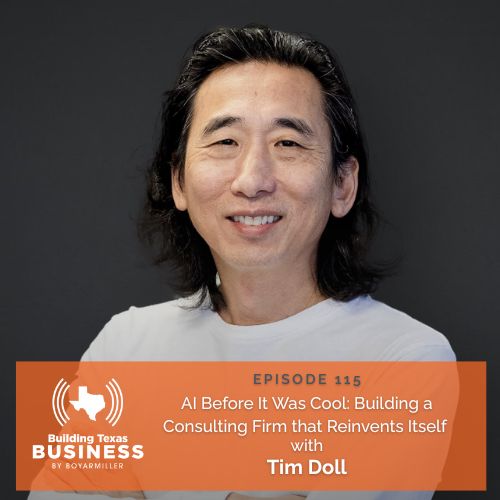
In this episode of Building Texas Business, Chris Hanslik sits down with Tim Doll, founder and CEO of Precocity, a boutique technology consulting firm, for a conversation about building a company that has thrived through more than two decades of relentless technological change. Tim shares how his early frustration with corporate bureaucracy became the spark to strike out on his own and build a company where vision could translate directly into action.
Tim talks about the firm’s origins in the early days of high speed internet and DSL, how the company evolved into a team of software engineers, designers, data architects, and AI engineers, and why he likes to say Precocity was doing AI before it was cool. He reflects candidly on the lessons learned along the way, from the importance of solid contracts and clearly defined expectations to the reality that success is less about a destination and more about always continuing to learn and grow.
The conversation takes a thoughtful look at how artificial intelligence is reshaping professional services, including the pressure it puts on the traditional time and materials model, the likely shift toward outcome based pricing, and the deeper challenge of how the next generation gains real experience when AI can handle so many entry level tasks. Tim and Chris also explore why going deep and developing genuine expertise matters more than ever in a world where AI offers breadth but not depth.
Tim also opens up about the culture he has worked to build at Precocity, hiring for character, culture, and capability in that order, embracing humility as a core value, and practicing a flat, servant leadership approach where the higher you go, the lower you go. He describes the company’s Jedi Tech Council, a biweekly forum where team members share their work, their successes, and their failures, and explains why focusing on people’s strengths rather than fixating on weaknesses has kept turnover low and tenure long.
If you are a founder, technology leader, or professional service provider trying to understand how AI will reshape your business model, how to build a durable and relational company culture, and why Texas continues to be such a welcoming place for entrepreneurs, this episode offers a grounded and forward looking conversation worth your time.
Transcripts are generated by machine learning, so typos may be present.
Chris Hanslik: Tim, thank you for taking the time and welcome to Building Texas Business. Thanks for having me, Chris. Love Texas, love business, so happy to be here. There are two of my favorite things as well, and so can’t wait to kind of get into a little more details with you. Let’s start by just having you kind of introduce yourself and the company to the audience and the listeners and kind of tell us what you’re known for. Yeah, great.
Tim Doll: Well, the name of our company is called Precocity. And it’s a funny name. We always kind of use the Schlotzky’s analogy of it’s a funny name, but serious company. We are a boutique consulting company specifically focused in technology. We have existed in some form or fashion for over 20 years. And we’ve gone through a couple of iterations of combining different companies into one. The latest version of that came about in 2015. But we are effectively a company of software engineers, designers, data architects, AI engineers. We’ve been in the space for many years and hope to continue to be in the space for many more.
Chris Hanslik: Well, it’s certainly, you know, I guess it’s always been an interesting space to be in for 20 years. The last 20 years, it’s obviously been growing. And I mean, what better time? I mean, no one can say you can’t go through the day without hearing or saying AI for the last several years. Seems like you’ve got a good runway ahead of you.
Tim Doll: We do. You know, it’s funny because AI is, I mean, somebody that’s been in tech since I think I started in 97, in technology specifically, 97, 98, which at the time was, you know, really focused on networking and, you know, and telecom and trying to create high speed internet, right? Because before everybody was using dial-up. And so… But as ubiquitous as broadband became in, I would say, in the late 90s, early 2000s, AI is just that, on steroids. Because it has become such, I mean, it’s a buzzword, but it is also transformative. And it is really transformative, disruptive, all of those things rolled into one. And so I think it’s a very interesting time to be in the midst of it. And we’ve been well positioned for this because I always tell our clients and people that we are about to work with that we’ve been doing AI since before it was cool. Because we started building out machine learning solutions back around 2014. You know, and so, but yeah, it is very interesting time right now. And I would say, depending on who you talk to, it’s, you know, it’s concerning. It’s, you know, but change always is, right? Innovation is always, and that’s the constant, right? You know, so it’s adapt or retire.
Chris Hanslik: It’s right. I mean, that hasn’t changed, especially around the concept and use of technology, right? I mean, it’s continued to evolve. probably for our lifetime, right? People were probably first scared of computers to begin with, and then laptops or whatever, and what’s going to happen. But let me take you back. Let me take you, you said, to 20 years. What was it that rkind of really was the impetus or spark for you to start the company and go along this journey as kind of a small business, I assume at the time, and kind of spread your entrepreneurial wings?
Tim Doll: Yeah, what was a spark for me was, honestly, was, can I speak really bluntly about this? Sure. Was large corporation bureaucracy. I was not really a big fan of that, right? And I worked with amazing people. I came out of a company called Efficient Networks, which built and deployed the very first DSL modem. which was a really cool thing to be a part of at the time. And then the company was acquired by a large company. And for me, it was really about, I really want to be able to have vision and affect change. Yeah. Right. And, you know, and so large companies are great, right? We deal with large companies, you know, and that’s why, you know, the question is how, how, how, you know, how blunt can I be about that? But, but, you know, but, you know, but there are different, you know, there are different types of people and personality types for different types of settings. Right. And, you know, and so for me personally, it was really about having a vision to be able to. do cool things, right? And not really have to be hamstrung by a lot of decision gates and committees and stuff like that. And there’s definitely values, right? Large organizations bring budgets, bring scale, and all those things that are great, right? And a lot of times, the entrepreneurs are the ones, the people that start things are not necessarily the ones that scale them to be the multi-billion dollar things, right? And they can be, right? But But, you know, I think it’s really just kind of an internal wiring thing for me.
Chris Hanslik: Well, if it gives you any comfort, you’re certainly not the first entrepreneur that I’ve heard, not including guests on this podcast, but within our client base at the firm. I mean, I think so many people have said, you know, I got frustrated with the corporate bureaucracy or whatever, felt constrained and went and did this thing and maybe maybe had an idea about that thing before they left. And I also think our economy needs both. Big companies have their pluses and minuses. I think you’re right. They can take some emerging technology and help scale it. It seems to me I’ve seen a lot of stories like yours where someone’s frustrated, they leave and then they create some really cool stuff. And then the big company comes in and might acquire it to then grow it even bigger. But I do think it’s a very or not an unusual story anyway. So kudos to you having the courage to do it, because I’m sure it wasn’t easy in those early days.
Tim Doll: No, I mean, it certainly wasn’t. But, you know, I think that at the time, you know, I didn’t really know what I was doing, you know. And so, you know, it’s kind of like I felt every other day like I stepped on a rake. Right. It was a step that I ended up hitting myself in the face. But, you know, it allowed me to really grow. I think, you know, you know, because, you know, I think the definition of success is really key. Right. How do you define success? Right. And, you know, financial success is is a metric. But but I think, you know, for a lot of people, you know, they define success very differently. You know, and for me, success is really always been about. really always being able to learn and grow. And technology is really perfect for that because if you’re not constantly learning, it’s like we have a very… non-grammatical term in our company, it’s ABL, always be learning, right? You know, because it’s not, you know, that’s obviously not a, you know, that’s not grammatically correct. But the sentiment is that, especially in technology, there’s no time to sit around and just say, well, this is what I’ve been doing. And this is the way we’re going to keep doing it, right? It’s always advancing, right? And, you know, and so just by virtue of that, you know, it feeds a lot of the internal wiring that I have as far as wanting to continually be trying new things. Yeah.
Chris Hanslik: You know, when you think about kind of those those early days starting out, what were some of the things you kind of look back on and go, man, can’t believe I did that or made that decision. And thank God we overcame it or learned from it. Some of the kind of lessons, you know, in those kind of trial and error days that you could share. Yeah.
Tim Doll: One of the big ones was having good contracts. You know, a lot of times, especially when you’re starting out, you know, you’re hungry and you’ll agree to anything. And then you’re like, okay, well, we can get this done. And ultimately, you have to grind it out, right? But if you don’t have a good contract, if you don’t have a good definition of what you’re doing and have agreement on what success looks like, then you end up with problems, right? And things can go from like, oh, it’s really great to be working with you to, I thought we were getting this and you delivered this, right? And then, you know… Anyway, go ahead.
Chris Hanslik: Sorry. Well, I was going to say, I counsel clients on that all the time. It’s kind of like an insurance policy. While everyone’s getting along up front, let’s just go ahead and take the time to get it in writing so we’re all on the same page. Because when time goes on, no process goes perfectly. And especially the person paying for delivery of a product, if it’s not coming on time, there’s going to be frustrations. Right. And I’ve just dealt with something recently when the contract was they didn’t take the time to do it right. It was very vague. It’s left open for a lot of interpretation. And it’s going to cost a lot of money to work through that where, you know, a small investment up front can save like 10x on the back end.
Tim Doll: Yes, and that is really key, right? I mean, and it’s a balance, right? You know, because we’re human beings dealing with other human beings, right? And, you know, but, you know, one of my favorite quotes was from an author. He said, the definition of success… is expectations met or definition of quality is expectations met that’s a big statement because it’s really squishy right how do you define expectations right i mean it’s like so some of these expectations are this and your expectations are this and so really really nailing that down And hopefully in a way that doesn’t become adversarial, right? But you really do need to define what success actually looks like and define what quality actually means, right? Because that’s really, you know, ultimately… people want to feel like they were heard and they want to feel like whatever they’re paying for meets their criteria. And so hopefully you can define that well enough. So I would say that was probably the biggest challenge was trying to really get to where I really understood, okay, well, this is really what a contract actually looks like, right? And so somebody with my background, which was not legal, it was really more in the design space, I was like, oh, yeah, we can do that. And then it’s like, oh, wait, we didn’t really agree to that, but it was kind of implied. And then so for the sake of meeting those, getting everybody happy, we ended up taking it on the chin a few times.
Chris Hanslik: I’ve seen it happen, right? And especially on the developer side, I think most developers that I’ve run across are like, well, they can kind of do anything, right? And then they don’t maybe think about, well, the time it might take. Right.
Tim Doll: And you you hit the nail on the head because people are very, especially in software engineering, are very optimistic about what can be done. Right. And the time. Right.
Chris Hanslik: And so, yeah, it could cause issues. Well, let’s talk a little bit about kind of technology. And what are you seeing kind of as emerging technologies or any trends? that are kind of shaping, you know, in your industry and maybe, you know, unique to maybe what’s going on in Texas and the business environment in the state?
Tim Doll: Well, first of all, I am, you know, I was not born in Texas. And like the old saying goes, but I got here as soon as I could. Yes. You know, and so I’ve been, you know, been a, I would call myself a native of Texas since 96. Okay. And I love the state. You know, every time I go somewhere else, I’m always… In the summertime, I kind of complained to myself because of the heat. But the climate of Texas, the people, and I don’t want to go off on too much of a tangent here, but I was so thrilled with the World Cup and the experiences that they had specifically on the people that came to Texas. They went to Buc-ee’s. They went to the South. And they found out that, wow, it’s really a great place.
Chris Hanslik: Wasn’t that fascinating to see how excited they were? Yeah. I thought you’re right. I mean, the video clips that we all saw on social media from Bucky’s or just eating barbecue, you know, like you see him holding the big ribs. And I think the realization that we were actually sophisticated and cool, what have they been hearing over there, right? Right. It was pretty neat. I have to agree with you.
Tim Doll: Yeah, not every, people aren’t pulling guns out and shooting at each other everywhere in the streets and stuff like that. Yeah. You know, but, you know, it’s really what we’ve known about Texas, right? I mean, you know, I think Texas is the closest thing to its own country that you have of any of the states, you know, and, you know, and it’s really, I think there’s a lot of pride and really, and that really, I think, helps drive a lot of the entrepreneurial aspects of Texas, right? And so you’re seeing the adoption, you know, like you’re seeing Texas be adopted by all these major corporations, right? I think it’s like according to U-Haul was like the number one move to state, right? By individuals, but then also you have all of these large, you know, you got everything from Yall Street to Toyota, right? All of these companies that are relocating their headquarters to, you know, the great state of Texas.
Chris Hanslik: That’s right. If it’s where the employee base wants to be, then, you know, they’re going to. And I think it’s probably a little bit of a chicken and an egg because the state’s making it friendly and friendly business environment. So the companies are wanting to do that low cost of living for the employees. So, you know, benefits kind of both organization and individual.
Tim Doll: Yeah, absolutely. It’s, you know, it’s the, I think the one of the things about that makes Texas so special, I think, you know, obviously the most important thing is the people and the people in the culture. And so, but your original question was around technology and kind of.
Chris Hanslik: Yeah, kind of what do you see? I mean, obviously AI, but I mean, you know, from 50,000 feet, but what are some things that are maybe emerging or some trends that you’re seeing that are going to impact businesses going forward?
Tim Doll: Yeah, I think that is a, I think it’s actually a very profound question right now. And I think that you’ll be able to relate to this as well because a lot of people in our industries, right, in the labor arbitrage industry, right, attorneys kind of function in that, right? You know, a lot of, and, you know, anybody in the professional services, you know, industries all kind of function in kind of this timing materials labor arbitrage model. um and ai has really you know has really change is going to be changing that right you know it’s you know and you know like corporate you know i think the wall street journal two weeks ago they put out a really um interesting article about um i think they were specifically focused on the labor arbitrage model But they were using the big four as kind of their proof point, which was all of these companies that have been effectively consulting with people times hours equals the business, right? And now with AI, it’s putting pressure on the hourly business model. Because AI is such an accelerator… To certain degrees, right? I mean, you know, AI is great. You know, it’s still emerging. But I think more than anything, it’s really putting pressure on a lot of business models to have to change, right? You know, in terms of how do we, you know, if we were doing a time materials labor and from top to bottom, right? Because corporate procurement. They still think about things historically, onshore, offshore. They bring on contractors from overseas or onshore that basically said, okay, well, this is how much this resource costs us times X per hour. And they build their business models. They build their cost models. They build all the things around that specific type of modality. And that is changing. And it’s going to be one, I think, that the AI will help people scale, helps humans scale. I’m a firm believer in technology for the good of humanity. We’re trying to use technology to solve human problems for the benefit of humans. And so trying to figure out how do those change? The prevailing thought right now is that it will shift towards outcome-based pricing, potentially. For labor arbitrage businesses. It’s always somewhere in the middle, right? But I definitely think that there is going to be a strong effect on businesses that function in traditional kind of models like ours has.
Chris Hanslik: Yeah, we’re seeing it. Right. Like you said, I think it’s coming at you. And maybe what we thought a year or two ago, how long it may take. I think everything’s happening sooner and exponentially happen. I know in my own experience, you can be on a call. with the client and they may be, they used to maybe Googling and now they’re, you know, in Claude or perplexity or chat GBT. And they’re, then they’re asking questions. Well, I’m just looking this up and, uh, and others would say, well, you know, I got this document and I went ahead and fed it in and asked it some questions and here’s what it told me. And so as that happens, you know, services, professional services, you know, specifically, I have to rethink, uh, And there’s tons of articles. It’s not going to replace anything, but it’s going to replace certain tasks that we used to do and it will change how we charge for those.
Tim Doll: Yeah, and that’s another interesting part about this because the AI companies, right, let’s call them, you know, the anthropics and the open AIs and all those, the big players and even the small players out there are trying to, you know, they haven’t solidified their business models yet either, right? You know, so their pricing models have changed, right? And, you know, we’ve kind of gone through similar to what happened with AWS, right, in the cloud where, you know, companies were effectively buying market share. right? But that’s not sustainable over the long term, right? And so what will end up happening with them, you know, and you’re already starting to see, you know, their pricing models are changing, right? The latest iteration of Clod, you know, the Fable Frontier model, basically, you know, I think the latest I read, and that’s the thing about AI, right? You can’t really trust any of the information you got yesterday. You have to, you know, keep up with it today. Right. That is no longer going to be part of their licensing package, right? You’re going to be paying per token, right? And so there are a lot of, I think, a lot of economics and things that are going to be coming to a head and having to start grinding it out to be able to figure out… How are they going to make money? And then how are we going to utilize tooling that effectively helps people have a greater scale, individual scale? And whether it’s through agentic development or agentic workers, which is basically a digital worker, or whether it’s just pure automation that takes humans out of doing manual things and then just puts them in the position of basically being a human in the loop, reviewing and approving things.
Chris Hanslik: Yeah, I think that pricing model you mentioned is important because I’ve heard people say, you know, it started off where it was kind of available to everyone. And now all of a sudden they get you hooked and now it’s, you know, there’s a charge and then it’s a little more of a charge. Someone the other day I was talking to said, I mean, no different than Netflix, right? Netflix used to cost nothing, and now they’ve kind of got you in. There’s price increases all the time. It used to be ad-free. Now there’s ads or whatever. You’ve got to pay. So it’ll be interesting to see how that unfolds. Yeah, I mean, well, and, you know, businesses can’t lose money forever.
Tim Doll: That’s not sustainable. Right. You can have the greatest product in the world, but if you’re giving it away, you know, it’s not solvent, right? You know, and so, but, you know, I think it’s a really exciting time, you know, right now for technology, you know, just to kind of be watching it in real time. You know, I think that we are definitely in an age that I think will be, you know, historically will be looked back on and think, you know, it would have been really cool to be part of that, right? A hundred years, like, you know, and, you know, because who knows what things are going to look like then. But we are in a very… pivotal period. And it’s really cool to be part of it.
Chris Hanslik: I’m sure. So let’s talk a little bit about going back to the company and as it’s grown, you know, what are some of the things that you, you know, that kind of done to make sure you’re bringing on the right people? to have a company that’s been around since 99, you have to be doing something right around building a culture that is cohesive and collaborative. So anything you can kind of share about some of the things that you’ve done to kind of make sure that’s happening?
Tim Doll: Yeah, I mean, it’s been, that part was, you know, because I’m a, and I didn’t even, you know, I think that I feel like culture first concepts, I think are fairly new in the last, you know, I would say about last 10 to 12 years. You know, all of my, all of what I would call success around building anything has come because I realized where my shortcomings were. Um, and, you know, and, and, you know, and so I’ve always really felt that find the best people that you can find. Right. And, and we, we internally, we have, we have what we call three C’s. Um, we have, we hire for character, capability, culture, and then capability. Capabilities last, um, because, you know, characters first, right. You have to be able to trust the people that you’re working with. Right. And, you know, and. And not just, you know, trust, you know, you got to be able to have, they’ve got to, you know, kind of function, you know, kind of have, you know, everybody, you don’t want everybody being the same, but you do want to have enough similar values, I think, within the organization. So one of our key values in our organization is humility. And that’s really a powerful, that’s a really powerful thing to wield because it basically says, I don’t know everything. Right. And so but yeah, we hire have specifically hired for character and then culture, you know, see what kind of a culture fit are they and then their capability, you know, and I say capabilities last. It’s important, but capabilities can be taught.
Chris Hanslik: I was going to say, right, the first two hard to teach.
Tim Doll: Yes.
Chris Hanslik: I don’t know if you don’t, but that third one, you expect people to be capable, but they may not be at the level you want, but you can always train them up if they have the other two.
Tim Doll: Exactly. Some of these guys I’ve worked with for coming on 20 years. For me personally, knowing where I’m not strong and then trying to hire or partner with people around me that are strong in the areas that I know I will never be good at. Recognizing that is key because if you work on your weaknesses all the time, you’re going to be terrible at everything. So, focus on your strengths.
Chris Hanslik: That’s something that’s lost a lot, Tim. Because of the concept of personal reviews, people often focus on weaknesses and how to make them stronger, while strengths don’t get the attention. For your average to good employees, their strengths are usually so good that if they just focus on those—and if they have the character and culture fit—then their weaknesses aren’t really inhibiting the growth of the company. The best analogy I read used Lionel Messi. He’s left-footed. If his coach had made him spend all his time learning to use his right foot, he probably would never have been the player he is now. Everyone knows he’s going to use his left foot, and they still can’t stop him.
Tim Doll: Yeah, and that’s a great point. If you focus on your weaknesses, you’re not going to be great at anything. But if you recognize the greatness in other people around you and let them shine, that’s really just servant leadership. Our internal view on leadership is
Chris Hanslik: And, you know, we talk about is you mean you’re you’re actually in a relationship with the people at work.
Tim Doll: Right.
Chris Hanslik: You don’t always want to talk to think that way, but it’s true. And there’s multiple, multiple dimensions to that relationship. But especially at least Monday to Friday, that’s where you’re spending most of your time and who you’re with. And. I think when we can adopt that mindset, then in the workplace we can give more grace to our coworkers than we maybe would if we didn’t think of them as someone we’re in a relationship with.
Tim Doll: Yep. Yeah, I mean, it’s simple, right? It’s the golden rule, right? Treat people the way you want to be treated. And it doesn’t matter what your title is. Right. If you’re going to do that, I mean, I have the most respect for people that don’t treat the janitor any differently than they treat the CEO. You know, and so, you know, I mean, how can you serve? Right. I mean, ultimately, if you are if you rise through the ranks, right, through any organization and you see people as a tool. your relationships are going to be at that level, right? You know, but, you know, and so, but, you know, so we’ve really tried to be very relationally focused in our organization. And I think to that point, we just don’t have a lot of churn because of it. That’s great.
Chris Hanslik: So you mentioned earlier the ABL, always be learning. What are some of the things you do to kind of foster that mentality? And for me, that kind of sounds like, you know, you are encouraging innovation all the time. What does that look like inside the company? Yeah, that’s a great question.
Tim Doll: So since we’re all technologists, we’re all also nerds. And, you know, and I say it’s like, it’s, you know, our Slack channel is hilarious because it’s like a bunch of guys that love Star Wars, right? They love Marvel, right? They love, you know, like all, you know, like, you know, they love all of these really, you know, kind of like, you know, pop culture-y things, right? And so we actually have internally a, what we call the Jedi Tech Council. Okay. And so, you know, similar like in Star Wars, right? You know, the Jedi Council. But it’s really, but what it is, is it is really a platform and a forum for all of our people to come together and present what they’re doing on a consistent basis, right? You know, so we’ll have like maybe one of our data engineers or our AI engineers present, and we do this biweekly, and we set an hour, and somebody… or multiple people will present exactly what they’re doing, some of the things they’ve been trying, what they’ve been doing for clients, right? Successes, failures, all those things, right? You know, it’s not intended to be, you know, a moment to pound the chest as much as it is to say, hey, here’s what I’m doing. And it also creates, opens dialogue, you know, because the best things happen in conversations, right? Mandates, you know, edicts, talking down, you know, talking one to many, conversations are always better. And it creates those… Those are those language conversations, right?
Chris Hanslik: Absolutely. That makes so much sense to me. They get in the weeds and they’re doing something great, but they may not see something that one of the other engineers is just as plain as day and it solves the problem or whatever.
Tim Doll: Bingo. That’s really astute. That’s exactly what ends up happening. Because we foster such a culture of humility… People don’t get butthurt when somebody says, hey, did you think about doing this? Because, you know, it’s not a moment of grandstanding. It’s a moment of sharing. So we use the Jedi Tech Council to really kind of do that. And it doesn’t matter, you know, let’s call quote unquote lowest level, right, to highest level. You know, everybody presents, everybody talks, and everybody gets an opportunity to provide feedback. I love that.
Chris Hanslik: And I love the name. That’s that’s keeps it that helps keep it at that level. Right. This isn’t I mean, it’s serious, but it’s not serious. We’re not going to take ourselves so seriously that we can’t just go in and be collegial and collaborative.
Tim Doll: Exactly. You know, and again, you know, coming back to relationships, you know, you want to you want to like the people that you work with. Yeah. Right.
Chris Hanslik: And so what about the others like. You know, headwinds, what do you see that you kind of are viewing as you’re kind of moving and seeing it, looking into the future as kind of some headwinds or challenges that you, your industry, your company is going to be facing? Yeah, I think I touched on it earlier.
Tim Doll: It’s having to pivot our entire business model. away from largely what you know, bulk of what we do is time material. And that’s just the truth of it, right? Because there’s basically for in our industry, there’s kind of there’s really only two really real ways that business gets done. It’s either time materials, or it’s project based. Right. And so the challenge with project based is you have to factor in risk. which basically inflates the cost, right? And then it makes it, then you also have to define all the variables, acceptance criteria, all these things, which can slow the business down, right? And then you also have to factor in bench time, right? For people that are sitting on the bench waiting for the contract. Time and materials is like, we’re going to work with the client and we’re going to staff it with really good people, right? With some high level objectives. But because of AI, basically, it… it’s you know it’s sped up the delivery of so many different things for what our guys can do that um the questions about time materials are like well why would i do that anymore because you know it’s like theoretically i can you know have one guy do the work of 12 right you know, with some, you know, using agents, using tooling and all that kind of stuff. And it’s honestly, it’s not a question that we’ve been able to answer yet. You know, like I talked about that Wall Street Journal article, it called it out as well just two weeks ago. It’s something that we’ve been talking about for well over a year about, hey, this is coming. You know, it’s our business model and the way we’ve done business is, I will call it materially threatened. And so we’re going to have to adapt.
Chris Hanslik: I agree. One of the other things, and I saw this in the Wall Street Journal, I think it was unique. It was talking about AI and I think how it’s going to change at least the law firm model. It was specific to that one. But other professional services, you know, another challenge in addition to pricing, which is definitely important because we want these companies like yours and mine around. And they’ve got to find a way that they can stay profitable. But then there’s the training aspect for the next generation. Right. And, you know, they were saying like, you know, the younger lawyers used to, you know, you put them and they would train and review things. Well, now that some of those are. what ai can do and so how are we going to train and and close that experience gap so that 20 years from now these kids getting out of law school or becoming young accountants or whatever can actually get the reps and train so that they have the experience and expertise that will be needed
Tim Doll: Yeah, I don’t think anybody’s figured that out because I think that’s a core humanity problem right now. Because AI doesn’t have depth yet. It has breadth. It has a breadth of knowledge, right? And I am a firm believer that AI forces people to go deep. Right. Because if you if you if your knowledge base isn’t deep, you won’t be able to tell what AI serves up if it’s right or not. Right.
Chris Hanslik: You know, so it’s like it’s going to serve something up. It’s fast and confident.
Tim Doll: And it’ll make it up and it’ll and it’ll lie to you. Right. I mean, have you have you had, you know, like I don’t want to call out chat GPT, but I’m going to. Have you had like chat GPT kind of lie to you? Say, hey, this is it. You’re like, are you sure? yes no really let’s pressure test this and it’s like oh no you might be right right you know they’re they’re called hallucinations right yes no we’ve we’ve experienced i mean you know in testing that we’ve definitely you know seen where there’s been errors and now
Chris Hanslik: We don’t use something like ChatGPT in the performance of kind of core legal work. And we have an AI policy here at the firm against it. There are tools that we are subscription-based to that are designed for the legal service and legal world that are contained so that they don’t hallucinate. And, you know, from the old Thompson and Reuters and others. So there are things that we can use to… have AI within the business. And we’re always trying to figure out, okay, well, what’s next and what can we do? But as an example, right, it would be, we think, we, our view is a violation. I think the ABA agrees, but we can’t put client information in one of those open systems for sure. But we have, we’ve tried to test things to see, you know, what comes back and it’s not always right.
Tim Doll: Yeah, I mean, you know, and again, going back to the whole problem of depth and experience, right? It is very chicken and egg. Well, how can I get experience? You know, I mean, you know, I have to do things right to be able to get that experience, right? And so I think that probably, you know, for every industry, how that shifts is going to be different. But I am just a firm believer in going deep, right? You know, the market has always rewarded people with debt, that have debt, right? I mean, you become a specialist in an area, right? You know, whether, let’s say you’re a litigation specialist in IP infringement, right? You know, or something like that, right? You know, there’s never going to be, AI is not going to replace your experience and your knowledge. It will supplement and hopefully speed it up. But it will reward the depth that you have. And, you know, and so that’s really kind of, you know, I know it’s not a strong answer in terms of practically how that’s going to happen. But I think, you know, notionally, I feel like, you know, going deep in any area is still valuable.
Chris Hanslik: Yeah, I think that’s very astute, and I think it’s right. So that’s great. So last thing I kind of want to just have you touch on, and given your experience in starting and growing this company, what advice would you give to an entrepreneur that’s looking to start a business in Texas?
Tim Doll: Well, I think come to Texas. It’s a great place. You’re going to like the people. You’re going to love the people. It’s a great business climate. Again, like I said, I wasn’t born here, but I got here as soon as I can. The climate is very pro-entrepreneur. It’s just a great place to be. The advice that I would give is that it’s like with anything else. It’ll probably be harder than you thought it was. Right. You know, it’s like, but that’s okay because it’s, you know, the destination isn’t the goal, right? You know, and, you know, it’s like, I don’t know. A lot of people have different views on this. I’m one of the people that don’t actually fundamentally believe in the concept of retirement. Um, just because, I mean, for me personally, you know, because what am I going to do? Right. Um, you know, and so, you know, it’s just, you know, enjoy the journey, um, learn as much as you can, um, and augment your, you know, augment your team, you know, get the best people you can find around you. Um, you know, that’s, that is really, I mean, that’s because that’s, again, they’re, they’re, they’re who you spend time with and they’re the people that are going to make the organization sharp.
Chris Hanslik: Yeah, that’s great. Great advice. So just on a personal level, kind of what do you like to do in your off time to kind of recharge and reset?
Tim Doll: You know, I’m a musician. And also, you know, an artist, although I don’t do that much painting anymore. But I play multiple instruments. I play, you know, drums is my primary instrument, but I also play guitar and bass. I’m a father. I have an 18 and 20-year-old, both daughters. And then I love skiing. I love water skiing and snow skiing, and specifically slalom skiing on water skiing. So it’s a great time of year for me right now because it’s the time I can do it. Yeah, that’s great.
Chris Hanslik: Well, I’ve got two daughters, too, so I’m a girl dad. You know how fun that can be. And close to the same ages. It’s terrifying. In some ways, yes. Okay, so you’re a Texan since 1996, I think you said. So you’ve been here long enough. Do you prefer Tex-Mex or barbecue?
Tim Doll: Barbecue.
Chris Hanlik: All right. Yeah. Well, great. Well, Tim, I want to thank you for taking the time to come on the podcast. Your story is fascinating. I love kind of the knowledge and journey you shared. So just really appreciate you taking the time to be with us today.
Tim Doll: Well, Chris, I appreciate the invitation. Happy to talk to you at any time.
Chris Hanslik: Okay. Well, maybe we’ll find a time to do it again. I think as much as changing with AI, it may give it a year or so and we’ll come back and see where we are.
Tim Doll: Or three weeks.
Chris Hanslik: Or three weeks. Exactly. Well, great. I’ll let you go. But again, it’s been a pleasure and I look forward to staying in touch.
With a deep understanding of your business alongside clear and honest communication, we help clients face challenges fearlessly.
Learn more about our services and how we help clients.