


With a deep understanding of your business alongside clear and honest communication, we help clients face challenges fearlessly.
Learn more about our services and how we help clients.


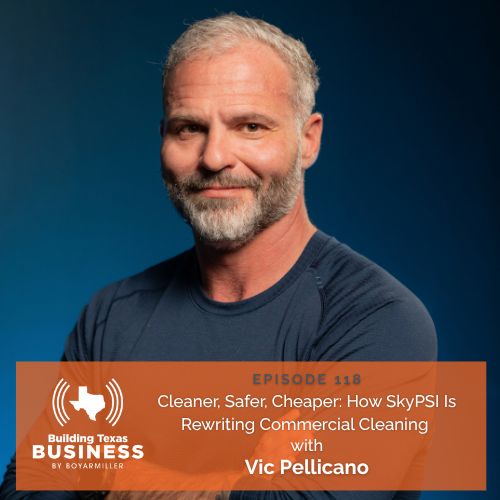
In this episode of Building Texas Business, Chris Hanslik sits down with Vic Pellicano, Founder and CEO of SkyPSI, for a conversation about how robotics and artificial intelligence are opening a new path for small business owners. Vic shares how his company equips independent operators with technology like power washing drones so they can clean commercial glass buildings faster, safer, and more affordably than traditional rope crews, and why he sees that equipment as a modern version of the American dream.
Vic talks about his unconventional journey from a childhood in a trailer park and a period of homelessness to teaching himself to code, working as a law clerk and sales rep, and eventually bootstrapping his first software company, Verenia, from a garage basement without investors before its acquisition by Oracle. He explains why he views every business as a people business, how showing up reliably and doing what you say builds a brand, and why grabbing new technology early, whether cloud computing then or AI and robotics now, can be the advantage that separates a company from dozens of competitors.
The conversation also explores why Vic chose to launch SkyPSI in the Dallas Fort Worth area despite living in Chicago. He describes the energy, talent pool, and welcoming business climate he found in Texas, and how those factors shape where a growing company should plant its roots when it plans to hire aggressively.
Chris and Vic dig into leadership as well, including setting clear expectations from day one, paying people well while expecting more from them, celebrating wins publicly, holding management accountable before frontline employees, and finding the right seat for good culture fits rather than letting them fail in the wrong role. Vic also offers direct advice for aspiring entrepreneurs about fully committing, solving a real problem for a real customer, and pushing through the rejection that tests every founder.
For business owners, entrepreneurs, and leaders interested in emerging technology, bootstrapped growth, building accountable teams, and why Texas continues to attract new ventures, this episode delivers a candid and practical look at betting on yourself.
Transcripts are generated by machine learning, so typos may be present.
Chris Hanslik: Vic, it’s great to meet you. Thanks for being a guest on Building Texas Business.
Vic Pellicano: Great to meet you, Chris. Thanks for having me.
Chris Hanslik: So I’m excited about the conversation. I know there’s a lot of stuff to cover, but let’s just start with you introducing yourself and your business to our listeners so they understand what it is you do and what your company’s known for.
Vic Pellicano: Yeah, my name is Vic Pellicano, and I am the founder and CEO at SkyPSI. What we do is enable our operators, who are folks running businesses, to get robotic technology like power washing drones into their business and, you know, grow their revenue. And the way I think about it more broadly is, you know, use the technology of today, AI and robotics, to better service their area, make more money for their families, and just make use of the stuff coming out.
Chris Hanslik: So you mentioned operators. Is that, I guess, they’re providing a service, a cleaning service, using this technology?
Vic Pellicano: That’s right. That’s right. So, you know, there’s over 17 million properties in the United States that need to get cleaned multiple times every year. If you’ve been around Dallas quite a bit, you notice a lot of glass, right? Glass is great because it’s timeless. You never know when the building was built. It’s just glass. That’s why you’re seeing so much of it in the new builds, because it actually saves a lot of money in the long run for building maintenance, because it always looks new. However, glass is a lot of work to upkeep, right? It’s got to get cleaned all the time. You see those guys hanging from ropes, stuff like that. So, you know, 20 years from now, you won’t see a guy hanging from a rope. It looks archaic now, right? It’s scary, by the way. Terrifying. Insurance will price that out at some point. But right now, buildings got to get cleaned, and that’s the best methodology. Drones are coming online. They’re getting better every year. So you’re seeing this new generation of commercial property cleaners, just guys, right, who are able to go out and acquire this equipment from me. And then they can go out to the commercial property down the street with windows and say, “Hey, you know, maybe you’re spending all this money cleaning your windows. Dangerous guys hanging off the building. It’s dangerous with the ropes and everything. And we can do it cheaper, faster, better using technology.”
Chris Hanslik: Wow. That’s awesome. So let’s talk about, then, how did you get into this venture? How did you come across the technology? It’s always a big step. I know you’ve had some other businesses, and maybe you can share some of those stories. But I think the hardest thing for most entrepreneurs is taking that first step.
Vic Pellicano: Yeah, absolutely. I mean, my first foray into entrepreneurship and owning my own business was… sorry. I started a company called Verenia about 15 years ago out of my garage basement. My wife had just gotten pregnant with our first son. And I started it, and it was the gutsiest call in my life, man. Before that, I had been homeless. My parents had died. I had some bad times. And this was far and away the scariest: to go into your boss’s office and say, “Hey, I’m going to go do this other thing. I don’t know if I’m going to have health insurance. I don’t know if I’m going to make money.” But you just get to a point in your life, I think, where you just want to own the outcome. You get tired of making other people money. You get tired. And it’s okay if you have investors or something like that, but it’s just exhausting when you feel like you’re just stuck behind people and you just can’t figure out how to go fast enough and accelerate. And when you believe in you and the vision… And especially, I think the biggest thing for me is, I’m a people pleaser at the end of the day, right? I like when people tell me, “You did a good job today.” You know, if you tell me to clean the floors in the other room, they’re going to be the best floors. You’re going to be like, “Jesus, this guy worked.” You know what I mean? And when you’re working at that level and you hear that, you think, man, I want to share this. You know, I want to go do this for other people. I want to enable people to do it. One of the greatest adventures of my life. But also, you got to have the guts to do it. I mean, it’s just that simple.
Chris Hanslik: So let’s talk a little bit about that. I guess that first company, Verenia. You know, when you think back, what was one of the biggest lessons you learned, maybe from a mistake you made, or just, you know, like you said, having the guts to do it? Someone listening is probably in the same position. I’m sure there are people where you were 15 years ago, like I said, taking that first step. What were some of the things you wish you knew then that you know now?
Vic Pellicano: Definitely that. It’s everything is a people business. You know, you’re going to read all the news about AI, about robots, about whatever. The cloud, in my day, was the new thing when I was starting my career. You’re going to hear a lot about the tech. But at the end of the day, you’re talking to another human being who either trusts you or doesn’t trust you. And you got to be somebody who shows up and says what they’re going to do and does what they said they’re going to do, and be reliable. And you ask that person to take a chance on you. And you do it at a discount. You do it for less than you’re worth. And you got to prove it. You got to prove it to him or to her. And you got to do that again and again. And you build champions. And you build that muscle underneath you. And then you build a brand, a reputation. That’s what a brand is, right? You build a reputation for being somebody that comes through, and then it all kind of comes after that. But the first thing you got to do is you really have to build that authority behind yourself. I think the biggest thing for me was really learning that the tech matters. The tech has to be solid. It has to be proven. It has to be great. But at the end of the day, especially in this B2B world, it’s people buying from people. They want to meet you. They want to shake your hand. They want to know when they have a problem, they call you, you answer, day or night. And as long as you’re that person, they will call you every time. And they don’t mind you making a profit either, because they just want you to be reliable and do a good job for them. And then you figure out from there how to scale it.
Chris Hanslik: That’s great advice. So then you’re moving forward to SkyPSI. Tell us a little bit. I guess, how did you come across this technology? What was it about it that made you see, you know, kind of this unique opportunity? And how have you been able to kind of capitalize on that?
Vic Pellicano: So I’m an investor in some of the areas around this ecosystem. One of the manufacturers, I’m an investor in. I’ve liked this for a few years, since I became a personal investor. What I like most about it: my dad was actually a truck driver. I grew up in a trailer park. My dad drove a truck, and I see this equipment largely the same way. You know, I’ve never been one for the enterprise, the huge companies, the multi-billion-dollar things. That’s never been me. But the small operators have always been mine. My dad was an operator by trade. I mean, right, a little trucking business. And what they would do then is they would invest in a piece of equipment and bet on themselves and say, “I bet I can show up and I can keep most of the profits for myself. And I can get my cousins, my friends, jobs working with me. And we can make money together, and we can make a living and take care of our families without having to ring a bell every day,” or whatever. Just be in charge of your own destiny. So that’s what I see from this new generation of entrepreneurs, right? Really betting on themselves. And again, the reason I knew this space, and I know the people buying into this, is because I grew up with them, right? I grew up with a bunch of truck drivers, and those guys were all, like, they’re just hustlers. You know what I mean? They work 10, 12, 15 hours a day. They were able to make a good living for their family. My dad, I never had to worry about food or where I was going to live. And that was because of the technology of his time, which was a semi truck, right? That was technology back then. We don’t think about it that way, but it certainly was. And he was able to, like, you know, use that. So when I looked at these drones, and I’ve invested in several things, but when I looked at these, I saw the American dream. You know what I mean? I saw a piece of equipment somebody could buy and make a bet on themselves that they could change their family’s outcome, like my dad did. And I thought, what a blessing to end my career, you know, 20, 30 years from now, having enabled thousands of guys just like my dad. And it just felt like the great payback.
Chris Hanslik: That’s great. So we’ll jump in a little bit more. So you’re in the Chicago area, but you founded SkyPSI in Dallas, Texas. So let’s talk a little bit about the why behind that. What were the advantages that you, I guess, believed would be there by starting a company in Texas, and how has that played out, you know, positive or negative, so far?
Vic Pellicano: The energy in all of Texas is amazing, especially in the Dallas-Fort Worth area. When you come to Chicago or New York or San Francisco, I think what you end up seeing is it feels a lot more like Europe. It feels like it’s done growing. It just feels like they’ve decided this is enough, and “We don’t need new stuff or new business or whatever. We’re fine.” What you see when you go to Dallas, and the reason I think you see so much interest from the business community and young people moving there, is there’s a new energy. It’s like, “We want to build new. We want to build new buildings. We want to build new industries. We want to invest in ourselves, and we want to invite people to come here to do that and not lord over them while they do it,” frankly. And I think it’s obvious. You know, when we put up job ads, right, for my old company, you’d get a handful of qualified people. I mean, in that area, the amount of people, it’s incredible. The amount of talent you guys are coalescing down there. My wife and I have gone to look at houses in Prosper and McKinney, and the houses are gorgeous, and they’re affordable, and the taxes are great. And the whole thing is set up to encourage people to come, and business too, right? It’s just very welcoming to everybody involved. Like, “Look at this new stuff we’re doing with the schools, the new stuff we’re putting in for the kids, the new investments we’re making for your family.” Up here, it’s more like, “Look at all the new rules to control kind of how you live and how you do business,” and stuff. It’s just a different way of looking at it. And I think that’s why you’re seeing the shift there, especially from the young working professionals. I mean, I can tell you half the people I know that had a lot of talent have gone to the Sun Belt. Specifically, I know a few that have gone to Dallas, but Charlotte, Florida. They’re just so encouraging, and they want new business and new energy there. And you can feel it when you go down there and you go to the new bar, the new restaurant, and things like that. Everybody’s excited to be there, and they see such a bright future. And in Chicago, it just feels cloudy.
Chris Hanslik: Yeah. Well, I love that you used the word “welcoming,” because I’ve used it before. I’ve lived here my whole life, and I’ve always believed it to be true, but you certainly see it. And it is great to hear from people outside of Texas that Texas is welcoming to everyone. We want business. We’re set up to make it easy to come and start a business and grow it. The resources around, all those things that a business owner wants: good talent, low cost of living. We see it not just in our existing client base here at the firm, but in new clients, especially coming out of COVID in 2020. And the number of businesses outside the state that want to relocate here, convert to a Texas LLC or corporation or whatever it may be, and set up roots here. And it’s not slowing down, which we’re very thankful for.
Vic Pellicano: No. Everybody I talk to in the business community… I’ll give you one example. This is not business related, but it’s about e-bikes. Out here, the Illinois state legislature just passed a law banning all e-bikes for anybody under 16. Firmly banning, like it’s illegal. The cops will arrest you, or DCFS will come take your kids, right? And I had read that Texas did the opposite thing, where they banned municipalities from banning e-bikes. And that’s just illustrative, I think, of the difference in the way government sees things. Here, it’s more to appease the people that are already here and, frankly, are older and just kind of established. And there, they’re saying, “No, we want to be open. We want to be welcoming to people. We don’t want to be controlling them. They will figure it out themselves. We have faith in them as individuals to sort it out.” So, I mean, just one of many, many things that I’ve noticed, now that I’m paying more attention to it: the differences in the governing style and the welcomingness.
Chris Hanslik: Yeah. So when you think about, you know, SkyPSI, just in general, and maybe specific to getting it started in the Dallas-Fort Worth area, what are some of the challenges you think you’re facing to try to get this to the scale that your vision is for it?
Vic Pellicano: The challenge is always people. It’s talent acquisition. You know, that’s why we picked Dallas instead of, like, an Austin or a Houston, because a lot of what we do ends up being brand, sales, and marketing related. That’s where a lot of the investment goes. I mean, because we have manufacturers and suppliers, we don’t do a ton of engineering at the moment, a little bit on the software side. But, you know, when we’re going to make an investment, we want a place where we invite our people and our customers to come, and they’re like, “This is impressive.” You know what I mean? Like, in the talent we acquire: “I want to work there. Look at this building. Look at these restaurants. Look at these bars. The warehouse is nice and clean, and it’s new.” You know, that’s what people want, not kind of the stuff off the side of the highway. So it’s so much about just the presentation, and then the people you can get who want to come to that area, right? Because you want the most talented, the brightest people. You want to pay them a lot of money and have them make you a lot of money, if you’re doing it right, right? And those people want to be in the cool areas. They want to be in the growing areas with lots of energy and, you know, nightlife and great parks and sunshine. And so you see a ton of that in Dallas. I mean, in Fort Worth, too. Fort Worth’s amazing. My wife’s favorite part of Dallas is Fort Worth.
Chris Hanslik: You’ll have to learn there. You know, you can’t say that Fort Worth is part of Dallas. People go, “No, we’re separate. We’re different.” You can start a civil war there, I think.
Vic Pellicano: Yeah, I mean, maybe I’ve got a lot to learn about the local stuff, but I loved it all. I mean, there’s nothing bad to say about it from an outsider so far. It’s wonderful. And again, I think for me, when I’m looking at starting a business, and we’re going to hire at least 50 people next year, you’re looking at it and saying, “Where are all the people I need to hire? Where are they living? Where are they moving? What is the next 10 years of the company going to look like? Where’s a good place to stick that?” Because, you know, the trend is your friend, right? You don’t fight the wave. You figure out how to ride it, right? Everybody’s going there for a reason. So you look at the reasons, and you make sure it makes business sense. But ultimately, that’s where the talented people are going, so you got to go there, right?
Chris Hanslik: So obviously, you are a big believer in technology and using that, you know, as part of your growth strategy and vision. Let’s talk a little bit about how you have been able to use technology and leverage it, right, to the success of your business. Obviously, there’s a lot that’s being discussed, you know, for the last, what, almost three years now. You can’t have a conversation without two letters coming up: AI. And there’s a lot of fear around that. There’s a lot of excitement around it. Depends on the day, depends on, you know, the climate and which way the wind’s blowing and who you’re talking to. But you’ve certainly been one that has embraced it. So talk about, I guess, how you have kind of managed or developed that mindset, and what you would encourage others to do to embrace the rapidly developing technology in the world we’re in today.
Vic Pellicano: Yeah, I think so. You know, when I was about 13 years old, we got a computer at home. My dad, despite being a truck driver, did some engineering on the side. So he had a ham radio in the basement, and he liked to talk to the other truck drivers around the world. It was, like, a cool thing. And as soon as the internet came out, we were like the first people in our neighborhood to have a computer and a 16K modem, you know. And I taught myself to write code when I was like 14 years old, you know, and I broke a computer or two. I got in some trouble. And I’m an engineer by trade, right? And my dad was a big believer. My mom would get mad because he wouldn’t take me to work and show me how to, you know, drive a truck or fix a truck. And that was good money in his day. That was, like, a primo job, right, being a mechanic. But he saw kind of that industry fading. And he told my mom one day, because they were having a discussion about this, he said, “No, I’m not going to teach him to do that, because I don’t want him to have that as a fallback job. You know, he’s going to have a different job. The world’s changing, and he’s going to work somewhere else.” And he would never teach me. By the way, I don’t think he loved teaching anybody anything anyway. But he was right about this.
Chris Hanslik: Right. So he had a very clear kind of plan and vision for you, right? Which is impressive.
Vic Pellicano: Yeah. And so I did. I got into computers. And by the time I went to high school, I was, like, teaching my teacher stuff. And, you know, when I went to undergrad, I’d done all the assignments the first month of the class or whatever, and I was top of my class and all that. And then, you know, my parents had passed through this. And then I went to law school, and they had both passed by this point. And so I went to work at a manufacturing company called Freeman Seating in Chicago, and I was doing sales there. I was a few years out of doing anything with my computer science degree. It was just kind of a job. I liked the people there. I had some friends there, but I was trying to figure my life out. I was homeless for a little while. I had an apartment now. And so what I did is, some of the sales stuff I was doing, I just started automating for myself, just kind of exercising those old muscles. And then I quickly became the lead developer at Freeman Seating, and I was writing software for the whole company. And then that elevated me to start Verenia, right, which Freeman Seating invested in. And I didn’t raise any money. You should know this about me, Chris. And that’s why I see my customers, my operators, the same way I see me. I didn’t know how to raise money. I still don’t know how to raise money, despite doing very well for myself. But what I can do is deliver great results for both customers and for the company. And so we bootstrapped Verenia from that day for 15 years. My only job before that was sales guy and software engineer at Freeman Seating, and law clerk, and dishwasher before that. And then straight through to being CEO of a company. I had to Google what a CEO did. And then I just cobbled it together over 15 years. And then Oracle came in and acquired the company five years ago, and I had to navigate all that, right? Again, no advisors, no investors, no board, just me and two guys I met as business partners. And we figured it all out. We walked the whole thing all the way through. And so what I think, that whole time, the through line there was the technology that came online, right? Computers came into my house at the right age. My dad embraced it and encouraged me to embrace it, and I learned before everybody else. And that two- or three-year head start is worth everything at the end of the day. You know, that’s all you get in this life, and it’s getting shorter now, right? But you get some advantage, and you have to take it, and you have to see it coming. And then, you know, the cloud came online, and we started running. So that was our differentiator. There were 70-some-odd competitors in our space, but none of them had cloud technology at the time. So we built ours on cloud technology, and that’s how we had the third-largest exit in our space, but we were unfunded, because we just grabbed the new tech. I mean, if you’re old enough to remember when the cloud came out, everybody said, “What if the internet goes down? Nobody’s going to use this. We have this whole room for servers.” Very similar talk. “Where is it, right? Where is the cloud?” And now nobody thinks about it. They just, you know, whatever. And the same thing will happen with AI. It’s inevitable. It’s a tool like everything else. Those who learn to embrace it now and accept it and use it to some, you know, advantage… And when I say “economic advantage,” which I was going to say, what I mean is value creation for somebody else. Like, how do I use this tool to do something good for this guy who doesn’t know how to use it? You marry those up and you’ve got a successful business. So we’re going to use these tools, these robots, these AIs, to create a cleaner, safer world through this technology. And then as new technologies come out, my operators, we’re going to enable them. We’re going to train them. We’re going to help them understand how to create value for people, install these robots, install these AI systems around themselves to run their own businesses. And then they’ll be able to grow and flourish as business people themselves. Meanwhile, we’re bringing on the new technology, we’re vetting it, and we’re handing it down to the operators, all ready to go.
Chris Hanslik: Sounds great. The other thing that occurred to me with what you’re doing now: if it’s cheaper and faster, property management and building owners might actually clean the building more in a year because they can, as opposed to maybe just once a year.
Vic Pellicano: That’s what we’re seeing all the time. And then what happens, especially with glass, is the first clean is always a nightmare. It’s got to be done with a squeegee and a razor blade sometimes. But now you can go get it with the drone four times a year. Sometimes four times a year is cheaper than once a year with guys with the ropes. You clean it four times a year, now it never gets that bad, right? The upkeep now has gotten so cheap. And then, by the way, you’re the operator. You go to this commercial building down the street, this property manager. You do it cheaper, faster, better. And that guy signs you to a contract. You might get a three- or five-year contract. And now you’ve got guaranteed money for three or five years from this guy down the street, right? So everybody wins.
Chris Hanslik: Yeah, I love it. So when you think about, you know, your story of law clerk to sales guy to CEO, not a traditional path by any stretch, but most entrepreneurs don’t take one. How would you describe your leadership style, and how do you think it has evolved since those early days to where you are today?
Vic Pellicano: That’s a great question, because it has evolved, and I’ve noticed that about me over the years. I think at first I spent a lot of time hiring young people like me, and encouraging, and us growing together, you know, and learning, because I didn’t know what to expect from people. I didn’t know how to hold people accountable. Kind of like if you have more than one kid. It’s the same thing with your first kid, right? And then as you get experience… Now I’ll say this: I hire somebody, I set very clear expectations, and I tell them, “I’m going to pay you better than anybody. And I’m going to expect more from you than anybody else. And I’m going to talk to you very, very plainly all the time, but I’m going to be fair, and I’m going to be understanding. I’m technical enough to listen to the engineers when they have a real problem that can’t be overcome, and we’re going to work through it. But also, I expect you to be great. I expect you to be different than everybody else.” I think one of the blessings I got from one of my mentors when I was younger: I’d missed a meeting with him, and I forgot for like two days to follow up with him. And I saw him in the hallway, and he said, “Come to my office.” I went in there, and I said, “I just blew it. You know, I don’t know what to say. I just messed up.” I said, “I just forgot.” And he looked at me, and he goes, “You don’t forget.” And he pointed out at the bullpen where I was sitting. He goes, “They forget. You don’t forget.” And I think the idea of helping folks separate themselves from the herd and saying, “You can be special. You are special.” And then you see if they are. And then gauging that appropriately and telling them, “Hey, this thing is just too big for you. You can’t do it. I’ve given it to you.” And give them rope to fail, and tell them when they fail. This doesn’t mean you fire them, right? Because companies grow. I always say even Cowboys Stadium has janitors, right? There’s a role for everybody in the village. This may not be the right seat on the bus for you, the right job in the stadium, however you want to phrase it. But “This ain’t it, kid. You can’t do it. You know, we tried. We’re going to move you somewhere better for both of us, because otherwise I’m going to fire you.” You know, my own son is going to come work for me at Sky. I made him go get another job. And I told him, “You got to work there for a year before you work for me. You got to prove you can hold your own bag. And second, when I hire you, I absolutely will fire you if you screw that up. And that’s going to hurt our relationship. But I want you to understand that this is not like… I was handed nothing. You’re going to be handed more than I ever was, but it ain’t coming on a silver platter. We all get up every day and earn it.” I still get up and wash the dishes and do what I did and do my workout, just like I did before I had any money. And so my kids see that. My kids see me working 80 hours a week, even though I don’t need to. And you don’t do the work to get the outcome. You get the outcome because you’re the guy that does the work.
Chris Hanslik: Absolutely. Absolutely. That’s a great one. And look, I agree. I mean, I think there’s no substitute for hard work. And I think, as you’ve learned, you have to lead by example and can’t ask anybody to do something you’re not willing to do yourself. So I think if you have that discipline in your behavior, it’s noticed. It’s noticed by the people that work for you and with you. It’s noticed by your children. And there’s really no other way to do it, because if you try to take a shortcut, I think, you know, you just look like a hypocrite, and you’re not going to have a sustainable workforce that, you know, has the drive that you have as the founder, owner, entrepreneur, and that you want and need them to have to be successful.
Vic Pellicano: That’s right.
Chris Hanslik: So a lot of that then goes into who you hire and how you go about hiring those people that can fit within the culture that you are trying to build for the company. So share with me some of the things that you think you’ve done to be successful in that hiring process, which is an imperfect science by anybody’s definition, but to get it right more times than you get it wrong.
Vic Pellicano: I think, you know, it’s been a long time since I dated. I’ve been with my wife 15 years. But I think expectations up front are very important. And I think if they hear you say the thing and, like you said, live the thing… And if you tell them exactly what you expect of them. So many people beat around the bush, you know, and hide behind sanitized words and bleached-out language. I think if you talk to people like you’re talking to, you know, one of your kids, honestly, and you’re real up front with them, that works the best for everybody involved. I’ve experimented with different ways, younger in my career, you know, like, “Ah, this is an awkward conversation.” No, you call somebody and you’re like, “Hey, you messed this up. How are you going to fix it? You know, are you going to do it? Do I got to find somebody else to fix it? What’s going to happen?” You know, and you ask them what you should do. “What would you do?” “Well, I’d be pretty upset.” “Well, I am.” So, you know. Or somebody does great. And by the way, the other side of that is, when somebody does great, you celebrate them in front of everybody. You parade them around. You make them feel like they’re champions, because they are, because they did it right. So you do both, and everybody knows that you’re going to be held to account when you make a mistake. Not publicly, or humiliated, or anything, but there’s going to be very clear consequences. And, you know, when you do something great, the boss is going to put you on his shoulders and walk you around and make you, you know, just the talk of the town. You know what I mean? Take care of it. And then I think the other side of it, too, is when you’re doing your accountability talks with folks and you’re trying to get them back on track, always be open to giving them an off-ramp to a different position. If your company’s growing, right? “Is there another fit for you in this firm that makes more sense?” You know, there’s a lot of talk about, like, you know, I don’t want to say going backwards in a career, but let’s say you’re in a sales development job where you’re calling people and you’re saying, “Hey, are you interested?” You’re great at that. I don’t know if you’ve ever heard the term. I think it’s the Peter Principle. That’s people elevate their careers to the level of their own incompetence.
Chris Hanslik: I think I’ve heard similar. I don’t know if I’ve heard it referred to that way, but yeah.
Vic Pellicano: You know, you’re a great sales guy. You become a sales manager, a good sales manager. You become VP of sales, and you’re crap at that, right? And then you stay there, because you can’t go up from there, because you’re no good at it. So then after a while, your company’s just filled with people who are bad at their jobs, right? And I hold management to account more than I do the workers. Those guys are doing a defined role. Management gets squishier. So those guys have to be held to hard account and be like, “Is this not a fit for you? Should we find another role that makes sense? Because I’ve given you clear metrics, and we’re not hitting them. So what are we going to do?” You know? And I think if you invite people into that conversation instead of scolding them… You don’t get mad at the fish because it can’t fly, right? You know, it’s a fish. It don’t fly. That’s just not what it does. So you have to recognize that about people. That’s your job as a hiring person and as a manager. And then beyond that, right, once you’ve identified that, if you misdiagnosed it, acknowledge it early and partner with them, if there’s a better fit in the firm for them, because that’s always the best outcome for everybody. Because hiring is a nightmare, especially if they’re a good culture fit. There’s usually something else they can do for you of value. And they would prefer that, and you would prefer that, if that works.
Chris Hanslik: That’s right. The key there was, right, good culture fits. You go out of your way to try to find that right seat for them, right? And you’re right. Once you do that, everyone’s better off. Everyone. Yeah. You said something that I want to go back to, because I believe it to be very true. And that is, you know, clear expectations, holding people to account, but it’s that celebrating the successes and the wins in addition. I mean, we always think about performance, and it has such a negative connotation, because people think, “I’m getting reviewed,” or “performance review,” and they’re going to talk about all the things I messed up, or what I need to do to get better. And we lose the side of what they do really well. And I think when you evaluate most of the people in your organization, probably 80, 90% of the time, they’re doing stuff really well. It may be that 10 to 15% that’s growth, improvement, whatever. So what my experience has been is when you can reinforce behaviors, good ones and bad ones, right, then people throughout the organization see, “Oh, okay, words are now connected to action. I know that those kinds of things are what they mean, and how it will be celebrated, and how I will do my job better.” And I think we can’t do that enough as leaders, so that everyone in the organization understands what we mean by “these are the success characteristics,” or whatever you want to call them. And then along the way, that’s what builds the culture that you want as the leader and the owner or the founder.
Vic Pellicano: Absolutely right. I mean, if you watch a football game, after the game, there’s a game ball. You know what I mean? And then they go, and then they hammer you. You know, it’s the same kind of philosophy at work. And work’s different. There’s always wins. There’s always somewhere to be positive. And you’re positive about those things, and you celebrate the people that did it. But, you know, I would say the other thing is, nine times out of ten, in my eyes, a business failure is usually a management failure. It’s my fault for putting people on a path that just was never going to work. It’s a manager’s fault for doing a project that was never going to work, or was experimental, and getting people’s hopes up, or whatever. So I tend to blame management down. And for the most part, I think people do their jobs. There are people who aren’t, and those people got to go. But I think largely the people in a role that’s defined, those people do their work. And so I always do it top down. And by the way, if that person’s still here and they’re not doing their job, that’s also the manager’s fault. So I have trouble blaming anybody but the management.
Chris Hanslik: Yep. Sorry. No. Extra guest on the show. I love it. So let’s maybe think about aspiring entrepreneurs. What advice would you give for someone that’s looking to start a business? And obviously, you know, we’re here in Texas, not that it has to be unique to Texas, but just any advice you would want to share or pass along?
Vic Pellicano: Yeah, I think it’s: if you do it, commit, right? Fully commit to it. It’s the only way to do anything great in this world, is to fully commit. I would say, you know, the other thing is, you don’t have to know every answer to everything going in. You know, the business schools are filled with guys with spreadsheets. None of them start businesses. You know what I mean? Businesses aren’t built on a spreadsheet. They’re built out here with other humans. So get out there. Talk to people. Talk to people who you think are your clients. Look at a problem. I think businesses are problem-solving machines. And if you can solve somebody’s problem at less cost than it costs them to solve it themselves, you have a profitable business. That’s the baseline definition to me. So I think you look around and you say, “What’s a problem out here? And what can I fix for somebody that is economically valuable to them, that they’re spending X amount of money to fix another way, or the wrong way?” Right? It’s unsafe, it’s whatever it is. Take a look at that. And I think the other thing is, the best businesses to start are ones where you know the problem intimately, or you know the customer base in some way, right? That’s not to say this happens every single time, right? But the easiest ones to start are where you really, really understand the problem, because you have to be the customer. You have to live it. You have to close your eyes and see their problems and how you’d want them solved, because if they could do that, they wouldn’t need you. You know, that’s your job. And so, you know, you sit around and dream that up, and then you call somebody and bounce it off them. And by the way, nine times out of ten, they’re going to go, “Ah, that’s dumb,” or “It’s a bad solution.” And then if you give up, that’s just the universe telling you you ain’t cut out for it, because there’s usually something there. Your pitch was wrong, or you got a bad angle, or a guy was just rough on you during the sales process. But, you know, if there’s a problem there, if there’s a real problem, and you create economic benefit for somebody like that, that’s a profitable business. But the universe will test you. God will test you, however you want to phrase that. And they try to get you to tap out. You know, it’s not that they don’t want you to succeed. They’re testing your mettle. They’re testing your toughness. Will you get through this? Will you get through all the no’s, all the rejection, all the hard times? You know, and if you can’t, you can’t. But you got to wake up and just say, “No, I’m doing it.” Even if you got to change the business model eight times in a week. Even if you got to, you know, move on from some co-founders, or switch to a different industry, or a different problem. Or a lot of times, what I find happens is you’ll start a business and you’ll discover something while doing it that’s actually a bigger problem, right? And then you shift the business to that part of it. And you’ve seen great tech companies do that. But it’s not just tech companies. Those just get all the headlines. It’s everybody. You know, somebody wants to start a distributorship for this, and then they find out the shipping is actually the problem for food or something, and then they create a little business to do that, right? So you got to go in, and you just got to live the problem and dig through all the surface-level stuff, and you’ll find something meaty in there. Somebody wants you to solve it, and then you solve it, and then you’ve got a business.
Chris Hanslik: Well, so many people that I’ve met who have been on this podcast talk about that. It was a gap that they saw, right? Or an area that needed a solution, and no one was providing it. And because of their experience, they had an idea: “This can fill that gap. This can solve that problem.” And then, to your point, it takes the courage to say, “I’m going to step out and start something to solve that.” And if you’re right about that, right, then there’s going to be a natural customer base, because those businesses have been suffering through that gap or that problem, and now you’re providing a solution.
Vic Pellicano: That’s right.
Chris Hanslik: Well, it’s been great. I mean, Vic, this has been a great conversation. I really appreciate you taking the time to share your story. You know, this new venture sounds very intriguing. And yeah, there’s not a major city in the country that doesn’t have a lot of glass skyscrapers, right? And so it seems like it’s got a lot of good momentum behind it. One thing I do: you’re relatively new to our great state, but I’m going to ask you this question, and it may be an initial answer. It may change later in life. You have to tell me. Do you prefer Tex-Mex or barbecue?
Vic Pellicano: Right now, I’m going to say Tex-Mex. I’m a big fan. When I was down there, I stayed at the Drover in Fort Worth.
Chris Hanslik: Oh, yeah.
Vic Pellicano: And they had Tex-Mex deep chicken-fried oysters.
Chris Hanslik: Okay.
Vic Pellicano: Which I’d never heard of, and it was amazing. So yeah, I’m a Tex-Mex guy right now.
Chris Hanslik: Oh, yeah. And of course, I mean, what a great little property they have there, and it’s right in the heart of the Stockyards. And there’s a lot of good Texas history if you walk around and absorb it. So, thanks again for taking the time. Congratulations to you on the various ventures you’ve had and your success, and I look forward to staying in touch.
Vic Pellicano: Yeah. Great to meet you, Chris. Thank you so much for having me.
With a deep understanding of your business alongside clear and honest communication, we help clients face challenges fearlessly.
Learn more about our services and how we help clients.